






Updated on June 29 at 8:15 p.m.
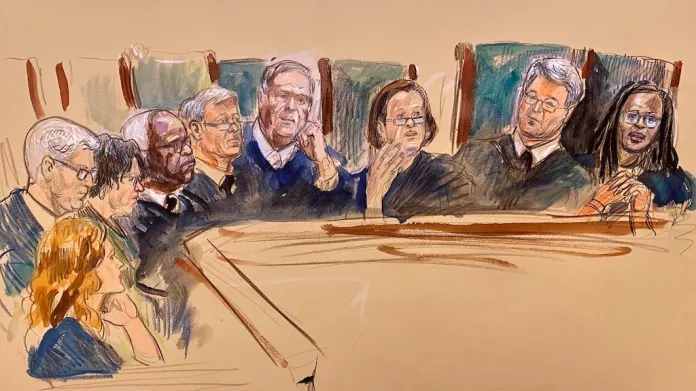
The Supreme Court on Monday gave President Donald Trump sweeping new authority over approximately two dozen multi-member agencies that Congress intended to be independent. By a vote of 6-3, the justices struck down a federal law that bars the president from firing members of the Federal Trade Commission except in cases of “inefficiency, neglect of duty, or malfeasance in office.” That law, a majority of the justices ruled, violates the constitutional separation of powers between the three branches of government. And in reaching that decision, the court overruled its 91-year-old decision in Humphrey’s Executor v. United States, which had upheld the law at the center of the dispute.
More broadly, Monday’s decision was a major victory for proponents of the “unitary executive” theory – the idea that the president should have complete control over the executive branch. Under this theory, the president should be able to fire any member of the executive branch, and laws – like the one that the court struck down – that restrict his ability to do so violate the separation of powers.
Writing for the majority, Chief Justice John Roberts contended that “the President must have the assistance of officers he can trust. Although it is up to the Senate to decide whether to confirm those with whom the President would prefer to work, neither Congress nor the courts may saddle him with those with whom he cannot work. Subordinates who exercise the President’s power are subject to removal by him. Then, and only then, can they remain accountable to the President, and the President to the people.”
Justice Sonia Sotomayor penned a 49-page dissent that was joined by Justices Elena Kagan and Ketanji Brown Jackson. “Today,” she wrote, “the Court discards” the “democratic regime” created by the Constitution “in favor of one that distorts the structure of Government to fit the majority’s theory of unitary, total executive control. The result,” she concluded, “is a President who emerges with far greater power than ever before.”
The Federal Trade Commission was created more than a century ago. It has five commissioners, no more than three of whom may come from any one political party. Each commissioner is appointed by the president and confirmed by the Senate to serve a seven-year term.
During his first term in office, Trump nominated Rebecca Slaughter to fill one of the Democratic seats on the FTC. Then-President Joe Biden renominated her in 2023 to serve a second term. Last year, the White House notified Slaughter in a letter that she had been “removed from the Federal Trade Commission, effective immediately.” The letter did not cite any of the legal grounds that would allow Trump to fire her. Instead, Trump told Slaughter that allowing her to remain on the FTC would be “inconsistent with my Administration’s priorities.”
Slaughter went to federal court in Washington, D.C., to challenge her firing. U.S. District Judge Loren AliKhan ordered the Trump administration to reinstate her, and a divided panel of the U.S. Court of Appeals for the District of Columbia Circuit rejected the government’s request to pause that ruling while it appealed. Judges Patricia Millett and Nina Pillard wrote that only the Supreme Court could overturn its decision in Humphrey’s Executor, which in their view was “controlling” in Slaughter’s case.
The Trump administration then went to the Supreme Court, asking the justices to freeze AliKhan’s order while litigation continued. Over a dissent by Kagan, joined by Sotomayor and Jackson, the court granted the government’s application – effectively permitting Trump to fire Slaughter – and set the case for oral argument in December.
In a 36-page opinion, the court on Monday reversed the lower court’s ruling. Roberts first emphasized that the Constitution gives the president “[t]he executive Power,” as well as the responsibility to “take Care that the Laws be faithfully executed.” The Framers of the Constitution, Roberts explained, wanted to create a system in which the one person, the president, was in charge of the executive branch. The officials who work for him, Roberts continued, are there to help him, but the president must be able to fire them if they are not performing well – so that he can carry out his own job.
Roberts acknowledged the Supreme Court’s decision in Humphrey’s Executor, upholding the same law at the center of this case. But that decision, he contended, “was tethered to a highly circumscribed and almost fictional view of the FTC’s role” as being “very limited”: “they were ‘neither political nor executive, but predominantly quasi-judicial and quasi-legislative.’” “At this point,” Roberts reasoned, “all that is left of Humphrey’s is its observation that an agency that ‘exercises no part of the executive power’ need not fall within the rule of Presidential removal.”
In this case, Roberts concluded, “the FTC unquestionably exercises executive power, and must therefore be controlled by the” president. For example, the current version of the FTC “enforces and administers some 80 statutes, which cover almost every facet of our Nation’s economy.” The agency both carries out investigations and then enforces compliance “through in-house adjudications.” Indeed, Roberts noted, the agency even “files civil suits on behalf of the United States in federal court.” “As we have said many times, the ‘discretionary power to seek judicial relief’ lies at the very core of executive authority,” Roberts observed. And because the FTC exercises such power, Roberts said, “Slaughter served as the President’s subordinate at the FTC—and … the President was entitled to cut her tenure short.”
The court’s ruling on Monday, Roberts indicated, did not resolve all questions about when an agency or entity exercises executive power, so that its officials can be fired by the president for any reason. Roberts emphasized that “not all offices created by Congress necessarily come with executive or even sovereign power attached” – for example, the Boy Scouts of America and Georgetown University. The same is true, Roberts continued, for “some functions traditionally handled outside the Executive Branch” – such as the Federal Reserve, “to the extent that it follows in the distinct historical tradition of the First and Second Banks of the United States—both of which influenced monetary policy and neither of which were subject to plenary Presidential control.”
The court was also not deciding, Roberts said, “the fate of officials not before us,” such as federal judges that do not have lifetime tenure. “All we do today is recognize what has been clear for a century,” Roberts wrote, “that those who fall within the President’s ‘general administrative control’ must be removable by the President at will.”
In a 16-page solo concurrence, Justice Neil Gorsuch praised the court for, in his view, “tak[ing] a notable step back toward the Constitution.” But he stated that this step was not “enough on its own.” Rather, given the agencies’ “enormous legislative and judicial powers,” “the only sure path is to finish the the journey we start today and restore legislative and judicial powers to where they belong: in Congress and the courts.”
In her dissent, Sotomayor stressed that Congress established multi-member agencies like the FTC “to address complex problems while enjoying some independence from Presidential removal and thus absolute partisan control.” In holding that the president can remove Slaughter and other FTC commissioners for any reason, she argued, the majority “gives the President a power unknown even to the English Crown against which the Founders revolted, elevating him above his once-coequal branches by transforming a duty to take care that the laws be faithfully executed into a license to act in defiance of those very laws.”
Monday’s decision, Sotomayor contended, “reshapes our Government. Dozens of independent commissions are now likely to become purely executive agencies, shifting tremendous power over broad swaths of American life into the President’s hands”—for example, the Federal Energy Regulatory Commission, the Consumer Product Safety Commission, the Nuclear Regulatory Commission, and the Merit Systems Protection Board.
Continue reading...
[ H/T SCOTUSblog ]