









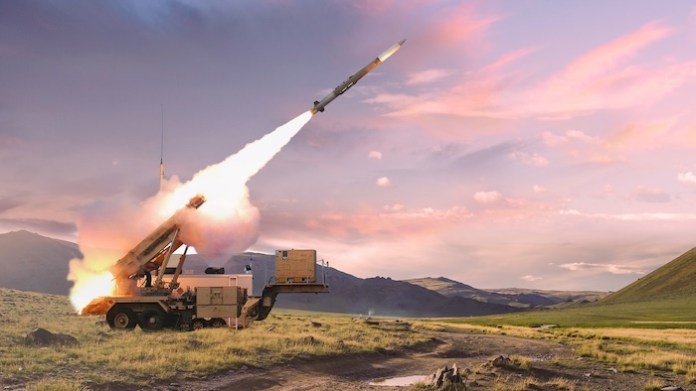
Lockheed Martin announced on Monday its plans to produce a new, cheaper Patriot missile interceptor designed to reduce the cost-per-kill while increasing magazine depth for American and European defense.
The new PAC-3 ACE interceptor will be less than half the cost of the current PAC-3 MSE per unit, the company said in its announcement, though it did not specify exactly how much it expects each missile to cost. The new missile will be built on the existing PAC-3 fire control system and will be integrated with the Northrop Grumman Integrated Battle Command System.
The Patriot Missile Defense System has proven its worth in multiple recent conflicts, including for the U.S. in the Middle East and for Ukraine against Russia, though the missile interceptors are both very expensive and depleting. Each PAC-3 MSE missile alone costs an estimated $4 million, highlighting how expensive the system can be during wartime.
“American and allied warfighters need a solution that is battle-tested and budget-smart, and PAC-3 ACE delivers exactly that by building on the unrivaled performance of the PAC-3 MSE,” said Tim Cahill, president, Lockheed Martin Missiles and Fire Control. “As we look to partner with our allies, we can further enhance resiliency and ensure our forces can swiftly counter emerging threats today and tomorrow.”
The company’s chief operating officer, Frank St. John, said in an interview on CNBC, “We’re gonna be at our first flight in 18 months, and then within a couple of years, we’ll be producing those.”
“The demand for MSE is greater than ever, and we are ramping production of the MSC capability to 2,000 a year by the end of this decade. PAC-3 ACE is going to be an interceptor that will handle about two-thirds of that threat set that PAC-3 MSC does today. It’ll be about between a third and a half the cost point,” he added.
The subject of expanding the U.S. and Europe’s defense industrial capacity has been a major subject of attention for the Pentagon and Trump administration. President Donald Trump traveled to Carlisle, Pennsylvania, last week to give a speech at the Pennsylvania defense summit, which had roughly 500 defense companies in attendance, and he made several defense industrial base announcements following the NATO summit earlier this month.
It will take years for the military to replace all of the weapons and missiles used during the current war against Iran, War Secretary Pete Hegseth has acknowledged, though he has also called the attention given to the issue overblown. He told lawmakers in May, “The munitions issue has been foolishly and unhelpfully overstated.”
HEGSETH: REPLACING MUNITION STOCKPILES USED IN IRAN WAR WILL TAKE MONTHS OR YEARS
The Center for Strategic and International Studies issued a report in late May detailing the extent to which the U.S. stockpiles have been depleted by the war.
“The United States has enough munitions for any plausible scenario in the Iran war, but the depleted inventories have created a window of vulnerability for a potential Western Pacific conflict,” it said.
Continue reading...
[ H/T Washington Examiner ]