






Updated on June 29 at 2:30 p.m.
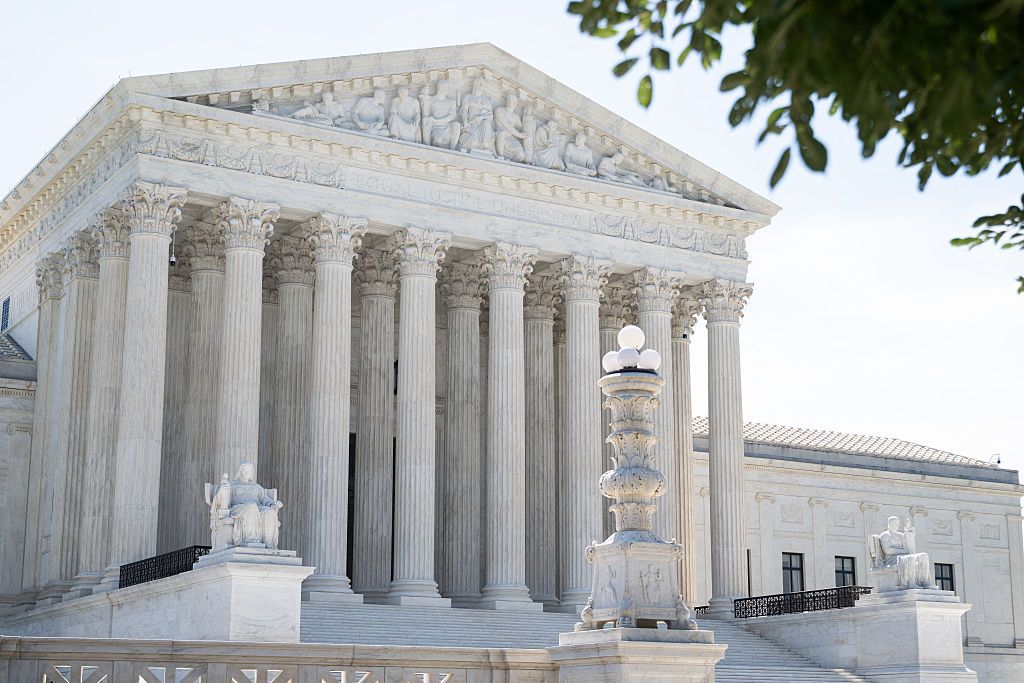
Just over four months before the 2026 midterm elections, the Supreme Court on Monday upheld a Mississippi law that allows mail-in ballots to be counted as long as they are postmarked by, and received within five days of, Election Day. By a vote of 5-4, the justices in Watson v. Republican National Committee rejected an argument, made by the political parties and others challenging the law, that federal law requires mail-in ballots to be received by Election Day.
Writing for the majority, Justice Amy Coney Barrett concluded that “the election-day statutes require the electorate’s choice to be made on election day. That occurs so long as election day is the deadline for individuals to vote—as it is in Mississippi. But the election-day statutes do not set a deadline for ballot receipt, so they do not prevent Mississippi from counting ballots postmarked before election day yet received afterward.”
Chief Justice John Roberts and Justices Sonia Sotomayor, Elena Kagan, and Ketanji Brown Jackson joined Barrett’s opinion for the court.
In a dissenting opinion, Justice Samuel Alito argued that “from this Nation’s founding until the last few decades of the 20th century—a period that spans the enactment of all three election-day statutes—having an ‘election’ on a particular day meant completing ballot collection on that day.”
Justices Clarence Thomas and Neil Gorsuch joined Alito’s opinion, while Justice Brett Kavanaugh joined most of the opinion.
Mississippi passed the law at the center of the dispute in 2020, in response to the COVID-19 pandemic. Four years later, the Republican National Committee and the Mississippi Republican Party, along with a Mississippi voter and a county election official, went to federal court in Gulfport, Mississippi, to challenge the post-election ballot deadline; the Libertarian Party of Mississippi filed a similar lawsuit a few weeks later, which was combined with the first suit. They argued that Mississippi’s law clashes with a federal law, first passed by Congress in 1845, that designates the Tuesday after the first Monday in November as the “election day.”
Senior U.S. District Judge Louis Guirola, Jr., upheld the Mississippi law. In his view, Congress had established a national Election Day to prevent two problems: requiring voters to go to the polls on multiple different days to vote in state and federal elections, and the prospect that, if elections were held in different states on different days, the results of earlier elections could influence the elections that followed. “Neither of those concerns,” he concluded, “is raised by allowing a reasonable interval for ballots cast and postmarked by election day to arrive by mail.”
The challengers appealed to the U.S. Court of Appeals for the 5th Circuit, which reversed, holding that federal law requires all ballots to be received by Election Day. Over a dissent by five judges, the full court of appeals turned down Mississippi’s plea to rehear the case, and the Supreme Court agreed in November to weigh in.
In a 22-page opinion, the court on Monday reversed the 5th Circuit’s decision and upheld the Mississippi law. Barrett emphasized that the question before the justices was “a narrow one about timing” – simply “whether counting ballots postmarked by election day, but received up to five days later, violates the federal election-day statutes.”
In the majority’s view, “[t]he defining element of an ‘election’ … has always been the electorate’s choice of a candidate.” That choice, Barrett wrote, “is made when voting is complete, not when ballots are received.” This means, Barrett continued, that – as with the Mississippi law – “the deadline for individuals to vote” must be Election Day. But the federal laws at the center of this case, Barrett stressed, “do not set a deadline for ballot receipt” and therefore “do not prevent Mississippi from counting ballots postmarked before election day yet received afterward.”
Barrett pushed back against the challengers’ argument that when Congress enacted two of the three “election day” statutes implicated in the case, there was no mail-in voting, and so the use of the word “election” necessarily means that the ballots must also be received by Election Day. “At bottom,” she said, that “theory is that because we are governed by 19th-century election-day laws, we are also governed by 19th-century voting practices. Carried to its logical conclusion,” Barrett posited, “this theory would call into question the way modern elections work” – for example, potentially jeopardizing early voting, “because in the 19th century, the polls were open only on election day itself.” “But,” according to Barrett, “historical practice, detached from statutory text, is not controlling.”
Barrett also pointed to the federal law requiring states to allow military and overseas voters to cast absentee ballots in federal elections. That law, she said, “presupposes that the deadline for ballot receipt is uniformly a matter of state law,” which “would make little sense” if those ballots had to be received by Election Day.
Finally, Barrett rejected the challengers’ contention “that requiring ballots to be received by election day protects election integrity and increases voter confidence in election results.” Such arguments, she said, are not legal arguments but instead “policy arguments” that “are properly directed to legislatures” instead. “The question today is not whether requiring ballots to be received by election day is a good or bad idea; the question is whether the idea has made its way into the United States Code.”
Alito’s dispute with the majority hinged on when, in his view, the “election” occurs. He acknowledged that “oth voting by mail and early voting have become popular, and” that the plaintiffs “do not dispute the lawfulness of these modern practices.” But, he said, “under federal law, the electorate’s collective choice must still be authoritatively expressed on election day. That requirement,” he said, “is met in a jurisdiction with mail voting or early voting provided that the critical act occurs on election day: the completion of the collection of the ballots that embody the electorate’s collective choice. That is what took place when all voting was done in person,” he wrote, “and compliance with the election-day statutes demands that the same occur in a modern election.”
Continue reading...
[ H/T SCOTUSblog ]