






The death of a public figure is a moment to reflect on a life of service and mourn a shared loss.
But in Russia’s information war against the United States, the Kremlin transforms tragedy into a strategic weapon.
The sudden passing of Sen. Lindsey Graham (R-SC) was quickly met with a wave of Russian propaganda designed to discredit his legacy, undermine support for Ukraine, and sow distrust within American society. By amplifying conspiracy theories about his death, Moscow also blurs the distinction between baseless speculation and the Kremlin’s own well-documented record of political assassinations, reinforcing its narrative that no political system in the West is more trustworthy than Russia’s.
Known for his hawkish foreign policy positions, Graham was one of the most vocal advocates for continued U.S. support for Ukraine and a frequent critic of Russia’s actions. His stance made him a target of Moscow’s ire, with Russian officials portraying him as an adversary. As a result, Russia placed Graham on a list of ‘terrorists and extremists” and issued an arrest warrant for his “Russophobic statements.”
Graham unexpectedly died on July 11, one day after returning from a trip to Ukraine, where he met with Ukrainian President Volodymyr Zelensky and toured a drone manufacturing facility. According to the Office of the Chief Medical Examiner’s preliminary report, the cause of death was identified as an aortic dissection.
Despite the official findings, Russian state media, government-affiliated accounts, and pro-Kremlin voices quickly promoted conspiracy theories about the circumstances surrounding his death and attacked his legacy.
Russian state media figure Margarita Simonyan used his passing to redouble attacks against him, claiming he was a puppet of defense contractors, a “paid blabbermouth,” and a “natural-born fascist.”
Alexander Dugin, a prominent Russian nationalist ideologue, suggested that Graham’s death could have been a warning directed at President Donald Trump and was a “Mossad job”.
Russian state television also amplified speculation surrounding Graham’s death. Vladimir Solovyov questioned the circumstances of Graham’s passing during his show, promoting a conspiracy theory that Graham perhaps “knew too much.”
Russian state-owned television network Zvezda, operated by the Russian Ministry of Defense, reinforced speculation about Graham’s death by featuring comments from political analyst Dmitry Solonnikov. He suggested that Graham’s trip to Kyiv may have been connected to his death, claiming that the senator “might have been told something terrible” during his meeting with Ukrainian officials.
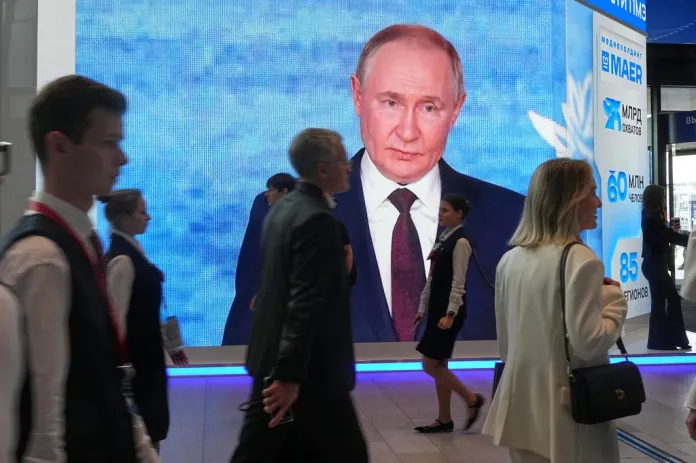
People walk past a screen with an image of Russian President Vladimir Putin at the St. Petersburg International Economic Forum in St.Petersburg, Russia, Wednesday, June 3, 2026. (AP Photo/Dmitri Lovetsky)
" data-image-caption="
People walk past a screen with an image of Russian President Vladimir Putin at the St. Petersburg International Economic Forum in St.Petersburg, Russia, Wednesday, June 3, 2026. (AP Photo/Dmitri Lovetsky)
" data-large-file="https://www.washingtonexaminer.com/wp-content/uploads/2026/07/putin-screen.jpg?w=696" src="https://www.washingtonexaminer.com/wp-content/uploads/2026/07/putin-screen.jpg?w=696" alt="Putin." class="wp-image-4643283" srcset="https://www.washingtonexaminer.com/wp-content/uploads/2026/07/putin-screen.jpg 1024w, https://www.washingtonexaminer.com/wp-content/uploads/2026/07/putin-screen.jpg?resize=300,200 300w, https://www.washingtonexaminer.com/wp-content/uploads/2026/07/putin-screen.jpg?resize=768,512 768w, https://www.washingtonexaminer.com/wp-content/uploads/2026/07/putin-screen.jpg?resize=150,100 150w, https://www.washingtonexaminer.com/wp-content/uploads/2026/07/putin-screen.jpg?resize=696,464 696w" sizes="(max-width: 1024px) 100vw, 1024px">
People walk past a screen with an image of Russian President Vladimir Putin at the St. Petersburg International Economic Forum in St.Petersburg, Russia, Wednesday, June 3, 2026. (AP Photo/Dmitri Lovetsky)
However, Russia’s exploitation of American tragedies did not begin with Graham’s death.
Last year, Russian government officials sought to use the assassination of Charlie Kirk to promote American division and incite fear. Russian media blamed both sides of the ideological spectrum for his death and predicted an American civil war.
And long before that, Russia sought to exploit the assassination of President John F. Kennedy to turn the American public against the government. Publications directed by the KGB tried to convince Americans that the CIA coordinated Kennedy’s assassination.
Russia seeks to use conspiracy narratives to sow confusion, fuel political divisions, and distract Americans from forming a unified response toward adversaries like the Kremlin. Emotionally charged events are particularly valuable in Russian information operations because they generate strong reactions, turning disagreement into distrust and creating opportunities to undermine.
PEACE THROUGH STRENGTH BEGINS WITH FORWARD PLANNING
Russia’s propaganda campaign after Graham’s death shows how the Kremlin uses tragedy not only to attack individuals, but to weaken trust within the U.S. The U.S. cannot prevent Russia from spreading conspiracy theories, but it can refuse to let Moscow define moments of national loss. This week, lawmakers’ efforts to advance Graham’s bipartisan Russia sanctions bill that holds the Kremlin accountable over its war in Ukraine are a step in the right direction.
The Kremlin may weaponize tragedy, but it does not get to define Graham’s legacy. In the years to come, the work he championed will speak louder than the propaganda aimed at erasing it.
Continue reading...
[ H/T Washington Examiner ]