








Some Supreme Court arguments seem relatively easy to read. After the court reheard Louisiana v. Callais, SCOTUSblog reported that the court appeared “ready to curtail [a] major provision of the Voting Rights Act.” Justices Clarence Thomas, Samuel Alito, and Neil Gorsuch had questioned the constitutionality of race-conscious redistricting, while Justice Brett Kavanaugh suggested that such remedies might require a time limit. The eventual decision confirmed the broad direction visible from the bench.
Other arguments reveal the likely winner more clearly than the precise coalition. In Trump v. Barbara, CBS News reported that the court appeared skeptical of President Donald Trump’s effort to restrict birthright citizenship, while a preargument Washington Post analysis described the administration’s chances of prevailing as extremely low. The administration ultimately lost. But the exact lineup was less apparent: Chief Justice John Roberts wrote the court’s opinion, and the judgment drew support from members of both ideological blocs.
Chatrie v. United States illustrates the opposite problem. After argument, the Associated Press reported that the court seemed inclined to permit police use of geofence warrants and that the justices had not embraced Okello Chatrie’s Fourth Amendment challenge. But the court ultimately ruled 6–3 that the government’s acquisition of Chatrie’s cellphone-location records was a search. One postdecision account called the result “somewhat surprising” because the argument had appeared to point toward continued use of the warrants, perhaps subject only to certain limits on time and geographic scope.
Together, these three cases capture the promise and the danger of reading the court from the bench. Sometimes the questioning exposes the likely direction of the decision. Sometimes it identifies the winner but not the coalition. And sometimes a reading of the argument ends up just plain incorrect.
This article tests how predictable the court is from oral argument. It examines the 56 signed decisions in cases argued from October 2025 through April 2026, encompassing 495 individual justice votes. The analysis compares several ways of reading oral argument: the number of words and speaking turns directed to each side, proportional and justice-specific measures of questioning, court-wide patterns, and the question-based measures used in earlier empirical research. It then compares those measures with Martin–Quinn ideological scores, which track justices’ ideologies.
The results point to a qualified conclusion. Oral argument contains meaningful information about individual votes, particularly for some justices and in closely divided cases. But it will not get you all the way there.
What oral argument predicted
The simplest oral-argument rule treats heavier questioning as evidence of skepticism. Based on this, if a justice directed more words to the petitioner, this suggests a vote for the respondent. If the justice directed more words to the respondent, it predicts a vote for the petitioner.
Applied mechanically, that rule predicted 64.2% of the individual votes in the 56-case sample. Speaking turns were slightly less informative: The number of times each justice spoke to the parties predicted approximately 60% of the available votes. This difference suggests that the amount of engagement matters more than the number of interruptions or exchanges.
These measures performed less well when the target shifted from individual votes to the eventual winner, however. The word-imbalance rule identified 33 of 56 case outcomes, or 58.9%. That result was slightly worse than its justice-vote performance.
A different rule made better use of the same information. Here, rather than treating every imbalance alike, this considered its magnitude. For example, a justice who directed 500 more words to one side supplied a stronger signal than a justice whose imbalance was only 10 words. This predicted 63.8% of individual votes and 64.3% of case winners. Allowing the relationship to vary by justice produced the strongest predictor. That model correctly called 66.5% of individual votes and 66.1% of case outcomes.
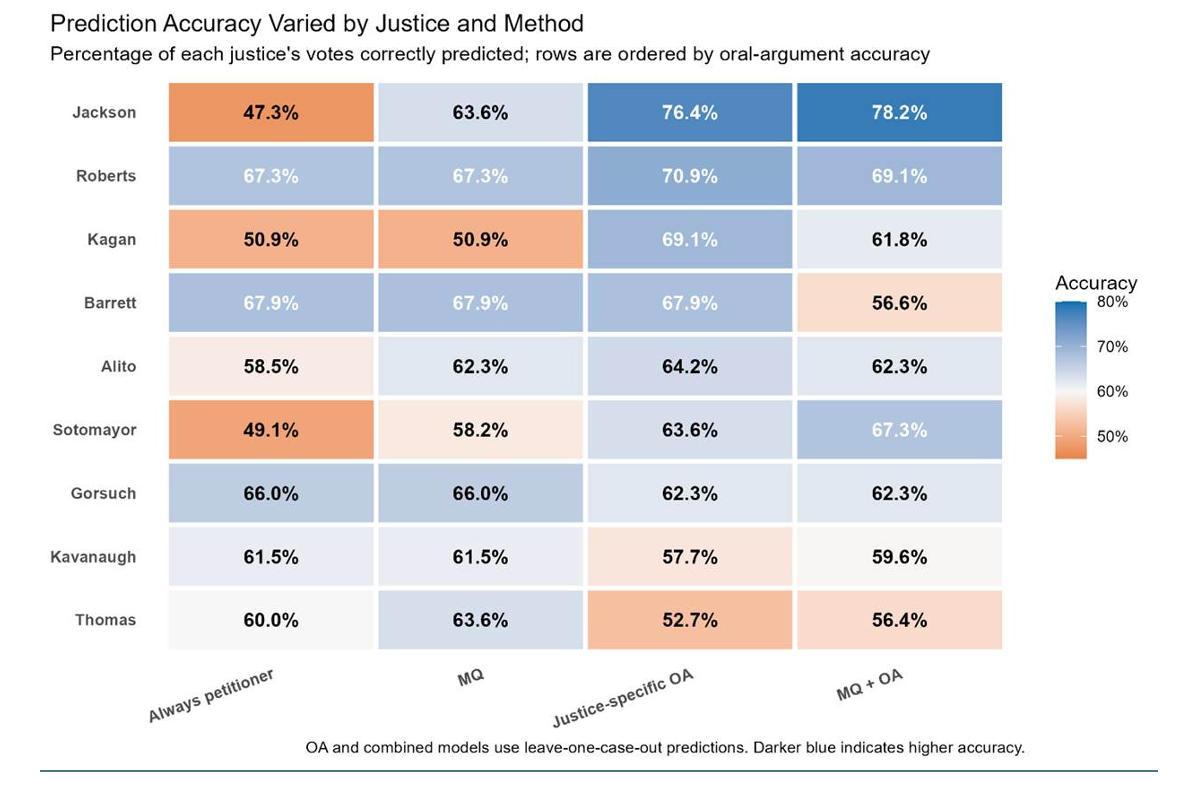
The raw word-imbalance rule was especially successful for Justices Elena Kagan, Gorsuch, and Ketanji Brown Jackson. It predicted approximately three-quarters or more of their votes. For Roberts and Justice Amy Coney Barrett, however, the same rule performed only slightly better than chance.
Those differences do not necessarily mean that some justices are candid and others are strategic. They may instead reflect different styles of participation. A justice who uses questions primarily to challenge an advocate may generate a strong skepticism signal. A justice who asks questions to clarify a position, manage the argument, or help refine a rule may produce a weaker or even misleading one. Sparse participation creates another problem: a small number of words can generate a large proportional imbalance without supplying much substantive information.
Ideology scores produced a different pattern. The ideological prior performed comparatively well for Barrett, Gorsuch, Thomas, and Kavanaugh. Oral argument added more for Jackson and Kagan. For Justice Sonia Sotomayor and the chief justice, combining ideology and questioning produced modest gains over either measure alone.
Oral argument was the most informative in closer cases
One might expect oral argument to be most useful in easy cases. A unanimous decision should present a clearer signal than a closely divided one, while a 5–4 case may turn on concerns too subtle to appear in simple counts of words or questions. Interestingly, the results pointed in the exact opposite direction.
The five cases decided by a 5–4 vote produced only 45 individual justice votes, so the estimates are necessarily imprecise. Within that small group, however, the raw word-imbalance rule predicted 82.2% of the votes. The justice-specific oral-argument model predicted 75.6%. Both substantially exceeded the 51.1% accuracy of predicting that every justice would vote for the petitioner.
The same pattern appeared in moderately divided cases, principally those decided 6–3 or 7–2. The justice-specific oral-argument model correctly predicted 78.8% of the votes in that group, compared with 60.3% for the petitioner baseline and 70.9% for the Martin–Quinn ideological prior.
Performance fell in the most lopsided cases. In unanimous and near-unanimous decisions, the major methods clustered around 56 to 59% vote accuracy. Oral argument therefore appeared to supply its greatest incremental information in cases where the justices themselves were divided.
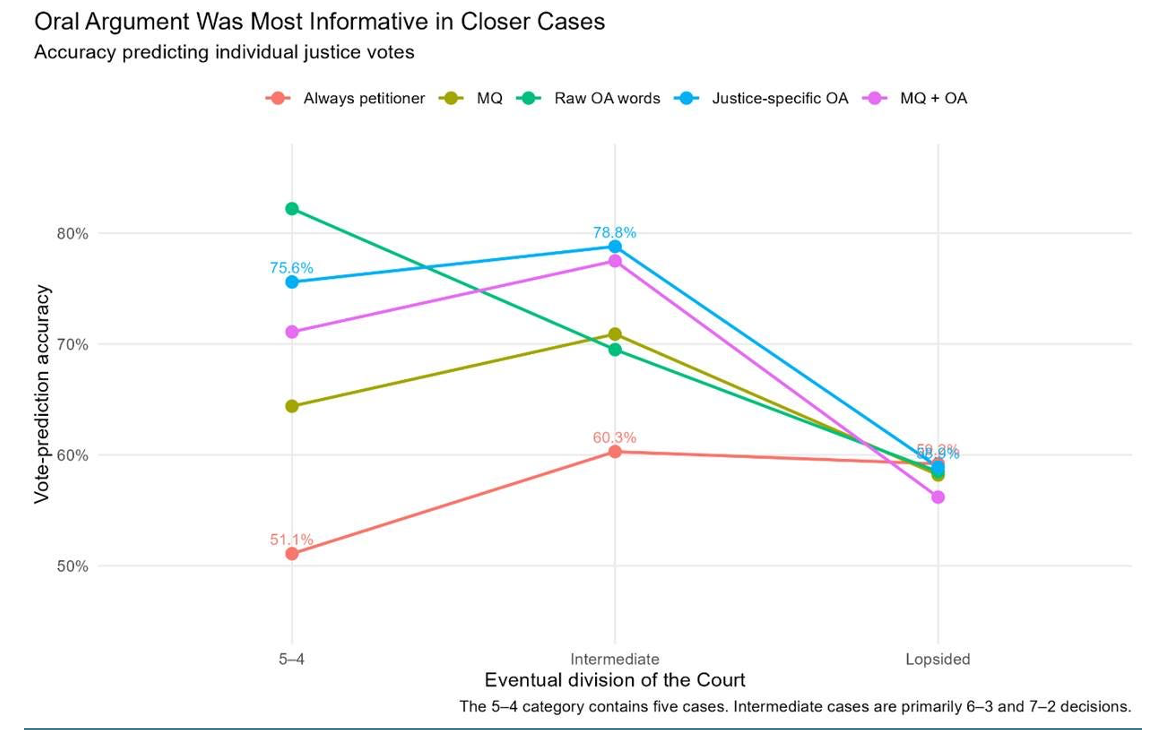
That result makes some sense. In a lopsided case, the justices may agree on the result while using oral argument to debate the scope, reasoning, remedy, or limiting principle. A justice can press the eventual winner sharply without seriously considering a vote for the other side. The questioning may thus reveal disagreement about the opinion rather than the judgment.
In a close case, by contrast, the concerns expressed at argument may bear more directly on the vote. The parties are competing for a genuinely uncertain majority, and the objections voiced from the bench may correspond more closely to the considerations that determine each justice’s position.
But there’s a twist: The improvement in vote prediction did not translate cleanly into better prediction of the winner. The principal models correctly identified three of the five 5–4 outcomes. That was the same number predicted by simply choosing the petitioner in every case.
Why? Because it takes only two justices to make a winning coalition. A model can correctly predict seven of nine votes and still identify the wrong winner if its two mistakes include members of the five-justice majority.
The distinction is important for assessing claims about Supreme Court predictions. A method may contain substantial information about the court’s internal alignment without reliably identifying which side will obtain the fifth vote. Again, oral argument appears to perform better at the first task than the second.
Ideology, simple baselines, and alternative measures
Martin–Quinn ideology scores offered a different kind of prediction. Rather than drawing an inference from what the justices said at argument, the ideological model asked whether the result sought by the petitioner aligned with each justice’s pre-term ideological position.
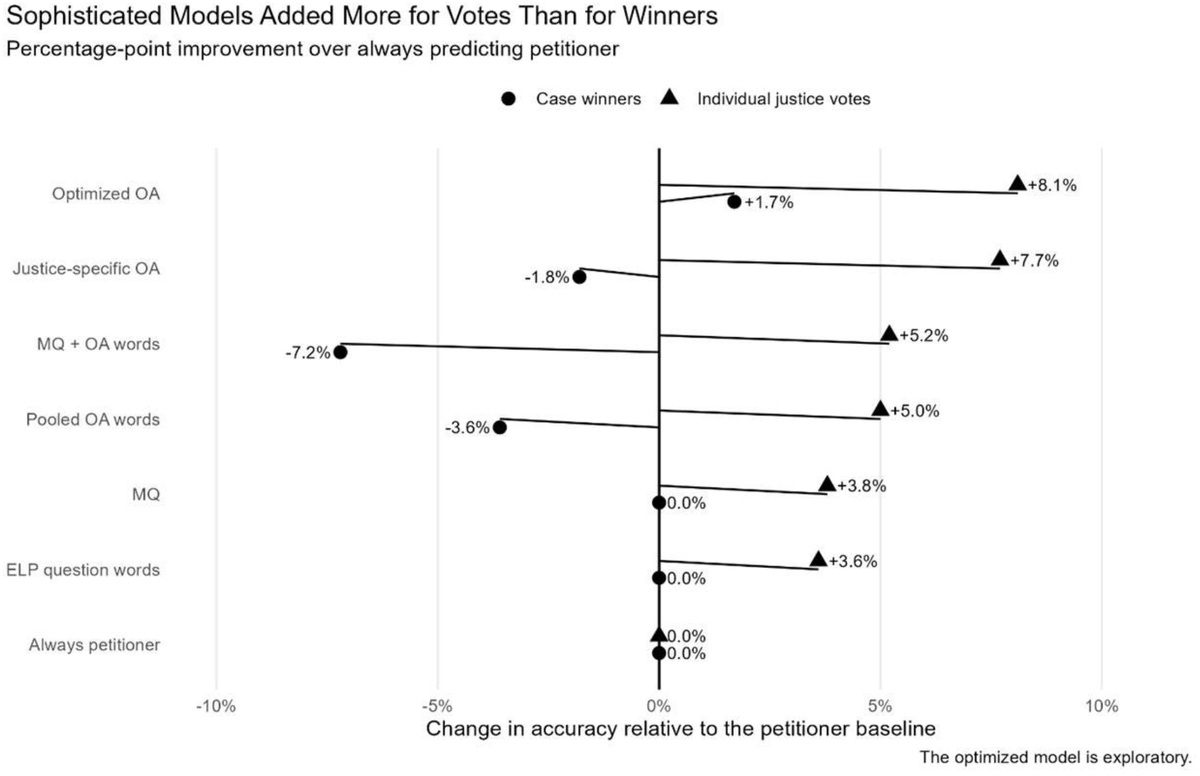
The MQ model correctly predicted 62.6% of individual votes. That was better than predicting a petitioner vote for every justice, but slightly below the principal oral-argument models described above. At the case level, MQ ideology identified 38 of 56 winners, or 67.9%.
That case-level result initially appears stronger than the oral-argument results. But it was identical to the accuracy obtained by always choosing the petitioner. Petitioners won 38 of the 56 cases in the sample. A model that selected the petitioner without examining ideology, the briefs, the argument, or the legal issue would therefore have matched the ideological case-outcome accuracy.
The baseline matters less at the individual-vote level because the justices did not all vote for petitioners at the same rate. Always predicting the petitioners would win produced 58.8% accuracy across the 495 justice votes. The MQ model improved on that result by 3.8%. The pooled oral-argument word model improved that by approximately five points, and the justice-specific oral-argument model improved that by nearly eight.
Combining MQ and oral argument did not produce the expected gain. A model using both ideological alignment and word imbalance predicted approximately 64% of individual votes, only slightly better than either alone. It predicted fewer case winners than MQ or the petitioner baseline.
When the argument pointed the wrong way
Perhaps the most revealing cases were those in which questioning strongly favored the losing prediction.
The conventional view is that the side receiving more attention is in greater danger. Across the full sample, that relationship existed, but it was far from uniform. Several petitioner wins occurred even though the court directed more words to the petitioner than the respondent.
Chevron U.S.A. Inc. v. Plaquemines Parish, which dealt with whether certain gas and oil companies should be held liable for damage to the Louisiana coast, was the clearest example. Every justice who spoke directed more words to Chevron’s side than to the respondents. A literal reading of the argument therefore predicted a respondent victory across the participating court. Chevron nevertheless won.
Olivier v. City of Brandon, concerning limits on convicted criminals challenging the law in which they were convicted, produced a similar mismatch. The court unanimously ruled for the petitioner, yet the questioning imbalance pointed toward the respondent. The argument exposed concerns about the breadth or consequences of the petitioner’s theory without signaling genuine uncertainty about the judgment.
Chatrie v. United States illustrates a different type of surprise. Contemporary reporting suggested that the court might permit the challenged geofence warrant under the Fourth Amendment or resolve the case narrowly. The eventual 6–3 ruling that obtaining the location records constituted a search showed that the questions had understated the strength of the Fourth Amendment coalition.
These cases help explain why word counts should be treated as evidence rather than a vote tally. A party can receive sustained questioning because its position is weak. It can also receive sustained questioning because its position is important, novel, difficult to cabin, or likely to become the basis for the court’s opinion.
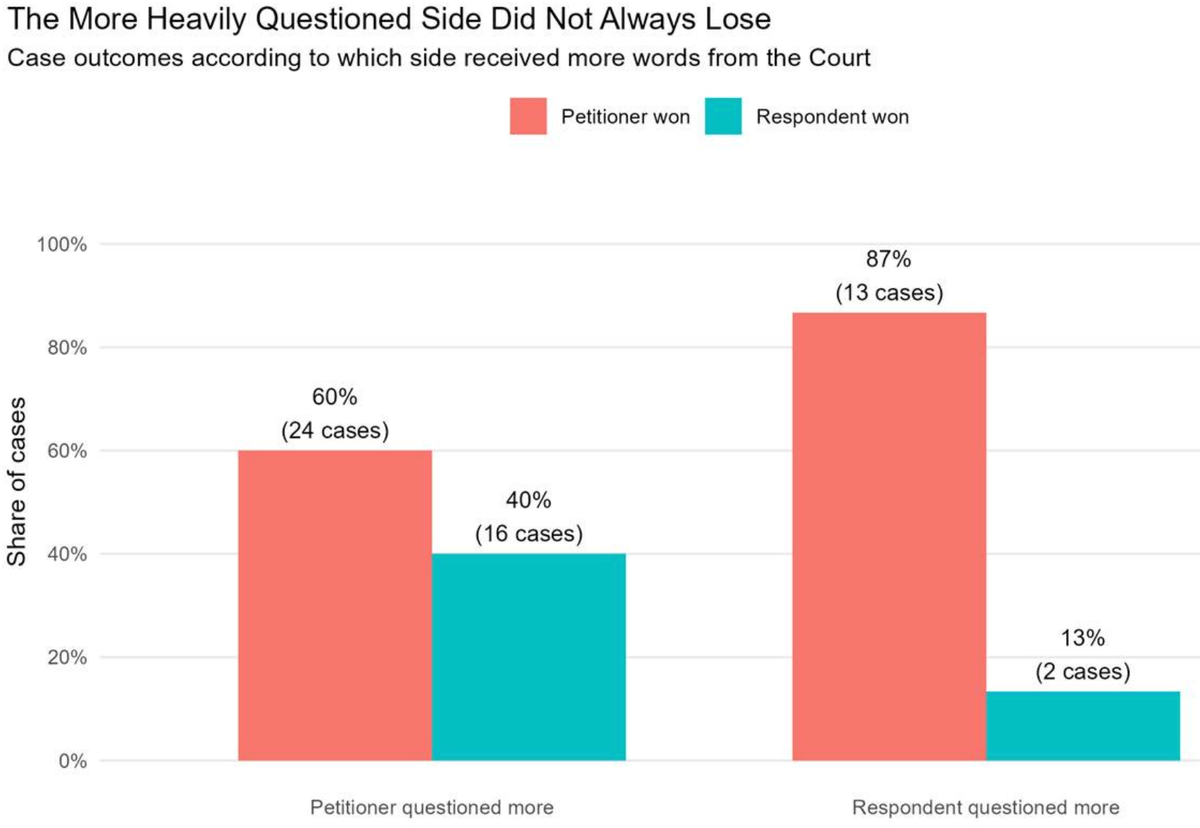
The reverse pattern also matters. In some cases, the questioning identified the winner even when ideology supplied little guidance. Those successes help account for oral argument’s stronger performance at the individual-vote level, particularly in close cases. The questions revealed concerns that were not captured by a justice’s general ideological position.
So what?
Supreme Court oral argument is informative, but its value depends on what one is trying to predict.
For individual justice’s votes, the amount of questioning directed to each side is somewhat meaningful. The strongest principal oral-argument model predicted approximately two-thirds of the votes, nearly eight percentage points better than always predicting that every justice would vote for the petitioner.
But this was not distributed evenly. Oral argument was especially useful for predicting the votes of some justices (Kagan, Gorsuch, and Jackson) and much less useful for others (Roberts and Barrett). It also appeared most informative in closely and moderately divided cases, where the concerns expressed at argument may have borne more directly on the justices’ ultimate positions.
Predicting the overall winner proved harder. Petitioners won 38 of the 56 cases, allowing an always-petitioner rule to achieve 67.9% accuracy without using any information about the arguments, issues, or justices. The Martin–Quinn ideology model matched that result. More flexible specifications approached 70% outcome accuracy, but that apparent gain amounted to only one additional correct case. Replicating the question-count and question-length measures used in prior scholarship did not change things. Those models matched the petitioner baseline for winners and performed below the justice-specific word model for individual votes.
Again, these findings place a real limit on claims that oral argument allows observers to forecast where the overall court is leaning, at least through simplistic word count measures. The questioning can help identify individual alignments, especially when the court is divided. But it is less reliable at locating that pivotal fifth vote. A model can thus understand most of the court’s members and still miss its overall judgment.
The bottom line: We should take postargument commentary with a grain of salt.
Continue reading...
[ H/T SCOTUSblog ]