





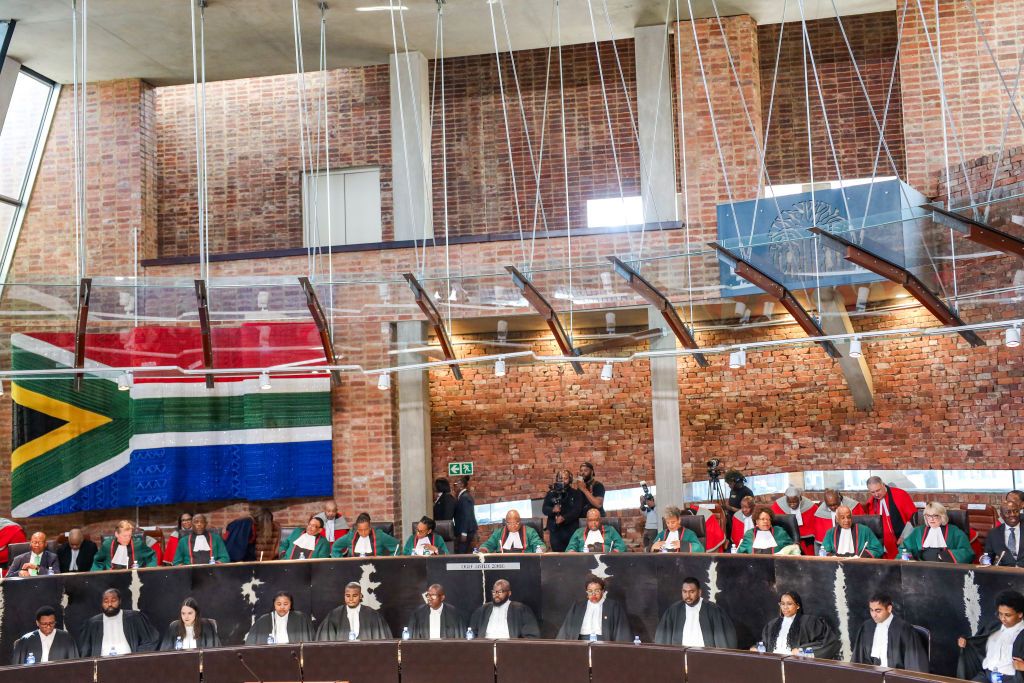
Welcome to SCOTUSblog’s recurring series in which we interview experts on different supreme courts around the world and how they compare to our own. Today’s column focuses on the Constitutional Court of South Africa. To help me understand this institution, I corresponded with Professor Penelope Andrews.
When was the Constitutional Court of South Africa established?
The Constitutional Court was established in 1994. It held its first official session in February 1995.
Does the Constitutional Court of South Africa only hear appeals? Are there any cases in which it has original jurisdiction?
The Constitutional Court serves as a court of original jurisdiction as well as a court of appeals. Section 167 of South Africa’s Constitution provides that the Constitutional Court is the highest court in South Africa and it may decide constitutional matters and any other matter, if it has granted leave to appeal - on the grounds that the matters raise “an arguable point of law of general public importance.”
Specifically, the Constitutional Court has exclusive authority:
- to decide disputes between organs of state at the national or provincial level, concerning the constitutional status, powers, or functions of any of those organs of state;
- to decide on the constitutionality of legislation at the provincial or national level;
- to decide that Parliament or the president has failed a constitutional obligation; and
- to certify the constitutionality of a provincial constitution that has overturned an act of Parliament.
Based on the prior answer, I think it’s a yes, but can the Constitutional Court of South Africa overturn acts of Parliament? If so, how often does this occur?
The Constitutional Court has overturned acts of parliament, including, in 1999, the Sexual Offences Act that criminalized homosexual conduct and this year the National Health Act that curbed the activities of certain health professionals. In 2011, it also invalidated the National Prosecuting Authority Amendment Act and the South African Police Service Amendment Bill establishing state agencies to fight corruption in South Africa. The Constitutional Court found that the legislation failed to secure an adequate degree of independence for the new body.
How many justices are on the Constitutional Court of South Africa?
There are 11 justices, including the chief justice and deputy chief justice.
How are these justices selected?
The Constitutional Court judges are selected by the Judicial Service Commission and formally appointed by the president. The JSC has 23 members comprising government representatives, members of the judiciary and the legal profession, members of civic society, and is presided over by the chief justice. The JSC manages the public selection process, while the president holds the final appointing authority. When a vacancy opens on the Constitutional Court, the JSC calls for public nominations. Candidates submit formal documents for consideration and candidates selected for interviews by the JSC undergo public interviews where they are questioned on their legal track record and suitability.
After the public interviews, the JSC compiles a list of nominees containing three more names than there are available vacancies. For example, if two seats are open, they submit five names to the president. The president must make the selection of the Constitutional Court judges after consulting the chief justice and the leaders of parties represented in the National Assembly.
Do the justices serve terms – if so, of what length?
Constitutional Court judges serve a non-renewable term of 12 years, or until they reach the mandatory retirement age of 70, whichever comes first.
Are cases decided by a simple majority?
They are.
How is the opinion writer assigned?
The chief justice decides which justice will be responsible for drafting the primary opinion for a case. The assignment is made following the initial post-hearing deliberations, where the justices discuss the case and the majority tentatively agrees on an outcome.
Is there a tradition of concurrences or dissents on the court?
There is a strong tradition of dissents and concurrence on the court. Indeed, in the court’s earliest days, judges tended to write lengthy opinions even in concurrence and/or dissent. This may be explained by their attempts to establish and clarify new legal principles. That tradition of lengthy concurring and dissenting opinions has waned somewhat in the last few years.
What were some major issues recently decided by the Constitutional Court?
During the presidency of Jacob Zuma, widespread corruption was unearthed and the Constitutional Court delivered several judgements on corruption and state capture. When the Constitutional Court in 2021 ordered that Zuma be imprisoned [after finding that he was guilty of contempt of court], there was considerable pushback from his supporters.
Another controversial case decided by the Supreme Court of Appeal, the penultimate court of appeal in South Africa, which the Constitutional Court let stand, involved the failure of the South African government to arrest former Sudanese President Omar al-Bashir who was wanted by the International Criminal Court for crimes against humanity. The Supreme Court of Appeal ruled that the government’s failure to arrest al-Bashir during a 2015 African Union summit in Johannesburg was unlawful. The court concluded that South Africa violated its international obligations under the Rome Statute.
What have been some particularly controversial issues decided by the Constitutional Court of South Africa throughout its history?
There have been several such cases:
- Where the Constitutional Court has decided on issues of indigenous law, there have been rumblings from influential sectors of the indigenous and rural communities. For example, the court in the 2004 Bhe decision held as unconstitutional the indigenous practice of primogeniture, which prevented girls and women from inheritance.
- In 1995 the Constitutional Court outlawed the death penalty. This was controversial in light of the prevalence of crime in South Africa, and indeed, informal vigilante killings rose after the outlawing of capital punishment.
- The court’s upholding of the constitutionality of the Truth and Reconciliation Commission was also another controversial decision, since many families of victims did not agree with the amnesty provisions of the TRAC.
- The right to health care and the obligation of the government to provide anti-retroviral medication to HIV positive individuals was consequential in light of the prevalence of HIV/AIDS in South Africa. It was controversial to the extent that the president and the Minister of Health were so resistant to confronting the connection between HIV and AIDS.
- Finally, the right of same-sex couples to be married was quite controversial, particularly in religious and some indigenous communities.
The United States Supreme Court is often seen as partisan. Does the Constitutional Court of South Africa have a partisan reputation?
It does not. I would venture to say that most South Africans could not give you the name of the Constitutional Court judges or their political leanings. They certainly do not have the “celebrity” status that many Supreme Court justices have in the United States. But despite the Constitutional Court being seen as non-partisan and fair, this has not prevented some politicians from attacking the judges as being “activist” and partisan, especially during the years of the presidency of Jacob Zuma. Such attacks stand in stark contrast to the example set by President Nelson Mandela, who despite findings against him by the Constitutional Court on some occasions, made it a point to publicly honor the decisions of the court, to highlight and educate the South African public about the new legal culture of accountability and justification.
Would you say the Constitutional Court of South Africa is considered a particularly powerful institution – say, compared to Parliament or the president?
I believe that the Constitutional Court is more respected in South Africa than the other two co-branches. Powerful? It does require officials to obey its orders – and for the most part, at least publicly, this has been the case. However, through a mixture of indifference and incompetence, public officials have disregarded Constitutional Court decisions, especially in the area of socio-economic rights.
The judiciary has been mindful of its role as a co-equal branch of government, but recognizing its institutional capacity vis a vis the legislature and executive. The Constitutional Court declared in one of its earlier judgments that all public power in South Africa is subject to constitutional review. So, for example, in a very early case challenging a presidential pardon issued by President Mandela, the Constitutional Court explored the question of whether the presidential pardon is subject to constitutional review. And they concluded in the affirmative.
The Constitutional Court has also not carved out exceptions to its jurisdiction, for example, like the political question doctrine in the United States. And the South African Constitution has an extremely generous provision regarding standing, which makes access to the Constitutional Court in South Africa in many ways much greater than access to the American Supreme Court.
Something we haven’t really touched on but should, especially given its salience in South Africa, is the issue of race. How has the Constitutional Court dealt with or navigated this difficult issue?
With respect to race, it's been very interesting. The Constitutional Court has not heard many cases on race. In fact, it's only heard two major such cases. The first had to do with affirmative action, and the court was very, very clear that affirmative action is constitutional, and so it reinforced an affirmative action program. The other one was an affirmative action case from one of the provinces involving one party classified as Indian and the other as African. This was somewhat like the challenge to the Harvard program where you had two minorities in competition, and in that case, the South African court again permitted the affirmative action program. It's different from the United States Supreme Court in that way because the United States Supreme Court said that you cannot take race into account and you have to apply strict scrutiny. Whereas in the South African cases, the Constitution specifically says that affirmative action is permitted as mandated by the Constitution.
So, if I’m understanding it correctly, you’re saying that fewer such cases are brought than in the United States because the South African Constitution is so explicit that things like affirmative action are acceptable?
Correct. Also important to remember is that Black people make up 92% of South Africa's population, and whites make up 8%. So it's a very different kind of conversation. Now that's not to say that at the political level and outside of court decisions there's not a lot of patronage and cronyism happening. But those are political questions, not legal questions.
What aspect of the Constitutional Court of South Africa do you see as superior to that of the Supreme Court of the United States?
First, representation. Because South Africa's constitutional court is only 30 years old, compared to 200 plus for the United States Supreme Court, the difference is that there has been a mandate in South Africa to transform the judiciary in terms of demographics and constitutional values. In 1994, there were 200 judges in South Africa, except for two every one of them was a white male. But the Constitution states that the judiciary must represent the makeup of South Africa, as well as represent the values of the Constitution. So now, after 30 years, the judiciary is majority Black – although majority Black male. In the United States, I would say that judges are appointed based on their ideological leanings. In South Africa, they are appointed based on demographics and ideological leanings to the extent that they are committed to the values of the Constitution, and I think that’s a good thing.
Second, with South African justices the commitment to the values of the Constitution is purposive, whereas in the United States they hide the ball. U.S. justices won't say what they believe, especially before the Senate. Some people might say, "Well, maybe South African judges pretend that they're committed to the Constitution.” That might be right, but at least they've got to say it clearly.
So what aspect of the Supreme Court of the United States do you see as superior to that of the Constitutional Court of South Africa?
Many U.S. justices, with some exceptions, have had relatively longer judicial careers. Much of this is for historical reasons: there were no Black judges and no female judges in South Africa historically. So the judicial pipeline for Black judges was somewhat limited. It's not that South African judges are not as competent or not as smart, but U.S. justices have more experience coming from other courts, and I think that’s a positive.
Continue reading...
[ H/T SCOTUSblog ]