









Christopher Nolan has long been fascinated by the journey home. His Batman origin story, at its core, concerned Bruce Wayne’s return to Gotham. Beneath its mounds of abstraction, Inception (2010) follows Cobb’s quest to clear his name and return to his children; Cooper spends Interstellar (2014) trying to do much the same across the vastness of space and time.
Which brings us to The Odyssey, Nolan’s most direct treatment of the theme: an adaptation of Homer’s ancient epic. I read three translations of the poem in preparation for the film, not because I hoped to grade Nolan on his fidelity to the source material, but because it is intriguing to see what varied interpretations a nearly 3,000-year-old poem can yield.
Nolan has cited Emily Wilson’s modern translation, with its famous invocation of Odysseus as “a complicated man,” as an inspiration. Yet, to me, his bombastic big-screen rendition pulses with the same everyman accessibility as W.H.D. Rouse’s 1937 prose translation, which dispensed with poetic frills and delivered an action-adventure epic for the masses. In Nolan’s benighted Bronze Age world, Odysseus (appropriately played by a grizzled Matt Damon) and his men speak in ordinary American accents and hurl F-bombs. Nobody sounds as though he has wandered in from a classics seminar. This is no bad thing.
The greatest triumph of The Odyssey is that it succeeds as a summer blockbuster while preserving the tenets of Homer’s moral universe. It is a masculine and conservative ethos, unmistakably forged in an earlier age in which humans answer to a higher order, choices carry consequences, and family, kingship, and faith impose obligations. Any online notions that Nolan has “gone woke” are misguided or intentionally misleading.
Under this moral scaffolding, Odysseus finds himself in the crosshairs of angered gods. He is the most cunning soldier in the Greek armies and the architect of the Trojan Horse strategy. Nolan depicts the storied horse with intriguing practicality. It resembles a crude vessel washed ashore rather than the picturesque wooden statue of popular imagination. Greek soldiers spend days crammed inside under harrowing conditions (it is certainly no suite at the Four Seasons). Its raw, abandoned appearance explains why the Trojans lower their guard. It is the most convincing version of the myth I have seen.
Yet Odysseus’s intellect is inseparable from his hubris. Having devised the scheme that sacks an impenetrable city, he begins to believe himself above the gods and above reproach. His journey home becomes the reckoning for that arrogance. From the Hebrew Bible to Planes, Trains and Automobiles (1987), the journey home remains one of humanity’s most enduring and relatable stories.
Nolan weaves the voyage from a collection of famous ordeals, beginning with the cave of the cyclops Polyphemus. “Sheep move in packs. Let’s follow it,” Odysseus confidently declares, leading his men into a mysterious cave after they anchor on their return from Troy. A giant boulder soon shuts them in.
What follows is a tense and terrifying sequence in which a 60-foot cyclops stalks through the darkness, plucking soldiers from the ground for supper. Coupled with Ludwig Goransson’s pounding score, it is a spectacle deserving of the biggest screen in your vicinity. After escaping, Odysseus heedlessly fires an arrow into Polyphemus’s eye, inviting the wrath of the cyclops’s father, Poseidon, and condemning his men to a torturous voyage.
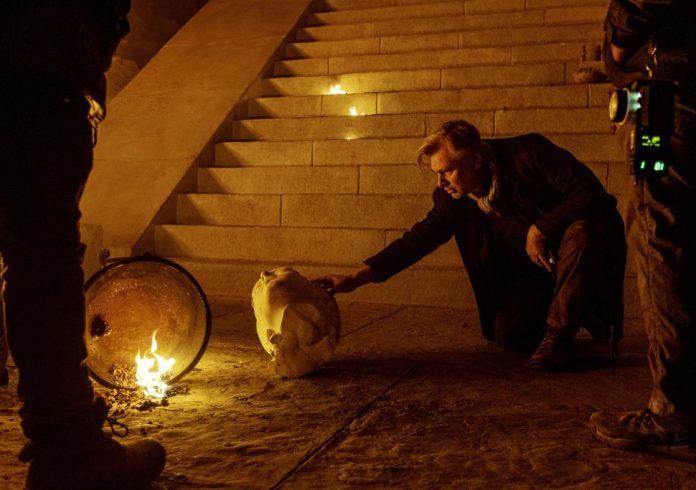
This image released by Universal Pictures shows director Christopher Nolan on set of “The Odyssey.” (Melinda Sue Gordon/Universal Pictures via AP)
" data-large-file="https://www.washingtonexaminer.com/.../07/AP26191599239906-e1784564547132.jpg?w=696" src="https://www.washingtonexaminer.com/wp-content/uploads/2026/07/AP26191599239906.jpg?w=696" alt="Director Christopher Nolan on the set of "The Odyssey." " class="wp-image-4655395">
This image released by Universal Pictures shows director Christopher Nolan on the set of “The Odyssey.” (Melinda Sue Gordon/Universal Pictures via AP)
The film’s teasers read “defy the gods.” The phrase turns out to describe Odysseus’s folly rather than a heroic aspiration. His transgression extends beyond the cyclops. To sail past the sirens, he orders his men to bind him to the mast so that he may hear their forbidden music while they clog their ears. It reminded me of President Donald Trump staring directly into a solar eclipse without protective eyewear.
The sirens, Circe’s transformation of Odysseus’s men into pigs, and his encounter with the Laestrygonians — towering, man-eating giants armed with tree-sized cleavers — are among the most masterfully terrifying sequences I have experienced in recent memory. Even Scylla’s appearance in broad daylight sent a chill down my spine. Has Nolan considered directing a horror movie? Goransson’s score reinforces this primal atmosphere through tense percussion, roaring chants, flutes, and a deep electro-orchestral throb that seems to rise from the earth itself.
Back in Ithaca, the moral architecture of Homer’s world is expressed through “Zeus’s law,” the sacred obligation of hospitality known as xenia. Strangers arriving at one’s doorstep are to be welcomed with food and wine, with honorable conduct expected in return. Game theory would formalize the logic millennia later. Penelope’s suitors violate it extravagantly, occupying Odysseus’s home, consuming his stores, threatening his son, and pressuring his wife into marriage.
The performances are uniformly strong. The pre-release anxiety over casting feels especially silly once immersed in Nolan’s grim, torchlit world, where everyone is weary and coated in dirt or oil; under this lighting and aesthetic, nearly everyone winds up looking Mediterranean. Lupita Nyong’o appears in only two scenes as Helen of Troy, but she is appropriately arresting. Her dark complexion immediately sets her apart, lending Helen the otherworldly presence demanded of the face that launched a thousand ships. Because the contrast serves the film’s visual mythology, it never feels like the diversity-focused casting of Bridgerton.
Anne Hathaway is a highlight as Penelope, the grieving queen awaiting her husband while scores of suitors vie for her hand, if not her affection.
My favorite, however, is Robert Pattinson as Antinous, the most brazen and vicious of Penelope’s suitors. He carries the ruthless entitlement of a man who plots to murder Penelope’s son, Tom Holland’s Telemachus, while feasting his way through his inheritance.
Pedantic purists will find several creative liberties. Odysseus recounts his ordeals to his captor, Calypso (Charlize Theron), reimagined as a benevolent therapist and desperate romantic who ensnares his mind out of love before releasing him of her own accord, rather than under orders delivered by Hermes from Zeus.
More significantly, Nolan largely removes the gods from the action. Athena (Zendaya) appears sporadically in Odysseus’s visions, closer to a manifestation of conscience than a deity intervening in mortal affairs. Zeus, Poseidon, and the divine council on Mount Olympus that opens Homer’s poem remain offscreen. It is difficult to diminish the grandeur of Nolan’s accomplishment, though I cannot help wondering what his formidable imagination might have made of the deities pulling the strings in the background.
RESTORING AMERICA: TOY STORY 5 FINDS THE TOYS REPLACED BY TABLETS
Yet The Odyssey has endured for reasons deeper than its gods and monsters. Nolan treats the storms, sirens, and shipwrecks as consequences of Odysseus’s pride, external manifestations of a man who believes himself above the mortal plane. Whether that higher order is personified by Poseidon or understood through monotheistic faith, the moral proposition remains: no man, however clever, is sovereign over creation.
The most consequential journey in The Odyssey takes place within its hero. Homer’s great question is whether a man can be stripped of his name and decades of his life yet still return home and reclaim the identity he left behind. The poem’s endurance lies in the universality of that longing. Everyone is trying to find a way back — to a home, a love, an identity, or the person they were before life altered them. Along with its epic scale and cinematic grandeur, this is what Nolan succeeds in capturing.
Harry Khachatrian (@Harry1T6) is a film critic for the Washington Examiner. He is a software engineer, holds a master’s degree from the University of Toronto, and writes about wine at BetweenBottles.com.
Continue reading...
[ H/T Washington Examiner ]