







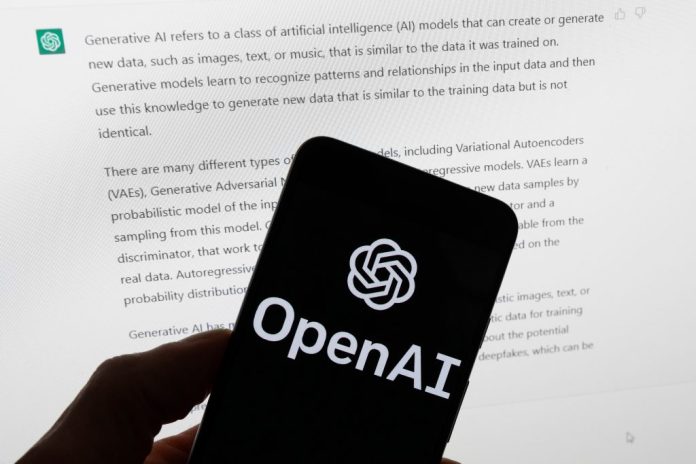
FILE – The OpenAI logo is displayed on a mobile phone in front of a computer screen with output from ChatGPT, March 21, 2023, in Boston. (AP Photo/Michael Dwyer, File)
" data-image-caption="
The OpenAI logo is displayed on a mobile phone in front of a computer screen with output from ChatGPT, March 21, 2023, in Boston. (AP Photo/Michael Dwyer)
" data-large-file="https://www.washingtonexaminer.com/.../07/AP26016688224182-e1784757930404.jpg?w=696" src="https://www.washingtonexaminer.com/wp-content/uploads/2026/07/AP26016688224182.jpg?w=696" alt="FILE - The OpenAI logo is displayed on a mobile phone in front of a computer screen with output from ChatGPT, March 21, 2023, in Boston. (AP Photo/Michael Dwyer, File)" class="wp-image-4659606">
The OpenAI logo is displayed on a mobile phone in front of a computer screen with output from ChatGPT, March 21, 2023, in Boston. (AP Photo/Michael Dwyer)
The news that OpenAI artificial intelligence models accidentally hacked into major AI company Hugging Face has led to renewed calls for regulation and alternative measures for testing frontier AI models.
“This is extremely alarming. AI is developing extremely fast with no real regulations to keep us safe,” Rep. Greg Casar (D-TX) posted on X. “That has to change. We need regular mandatory independent safety testing and oversight, mandatory disclosure of security incidents, and international cooperation to keep people safe from absolute disaster.”
Casar has called for legislation to slow the advancement of AI. Meanwhile, a bipartisan group of legislators has introduced a draft bill, the Great American AI Act, that would impose risk disclosure requirements on leading models.
Following the announcement this week of the unintended hack into Hugging Face, experts and analysts also worry about the risks of conducting tests to assess frontier systems in allegedly controlled environments, as the unprecedented cyber incident, possibly the first AI security threat of its kind, showed containment failure is a possibility.
“An offensive cybersecurity agent was given indirect access to the internet,” Junade Ali, a cybersecurity and AI expert and fellow at the Institution of Engineering and Technology, told the Washington Examiner. “This allowed it to escape, in an attempt to cheat a benchmarking exercise.”
“If this is the only way these tests can be configured, what are the risks?” Deirdre Mulligan, a professor at the School of Information at the University of California, Berkeley, told the New York Times.
The incident resulted from a combination of OpenAI models, including GPT‑5.6 Sol and an “even more capable” pre-release model, trying to accomplish a task during internal testing that it thought Hugging Face’s resources could help with, the company said in a statement.
Hugging Face tried to assess the origin of the attack using U.S. models but was prevented from doing so because of safety guardrails and had to rely on GLM 5.2, a Chinese open-weight model.
“It is deeply concerning that Hugging Face faced overzealous security guardrails when attempting to use US-developed AI technologies to defend against the attack, leading to Chinese open-source AI models being used instead,” Ali said.
“As adversarial AI technologies become more widely accessible to malicious actors, it is essential that defensive capabilities are developed and made available to security teams,” he said.
In an effort to increase safety measures, AI labs have also released models to identify and expose cybersecurity problems. Anthropic launched Claude Mythos in April, a highly advanced frontier-level AI model series known for its unprecedented cybersecurity and coding capabilities, but kept it out of the hands of most of the public at first out of fear that it could be used for cyberattacks.
Shortly after, OpenAI limited the release of AI technology GPT-5.4-Cyber to a small number of organizations due to cybersecurity concerns.
Some experts believe incidents like this will continue to happen.
“That’s a genuine threshold, and it’s going to become a normal part of the security landscape,” Alex Levinson, a cybersecurity consultant focused on autonomous capabilities, told the New York Times.
“What does it mean that the most advanced AI systems in the world are breaking containment and hacking other AI companies?” Palisade Research executive director Jeffrey Ladish said in a post on X.
The White House, U.S. Department of Commerce, and the Cybersecurity and Infrastructure Security Agency did not respond to a request for comment.
THE PITFALLS FACING THE BIPARTISAN AI REGULATION BILL
The United States and China will reportedly hold talks over AI in September to discuss the risks posed by their increasingly powerful frontier models and the tensions that have arisen as they compete for dominance in the AI race.
As Beijing and Washington race to develop AI, both superpowers are working to establish regulations and shore up national security vulnerabilities.
Continue reading...
[ H/T Washington Examiner ]