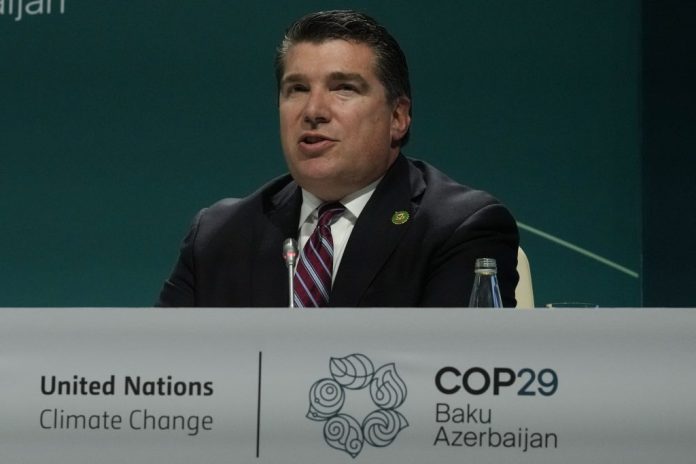









Democratic National Committee chairman Ken Martin implored an influential committee to quickly select the early primary voting slate to present to the full DNC body next month.
The DNC’s Rules and Bylaws Committee is holding a two-day meeting in Washington this week to decide which four or five states will hold the first 2028 nominating contests, before sending the list to the entire DNC body for a vote. But the 49-member Rules and Bylaws Committee could punt on the decision to next month, when the full DNC body will meet, or even later, amid heavy angling from states to hold the first primary.
“I firmly believe, as your national chair, that making this decision now, before there can be any accusations of impartiality, is critically important,” Martin said in his remarks on Thursday. “The integrity of this work must be our highest standard, and that means getting this done.”
Martin warned that delaying the process could mean a decision isn’t made until after the 2026 midterm elections, when Democratic presidential candidates will have likely announced their campaigns.
“Our rules require that the full DNC vote to ratify the rules while waivers [are] approved by this committee,” said Martin. “So, if this isn’t done in time for our meeting in Austin a few weeks from now, our next opportunity to get them approved would not be until early next year, at which point there will be candidates already in the race.”
Several DNC members who spoke to the Washington Examiner concurred that the committee should have the early voting schedule finalized in time for the DNC full body meeting next month in Austin, Texas.
“We absolutely should decide tomorrow. Can’t be kicking the can down the road. I’m so tired, let’s just decide,” said member Kenny Thompson Jr. “They put us here to decide. So let’s just decide.”
“We’re not talking about choosing between 50 states,” Thompson added. “We’re talking about choosing between like seven … So like, how hard could it be?”
Andre Treiber, another DNC member, said the committee needed to decide on the nominating schedule so that it would be “fair for everyone involved that they know the playing field that we’re dealing with.”
“The longer we keep that in flux, the worse it is for our candidates in terms of being able to prepare for what they need to do to win the nomination,” Treiber continued. “So I really think we need to adopt this now.”
Nevada and South Carolina are widely seen as the top two seats that will go first in the nominating calendar, with Michigan, New Hampshire, New Mexico, and Virginia among the states that could fill out the other early voting primaries.
But Nevada and South Carolina supporters have bitterly fought about what message the DNC sends to Latino and African American voters if either state is chosen to vote first. Black voters in South Carolina boosted former President Joe Biden in the 2020 Democratic primary season. Biden rewarded the Palmetto State by making it the first nominating state in 2024, dethroning the Iowa Democratic caucus after a disastrous app crash delayed results in 2020. The Supreme Court’s Louisiana v. Callais decision has also stoked more calls to support black voters, as Republican states in the South have gerrymandered black House Democrats out of their seats.
Yet Nevada’s battleground status and large Latino population also make it a strong contender to dethrone South Carolina in 2028, particularly as Latino voters drifted away from the Democratic Party in 2024.
A DNC member who requested anonymity said they didn’t like the infighting over minority voters.
“All the states that we’re looking at have diversity,” said the member. “So this idea that it’s like only one state versus another, and that we’re pitting communities against each other, I think it’s more about how do you build a winning coalition and demonstrate that you can do that.”
Complicating the nominating schedule is New Hampshire state law that requires it to hold the nation’s first primary. In 2024, the state held an unsanctioned primary before South Carolina’s primary. But last month, the DNC Rules and Bylaws Committee voted to approve a $270,000 fine against any state that holds an unsanctioned primary and stipulated that the state would lose 100% of its delegates, including all automatic delegates.
New Hampshire Democratic Party chairman Raymond Buckley was coy about what would happen if his state is once again overlooked for the first spot in the nominating contest.
“Well, we’ll hopefully not have to deal with that,” Buckley said when asked by the Washington Examiner what the state party would do if it doesn’t go first. “I still have faith in my committee colleagues.”
Democrats are likely hoping to avoid past perceptions that the “establishment” wing of the party was tipping the DNC towards their preferred candidate, an accusation that arose during the 2016 primary between Hillary Clinton and Sen. Bernie Sanders (I-VT). Sore tensions after former Vice President Kamala Harris’s quick ascension to replace Biden once he dropped out of the 2024 race have also plagued the party.
At the Thursday meeting, Martin again stated his preference for staying out of the horse race to decide the nominating schedule.
“As I’ve made it very clear to this committee many times, my job is not to put my thumb on the scale and to dictate to this committee or to anyone else what the calendar should be,” Martin said. “That is a decision this committee will make.”
Martin, however, did push for the DNC to add a fifth early-voting state in the South due to changing demographics across the nation.
“We need to have an eye to the future of the electoral map and states to where the puck is going,” he said. “In 2030, the Census is going to take the puck to the South and to the Southwest, and that’s why I believe the fifth state that receives a waiver needs to be from the South.”
If South Carolina is not chosen for the first nominating contest, Virginia is widely believed to be the second southern state added to the early voting schedule.
Looming over this week’s meeting is the fundraising gap between the DNC and the Republican National Committee. New Federal Election Commission reports show the DNC had $16.3 million cash on hand at the end of June but more than $18 million in debt, while the RNC had $128 million cash on hand.
In a Substack post, Martin defended the DNC’s “victories or overperformances in 90 percent of key races since Trump was elected” and claimed that “the current DNC has raised the most money of any DNC without the White House in the 198-year history of the Democratic Party.”
NEVADA AND SOUTH CAROLINA BATTLE IN DNC TO BE FIRST 2028 PRIMARY STATE
Martin also sought to portray a confident tone that the nominating process would ultimately help the party return to the White House.
“What we are about to do over the next two days will chart a course for not just our party, not just our eventual nominee, but when we win the White House for the next president of the United States,” he said.
Continue reading...
[ H/T Washington Examiner ]