


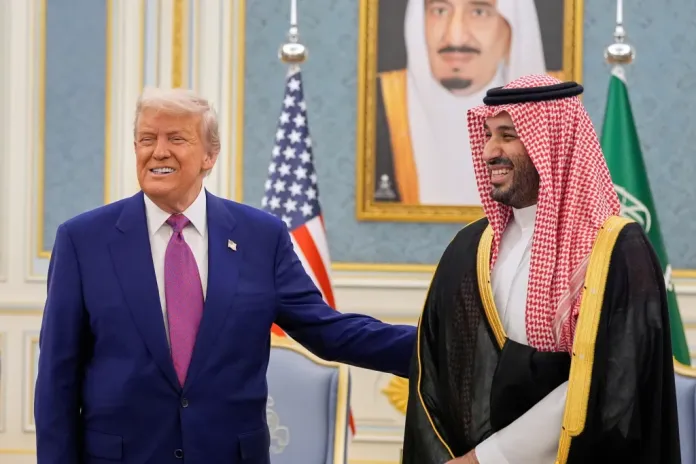
President Donald Trump signed a multibillion-dollar nuclear cooperation agreement with Saudi Arabia on Wednesday, and the deal is currently under review in Congress.
Trump, however, said the U.S.-Saudi nuclear cooperation deal hinges on whether Saudi Arabia joins the Abraham Accords.
The Trump administration has placed a strong emphasis on the Abraham Accords, with Trump “mandatorily requesting” multiple Arab nations to join the Accords as a means of negotiating the war in Iran.
So what exactly are the Abraham Accords?
When were the Abraham Accords developed?
The Abraham Accords were signed at the White House in a signing ceremony on Sept. 15, 2020, during the first Trump administration.
The stated purpose of the Abraham Accords is to increase diplomatic relations among Israel and other Middle Eastern countries.
“The best way to address challenges is through cooperation and dialogue,” it reads. “Developing friendly relations among States advances the interests of lasting peace in the Middle East and around the world.”
Arab countries that sign the accord must recognize Israel as a sovereign state.
The series of diplomatic relations is strategically named after Abraham, a biblical patriarch considered a significant religious figure in all three of the major theistic world religions: Islam, Christianity, and Judaism.
“We, the undersigned, recognize the importance of maintaining and strengthening peace in the Middle East and around the world based on mutual understanding and coexistence, as well as respect for human dignity and freedom, including religious freedom,” reads the declaration’s opening lines. “We encourage efforts to promote interfaith and intercultural dialogue to advance a culture of peace among the three Abrahamic religions and all humanity.”
The Abraham Accords declaration was signed by Bahrain, the United Arab Emirates, and Morocco in 2020. Sudan also signed the normalization agreement, although the country has stalled in finalizing a bilateral agreement with Israel.
Kazakhstan became the first post-Soviet state to join the agreement, signing the declaration in November of last year.
Who is the architect behind the Abraham Accords?
Jared Kushner, Trump’s son-in-law who serves as the U.S. Special Envoy for Peace, is credited as the chief U.S. architect and negotiator behind the accords.
Ahmed Chari, who serves as a board member of the Atlantic Council, a think tank supportive of NATO and U.S. presence abroad, said the Abraham Accords provide sound strategic incentives and mutual gains, arguing the Accords envision the destruction of Hamas while neutralizing violent political structures.
“Future generations will judge us not by how loudly we denounced what was wrong, but by how creatively and ruthlessly we stripped power from those who refuse peace and then built structures that made peace permanent. I believe Jared Kushner helped plant the first trees,” said Chari in an op-ed published by the Jerusalem Post last year.
Kushner has close ties to Saudi Arabia. His investment company, Affinity Partners, has received nearly $2 billion in investments from the Saudi government alone, reports Reuters, and Kushner has maintained close diplomatic ties with the Saudi crown prince, Mohammed bin Salman.
How popular are the Abraham Accords?
The popularity of the Abraham Accords is heavily divided. U.S. and Israeli officials have a highly favorable view of the agreement, whereas the accords are viewed unfavorably by many Arabs.
The Abraham Accords Peace Institute, whose organization was later dissolved into the Heritage Foundation, admitted that the Accords remain deeply unpopular among most Arabs.
“It appears that there is a sense among parts of the population that the Accords have not directly benefited them,” said Asher Fredman, Israel’s director for the Abraham Accords.
TRUMP VOWS IRAN WILL ‘PAY’ FOR KILLING US TROOPS. WHAT COMES NEXT?
Imad Harb, who focuses on Middle Eastern geopolitics and U.S.-Arab relations, argued that the Abraham Accords have utterly failed to achieve peace.
“None of these deals changed the situation on the ground in the Middle East’s hotspots, particularly in Palestine,” Harb said in an op-ed published by Al Jazeera in 2021.
Continue reading...
[ H/T Washington Examiner ]