



President Trump says the United States is “all set” for a new attack on Iran—one he described as bigger than anything Washington has unleashed against the regime before.
No final order is public.
The military is ready, the pressure is climbing, and the decision now appears close.
This is no vague warning from a campaign stage. It comes while American forces are already striking Iranian targets, enforcing a naval blockade and operating across a region where two vital shipping lanes are under threat.
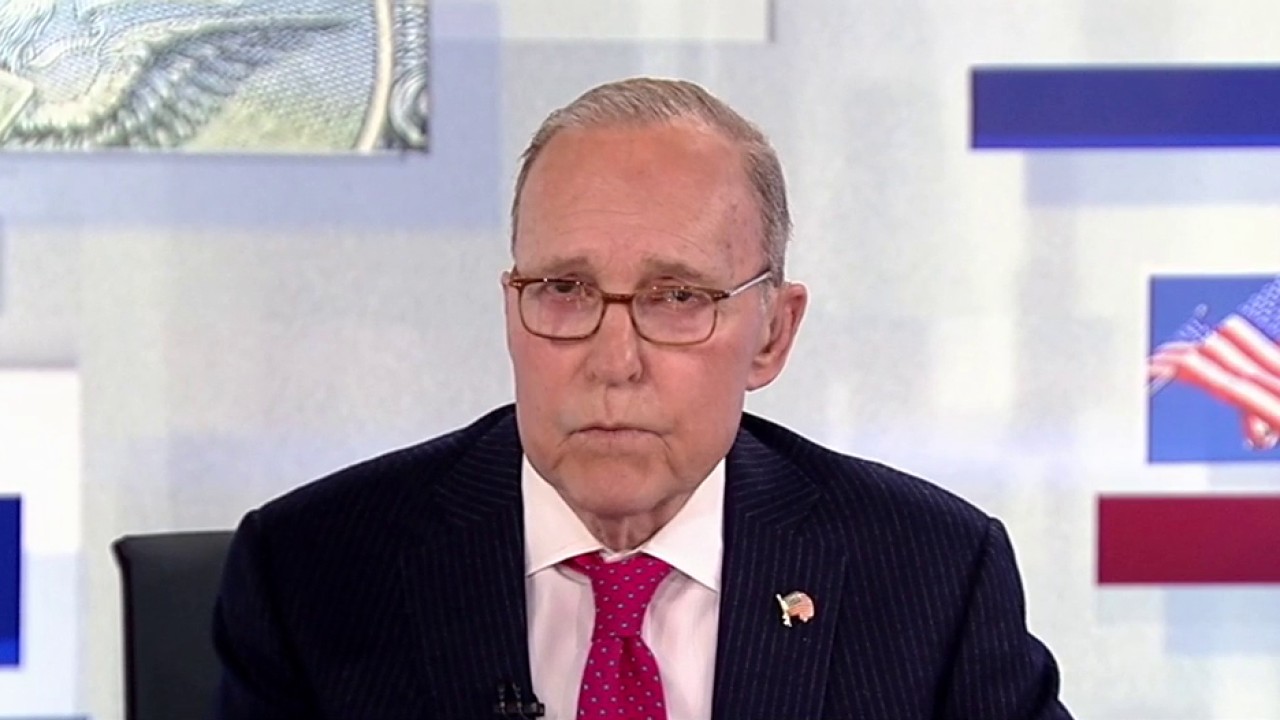
Axios spoke directly with President Trump on Thursday as the crisis accelerated. The outlet said he was seriously considering restarting major combat operations, including strikes larger than those carried out during Operation Epic Fury, while acknowledging that no final command had been issued.
The question was not about another routine overnight strike; it concerned a new phase of major combat operations after nearly two weeks of renewed attacks. President Trump answered, “I am considering a massive attack. Bigger than ever before.”
He then said the choice was close and the operational preparation was complete—a critical distinction between military readiness and presidential authorization. He added, “I am close to making a decision. We are all set for it.”
The interview also made the decision status clear. President Trump warned that a new attack would carry consequences and said the choice was still his.
Iran, he said, is asking to negotiate without offering terms Washington will accept. His assessment was that Tehran is not ready for a deal, even as American forces stand prepared for escalation.
That is both a warning and an important line in the sand.
President Trump said the operation is ready. He did not say he had given the order.
Israel would join quickly if asked, according to the president. But he made clear that the United States does not need another country to carry out what is being considered.
That distinction matters. The headline is not that another routine round of strikes may be coming.
The headline is the scale.
President Trump is openly weighing an assault larger than Operation Epic Fury, the campaign that already hammered Iran’s missile forces, air defenses, naval assets and military infrastructure.
And the threat did not emerge in a vacuum.
"They are starting up again… If they do this again, the U.S. will hold Iran responsible, in that the Houthis are a Surrogate and/or Proxy of Iran, and major military punishment will be inflicted upon Iran and, of course, the Houthis, themselves" – President Donald J. Trumppic.twitter.com/aGLaW6C4nw
— The White House (@WhiteHouse) July 23, 2026
Reuters reported that Iran-backed Houthi forces attacked two Saudi oil tankers in the Red Sea, threatening a second major maritime chokepoint as the Strait of Hormuz remained caught in the conflict.
The attacks put the Bab el-Mandeb route at risk and sent Brent crude above $100 per barrel. Ships had already begun changing course rather than gamble on the passage, adding time, cost and danger to global trade.
President Trump answered by warning that another Houthi attack would trigger “major military punishment” against both the group and Iran, which he described as the Houthis’ sponsor and proxy master.
Iran, meanwhile, continued striking at American positions and regional countries that host U.S. forces. The conflict was no longer confined to one front or one stretch of water.
The Associated Press reported that roughly 12 percent of global trade passes through the Bab el-Mandeb and the connected Red Sea route. That traffic now faces new uncertainty while the Strait of Hormuz—the route for about one-fifth of the world’s oil and gas in peacetime—remains under pressure.
The Houthis said they struck the Encelia and the Layla, setting fires on both tankers. Saudi authorities confirmed that the Encelia was hit, while there were no reported casualties from the attacks.
Bab el-Mandeb connects the Red Sea to the Gulf of Aden and the Indian Ocean. A sustained threat there would squeeze the alternate route Saudi Arabia has been using while Gulf shipping remains disrupted.
The economic threat is immediate. So is the military response.
American forces have carried out strikes on Iran for 12 consecutive nights, targeting systems used to threaten civilian mariners and commercial shipping. Iran has answered with missiles and drones across the region.
Every exchange raises the price of the next one.
U.S. Central Command said the latest completed round struck Iranian maritime capabilities, missile and drone storage facilities, coastal surveillance sites and air-defense assets.
CENTCOM described it as the twelfth consecutive night of attacks. The command also said American forces had resumed a naval blockade, targeted dozens of military sites on land and positioned more than 50,000 U.S. service members across the Middle East.
The July 22 operation ended at 10:30 p.m. Eastern time after American forces hit military targets tied to Iran’s ability to threaten commercial vessels. The target set covered both offensive weapons and the systems used to find and defend them.
By Thursday, the blockade had redirected 12 commercial vessels and disabled one to stop traffic into or out of Iranian ports and coastal areas.
That is the force already in motion before the larger decision.
The new option President Trump is considering would not begin from zero. It would be layered on top of active strikes, a naval blockade, regional deployments and months of combat operations.
The White House described Operation Epic Fury as a broad campaign against Iran’s ballistic-missile arsenal, naval forces, terrorist-proxy network and nuclear ambitions. Its stated goals included destroying missile production, eliminating the regime’s navy, severing support for terror proxies and blocking every path to a nuclear weapon.
The opening attacks reached deep into Iran and hit command-and-control facilities, air defenses, missile and drone launch sites and military airfields. The campaign combined long-range airpower, naval operations and regional forces against a target system built over decades.
That was the benchmark President Trump invoked when he said the next option would be “bigger than ever before.” He is not comparing it with a pinprick response; he is comparing it with a campaign designed to cripple multiple pillars of Iranian military power at once.
President Trump is now talking about something bigger.
That does not reveal the target list, the weapons package or the hour. No responsible account can claim those details before the commander in chief announces them.
“All set” means the planning is no longer theoretical.
The aircraft, ships, intelligence, logistics and personnel required for a major operation do not appear overnight. The visible posture shows that the United States already has enormous combat power in place.
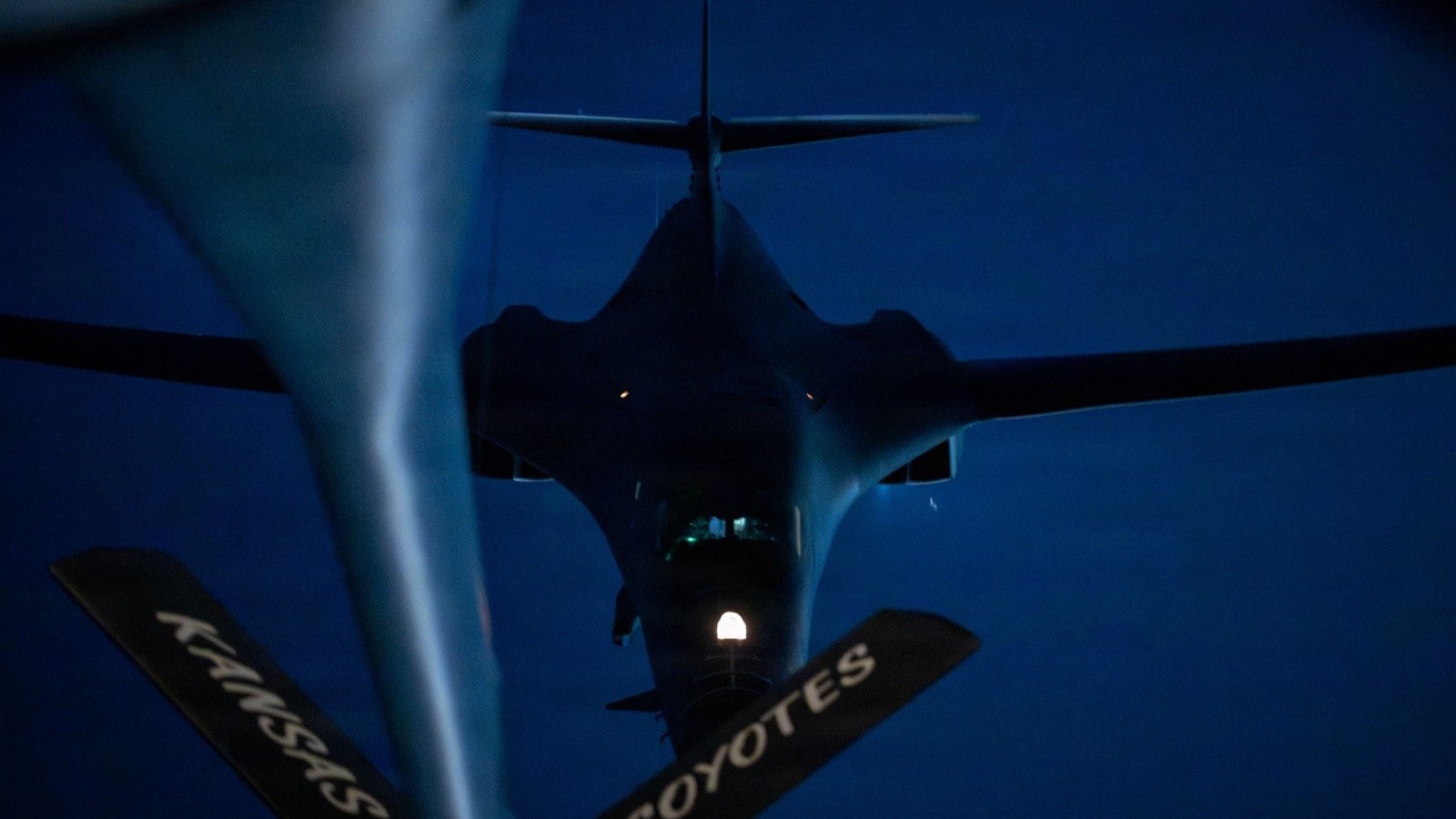
Official military imagery documented B-1B Lancers flying nighttime missions during Operation Epic Fury, including aerial refueling that extended the bombers’ reach.
The U.S. Air Force says the B-1B carries the largest conventional payload of guided and unguided weapons in its inventory. The long-range bomber is designed to deliver large quantities of precision and non-precision weapons across enormous distances.
Its variable-sweep wings, speed, radar targeting and long loiter time allow it to work inside mixed strike packages. Aerial refueling extends that reach even farther.
The official fact sheet lists loads of up to 24 2,000-pound joint direct attack munitions or 24 long-range air-to-surface missiles. That is one aircraft in an operation that would also draw on fighters, drones, warships and intelligence assets.
The B-1B’s role during Epic Fury shows what “all set” can look like in practice: long-range crews, tanker support, precision weapons and a target package assembled before the public sees the first launch.
That history gives weight to the phrase “bigger than ever before.”
It also gives Iran one last reason to reconsider.
President Trump has often used overwhelming pressure to force an adversary toward a deal. Tehran may decide that this is another negotiating hammer.
That would be a dangerous gamble.
The president says Iran has not absorbed enough pain to accept terms. The Houthis have now expanded the threat to another shipping lane.
American forces are still being targeted, and oil has crossed a politically and economically dangerous threshold.
Any one of those facts would be serious.
Together, they explain why the next decision may be the largest one yet.
President Trump has put Iran on notice.
The force is ready. The scale is unprecedented.
The final order is the only piece still missing.
Continue reading...
[ H/T WLT Report ]