




During World War II, Winston Churchill observed that “truth is so precious that she should always be attended by a bodyguard of lies.” In Sudan, years of disinformation have obscured a central reality: The Muslim Brotherhood played a decisive role in igniting the country’s war. Yet an even more consequential truth deserves greater attention.
The Muslim Brotherhood’s project in Sudan is not merely a domestic struggle for power. It is an Islamist project that strategically converges with Iran’s regional ambitions, reinforcing its efforts to expand its influence across the Red Sea and Africa.
For Tehran, Sudan is strategically invaluable. It offers access to Africa, over 500 miles of Red Sea coastline, and a position that would help connect Iran’s network stretching from Iraq, Lebanon, to the Houthis in Yemen. Recent Iranian threats to disrupt both the Strait of Hormuz and Bab el-Mandeb illustrate how control over strategic waterways can become geopolitical leverage. An allied Islamist movement controlling Sudan would significantly strengthen that strategy.
Sudan’s importance extends beyond geography. It sits at the crossroads of the Horn of Africa, the Middle East, and the Sahel, with major gold reserves, critical minerals, and vast agricultural potential. Yet since war erupted in April 2023, the country has descended into one of the world’s worst humanitarian disasters, with tens of thousands killed and millions displaced.
The conflict is often portrayed simply as a struggle between two rival generals. That explanation overlooks Sudan’s deeper political crisis. After ruling for three decades, the Muslim Brotherhood captured the state, leaving its institutions deeply intertwined with Iran and transnational Islamist networks while systematically preventing the emergence of an inclusive national order.
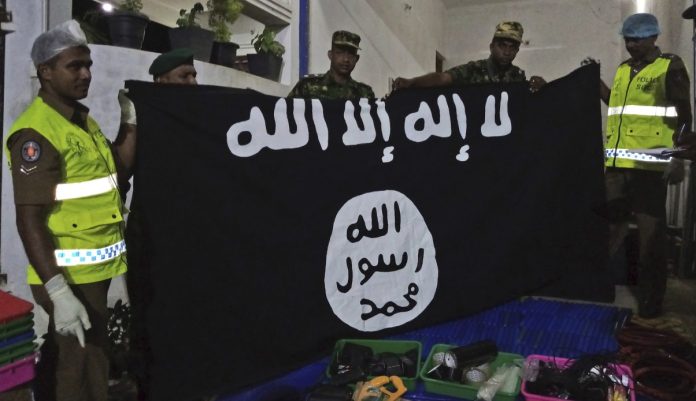
The partnership between Tehran and Sudan’s Islamists dates to the 1980s, when they forged strategic ties after Iran’s Islamic Revolution. After seizing power in 1989, Sudan’s Islamists reshaped the country’s security institutions along Iranian lines, deepening military and intelligence cooperation with Tehran. Sudan also became a hub for international Islamist networks, hosting Osama bin Laden in the 1990s. This environment contributed to Sudan’s designation as a U.S. state sponsor of terrorism and became part of the ecosystem that enabled major terrorist attacks against the United States, including the bombings of the U.S. embassies in Kenya and Tanzania, the attack on the USS Cole, and ultimately the 9/11 attacks.
The 2019 revolution marked a decisive break with that trajectory. Sudan’s civilian-led transitional government pursued democratic and economic reforms, distanced the country from its Islamist past, restored ties with the U.S., and joined the Abraham Accords.
The October 2021 coup by the SAF and RSF reversed that progress and restored Islamist influence within the state. Since the war began in April 2023, that influence has expanded across institutions under the authorities controlled by the SAF, while ties with Iran have rapidly recovered.
Evidence suggests those ties are no longer merely diplomatic. In April, U.S. authorities charged Iranian national Shamim Mafi with brokering more than $70 million in Iranian arms sales to SAF, including Mohajer-6 drones, bomb fuses, and other weapons linked to the Islamic Revolutionary Guard Corps.
A June study by Century International and the XCEPT research program concluded that Iran rebuilt its partnership with the SAF through Islamist networks, supplying Mohajer-6 drones and supporting local drone production. The report warns that Sudan could become a logistics hub for Iran’s regional drone network while these factions benefit from operating through internationally recognized state institutions.
The report assumes that Sudan’s Islamist networks can be pulled away from Iran by offering them alternative partnerships. Four decades of history suggest otherwise. Their relationship with Tehran is driven by ideological affinity and shared strategic objectives, not by expediency alone. Changing their external patron would not change the nature of the project. The priority should instead be preventing these networks from consolidating their grip on Sudan’s state institutions.
That makes any move by some international actors to normalize General Burhan’s authority strategically risky. The critical question is whether the international community is prepared to accept a state dominated by a movement designated by the U.S. as a terrorist organization, closely linked to Iran’s Revolutionary Guard, and facing credible allegations of using chemical weapons against civilians — all while controlling one of the world’s most strategic maritime corridors.
Sudan still has another path. The framework already exists. The September 2025 roadmap agreed by the Quad — the U.S., UAE, Saudi Arabia, and Egypt — recognizes that there is no military solution and calls for an immediate humanitarian ceasefire followed by an inclusive, civilian-led political transition free from domination by either warring party and excluding extremist movements. Both sides have committed war crimes and grave abuses against civilians. International diplomacy should instead apply coordinated pressure on all parties to pursue that roadmap rather than legitimizing military rule.
HE LIVES IN HIDING IN SAUDI ARABIA — AND TRUMP STILL CALLS HIM YEMEN’S PRESIDENT
For the U.S., the stakes are strategic. President Donald Trump supported Sudan’s civilian-led transition by removing Sudan from the U.S. State Sponsors of Terrorism list and restoring its international standing. The 2021 coup and the war that followed reversed those gains. Sudan remains unfinished business for Trump. Helping restore a civilian-led democratic transition would not only address the world’s largest humanitarian crisis but also deny Iran another strategic foothold on the Red Sea.
The lesson from the Middle East’s conflicts is clear: When ideological movements capture the state, local wars become regional threats. Sudan is next unless the world acts now.
Khalid Omer Yousif is a Sudanese political leader and former Minister of Cabinet Affairs in Sudan’s civilian-led transitional government (2019–2021). A longtime advocate for democracy, peace, and civilian rule, he has opposed Sudan’s Islamist regime since his student activism in the late 1990s. He played a leading role in the 2018-19 revolution, helped negotiate Sudan’s democratic transition, and has remained active in efforts to end the current war through a civilian-led political process. He writes and speaks regularly on Sudan, regional security, and countering extremist movements.
Continue reading...
[ H/T Washington Examiner ]