





Please note that SCOTUS Outside Opinions constitute the views of outside contributors and do not necessarily reflect the opinions of SCOTUSblog or its staff.
By my count, the 58 oral arguments of October Term 2025 resulted in 5,095 questions from the justices. What kind of questions did they ask? Are there patterns of what questions a certain justice poses? Can an advocate know beforehand who will ask what?
***
I’ve been interested in the dynamics of oral argument since law school. My professor, Richard Lazarus, taught a seminar that included watching oral advocates prepare, and we would then attend a Supreme Court argument. We sat in on Paul Clement’s moot in a complex and (to all but lovers of administrative law) rather boring case about the Federal Energy Regulatory Commission. I remember Lazarus telling us: “The chief is going to ask about the limiting principle. He always wants to know – what’s your limiting principle?”
The next day we walked under the towering marble pillars and took our seats in the gallery. Solicitor General Don Verrilli rose, and the chief justice’s second question arrived right on schedule: “t’s just as obvious, it seems to me, that you have to have some sort of limiting principle, otherwise FERC can do whatever it wants. So what is the limiting principle that you would suggest to us?”
Since then, I’ve wanted to know if data backs our intuitions up. SCOTUSblog’s Adam Feldman has applied quantitative methods to track who votes with whom and who speaks the most during oral argument. But no one, as far as I know, has systematically tagged and analyzed every question over the course of a term in order to understand each justice’s style. So I built a taxonomy of question purpose, technique, and tone and applied it to those 5,095 questions.
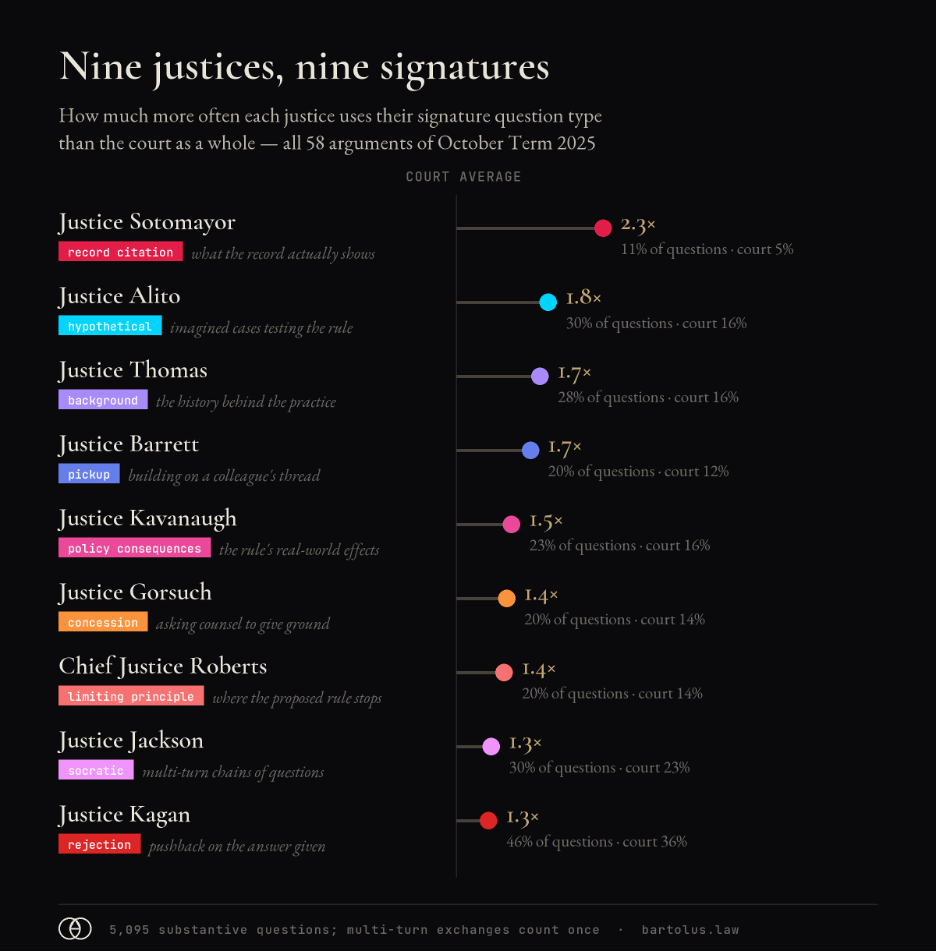
Below is the “distinctive” question for each justice, along with a representative example of each – verbatim from the transcript, shown with its tags exactly as they appear in my database.
Chief Justice John Roberts: the limiting principle
The chief asked the fewest questions on the court — 208 this term, against Justice Sonia Sotomayor’s 901. When Roberts does lean in, Lazarus’ prediction still holds a decade later: one in five of his questions tests a limiting principle. The limiting principle question probes the line where the advocate’s proposed rule stops. Judges care about the limiting principle because it looks beyond the case before the court to the next 50 cases that will be decided under the same rule – in other words, the chief’s questions are often most focused on the long-term consequences, not just on the immediate dispute before him.
In Chatrie v. United States, for example, the government defended geofence warrants, which identify every phone near a crime scene. The chief wanted the limit that would prevent the government from using this technique to become Big Brother:
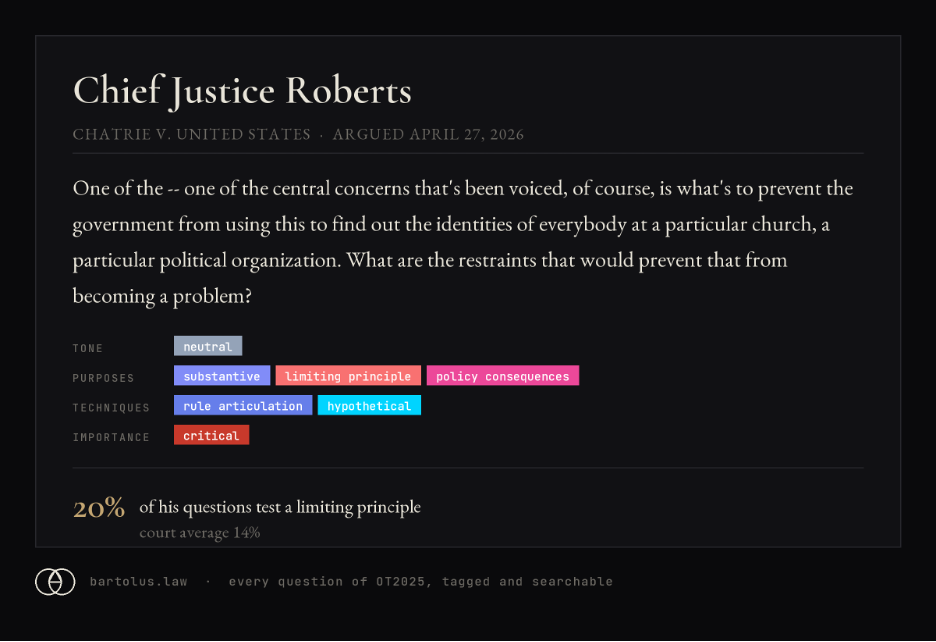
The chief doesn’t seem to have been persuaded by the government’s answer (that there are statutory guardrails, and the Constitution does not provide “categorical protection around something like a church”) – he sided with the 5-4 majority narrowly holding that the government’s actions constituted a search.
Justice Clarence Thomas: background
On a court where originalism is in style, Thomas perhaps stands out most for his focus on history. Given this, it is perhaps unsurprising that he asked the most questions about the factual and legal background of the cases. Twenty-eight percent of his questions concerned this, nearly double the court average and the highest share on the court. He is also the least active questioner among the associate justices: his 350 questions were significantly lower than the next closest justice (Justice Elena Kagan at 485).
In United States v. Hemani, which asked whether Congress may disarm drug users, Thomas reached back to the founding-era statute books. He wanted background specifics to know if one type of historical practice (disarming “habitual drunkards”) was similar to disarming drug users like Hemani today, and could thus be justified through the lens of originalism:
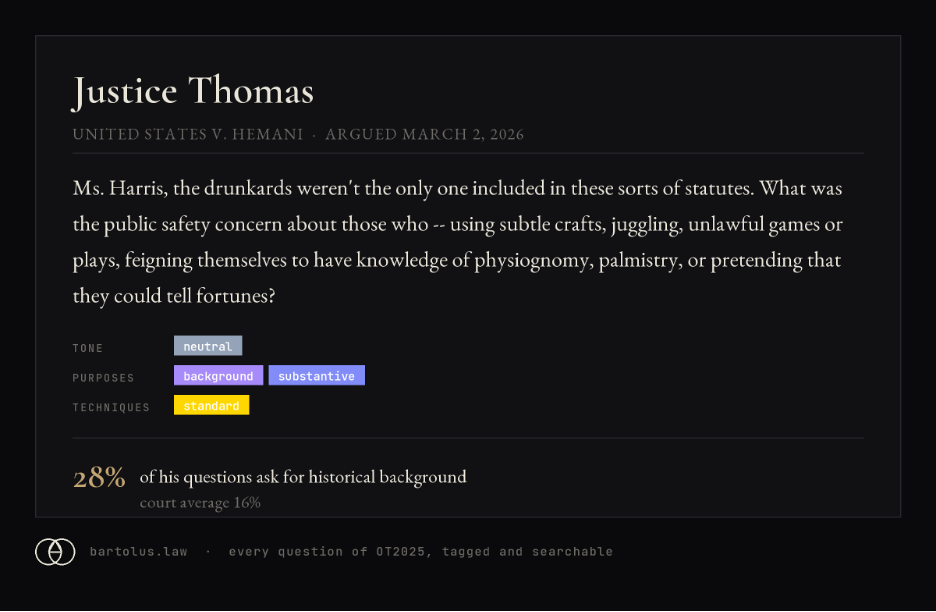
Although the government did its best to paint such laws as analogous, it did not succeed. All nine justices found a Second Amendment violation.
Justice Samuel Alito: hypotheticals
The hypothetical is probably the question type most associated with oral argument and law school moot courts. It’s also famously part of the “Socratic Method” used in first year classrooms. But it’s the former prosecutor, not the former law professors, who most favors the hypothetical. Roughly 30% of Alito’s questions posed a hypothetical, nearly double the court average.
In Flowers Foods v. Brock, about which transportation workers are exempt from the Federal Arbitration Act, the petitioner proposed a driver was only engaged in “interstate commerce” if the driver crossed a state line. Alito pushed that rule to its limit:
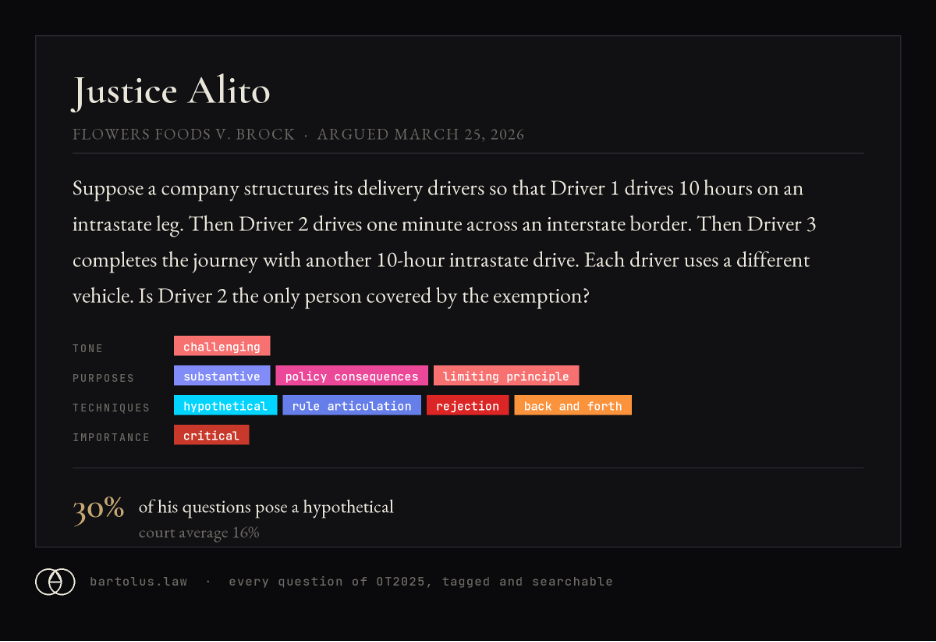
Flowers ended up being one of the “simplest” cases of the term, with a unanimous court deciding the issue in eight pages. The hypothetical Alito posed may help to explain why – the petitioner’s theory came to look silly when applied to a tough set of facts.
Justice Sonia Sotomayor: record citation
Sotomayor asked more questions than anyone – 901 this term, nearly one of every five questions asked. Her questioning is often concrete: she cites the record, or asks for record citations, at 2.3 times the court average. (This may not be surprising coming from a former district court judge.) These questions ask the advocate to point to specific evidence or documents in the record. It is perhaps the most demanding type of questioning of an attorney, as it requires recall of often thousands of pages by the time the case reaches the Supreme Court.
For example, in Pitchford v. Cain, a death penalty case challenging the racial composition of a jury, Sotomayor challenged the advocate for the state to point to specific statements from the district court or parties:
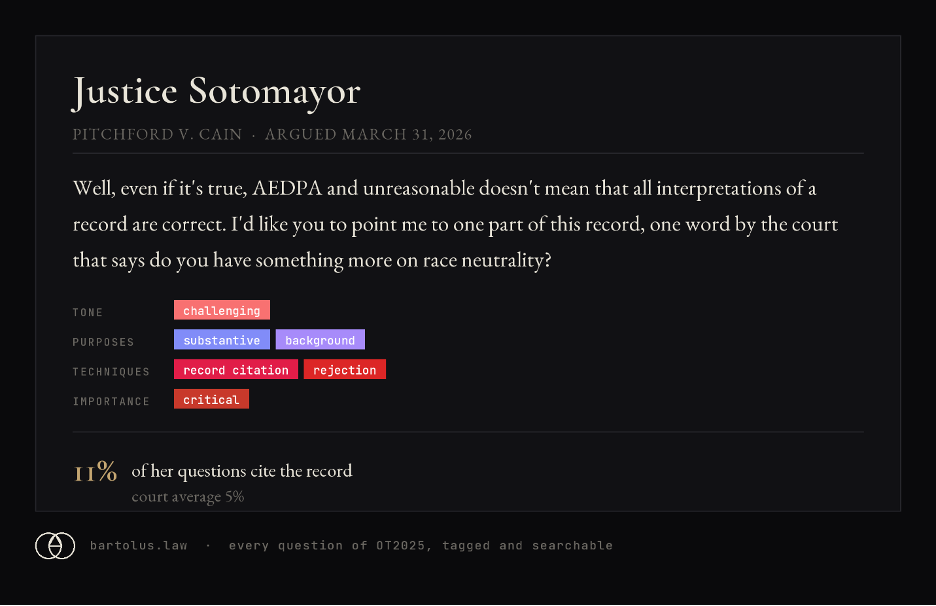
The record was central to the court’s reasoning in Pitchford: the opinion relied on the trial court acknowledging that the defendant preserved a Batson challenge (a claim that jurors were illegally excluded based on their race), and the court concluded that the state’s argument that Pitchford waived the challenge was “not a reasonable reading of this record.”
Justice Elena Kagan: rejection
Kagan’s signature is the rejection. When an attorney delivers an unsatisfying answer, Kagan lets him or her know. Forty-six percent of her questions pushed back on the advocate’s answer or reasoning – by far the highest share on the court. In a rejection, a justice tells the attorney that the answer wasn’t good enough. It’s one way that oral argument reveals how a justice sees the case – it’s unlikely that a justice will sign on to an opinion that adopts reasoning she’s already rejected in court.
In Wolford v. Lopez, Hawaii defended its limits on carrying firearms onto private property. Kagan rejected how the United States, as a “friend of the court” supporting the plaintiffs, described the “history and tradition” analysis for Second Amendment cases. This test differs from “means-ends scrutiny,” where a court identifies the government interest a law serves, and how well the law is tailored to further that interest:
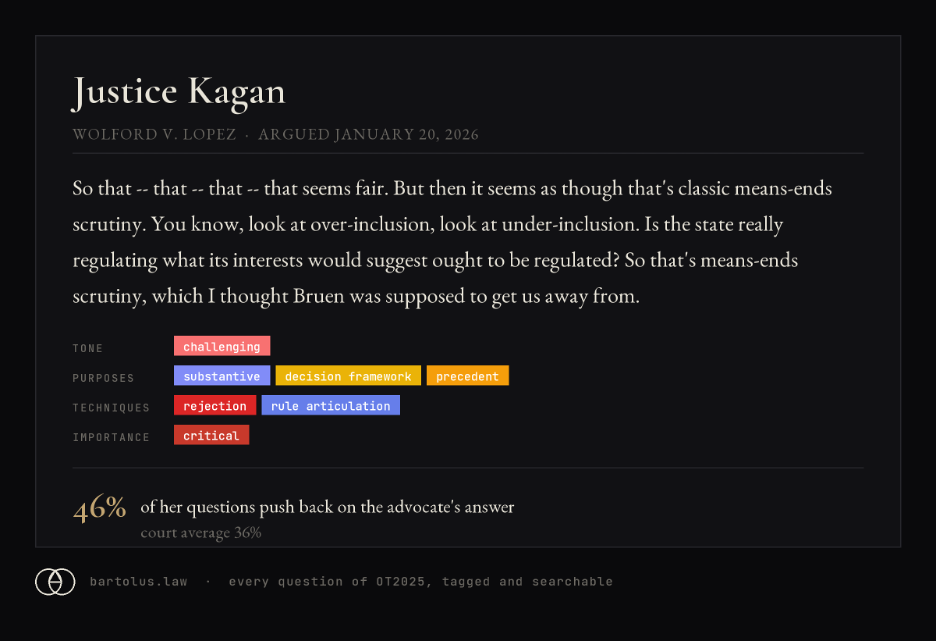
Kagan dissented in Wolford, and her two-page opinion shows that she meant it when she said Bruen means no “means-ends scrutiny” for gun cases. She considered founding era laws to be sufficient analogues because the historical examples were, in her view, close enough to the challenged Hawaii law to comply with the Constitution.
Justice Neil Gorsuch: concession
Justice Gorsuch hunts for concessions. The concession is another major aspect of oral argument – an attorney can provide an answer that binds the client. Sometimes, an attorney will even abandon an argument made in the briefing. One in five of Gorsuch’s questions asks the advocate to give ground – a fact, a premise, an implication of their own theory – the highest share on the court.
In Landor v. Louisiana Department of Corrections, on whether state prison officials may be sued for damages under the Religious Land Use and Institutionalized Persons Act, he stated the implication of the plaintiff’s position and invited her to own it:
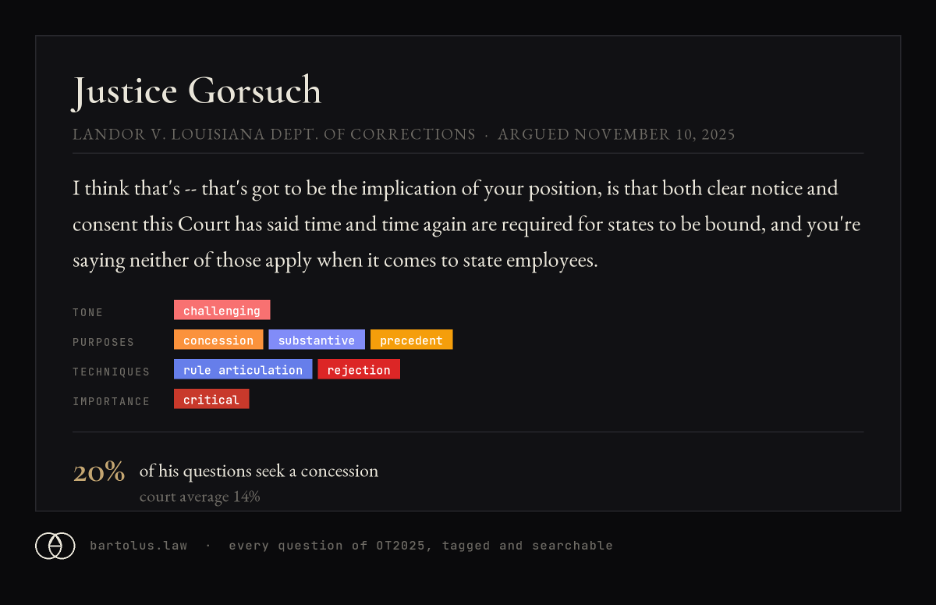
Gorsuch wrote the 6-3 majority opinion in Landor, and unsurprisingly, consent and notice were center stage: the court sided against the prisoner, writing that he “does not allege that any of those individuals has entered any agreement with the federal government, let alone that any of them has voluntarily and knowingly consented to answer private suits under RLUIPA.”
Justice Brett Kavanaugh: practical consequences
Kavanaugh is perhaps the most pragmatic of the justices at oral argument: he wants to know how the court’s decisions will affect the country. Twenty-three percent of his questions weigh practical consequences – what the proposed rule will do in the real world – 50% higher than the court average. (He also cites amicus briefs at 3.3 times the court average, the largest single deviation in the dataset; if your association filed a brief, you can assume Kavanaugh read it.). Kavanaugh wants to understand the effects of deciding the case a certain way and seems to want the public to understand it as well.
Perhaps nowhere was that approach clearer than in Trump v. Cook, on the president’s power to remove a Federal Reserve governor:
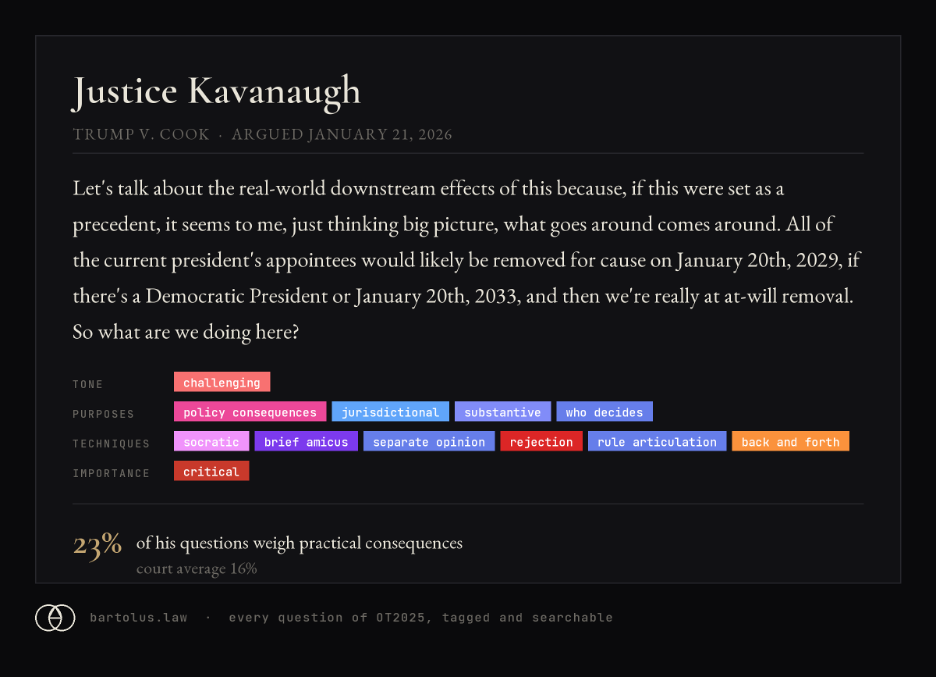
Here, the consequences weren’t just how a rule would affect the economy, but how the rule would affect the political system and relations between the parties. Kavanaugh voiced those concerns in his short concurrence to the 5-4 majority, explaining that he wanted to avoid even “temporary uncertainty about the status of the Federal Reserve [that] could spark political upheaval.”
Justice Amy Coney Barrett: pickup
Barrett is the most likely to refer to other justices’ questions. One in five of her questions picks up a thread another justice started – the highest share on the court, two-thirds more often than average. She returns to the answer the advocate gave Justice Ketanji Brown Jackson or extends Gorsuch’s hypothetical. If there’s an unfinished answer, Barrett is the most likely to return to it and see it to completion.
In Hain Celestial v. Palmquist, about a potential jurisdictional defect in removing a case to federal court, she waved off her own line of questioning to reopen a colleague’s:
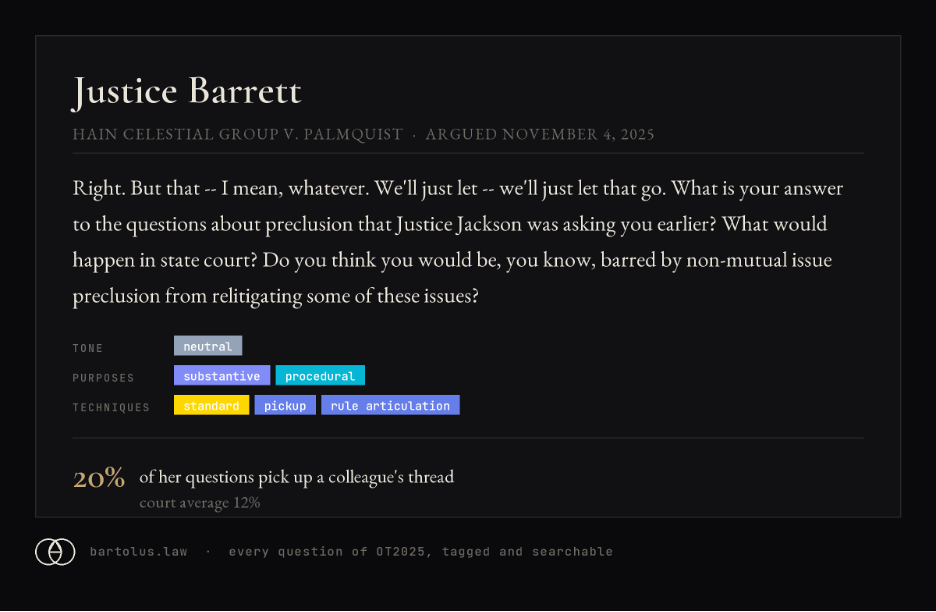
Now that oral argument allows for the untimed seriatim (justice-by-justice) questioning at the end of an advocate’s time, there’s nowhere to hide if an answer is incomplete or unsatisfying. And Barrett is the most likely to bring it back.
Justice Jackson: Socratic
Jackson’s questioning often proceeds through multi-step chains. Thirty percent of her questions arrive as multi-turn Socratic sequences — the highest share on the court — each answer feeding the next question until the advocate has walked the full path she laid. The Socratic approach asks the advocate to accept a premise and then tests whether the attorney can follow that premise to a defensible conclusion. (She also has a signature phrase – “can I invite you” – a gracious invitation that is not entirely optional.)
In Louisiana v. Callais, about the role of race in redistricting under the Voting Rights Act, Jackson deployed that Socratic approach:
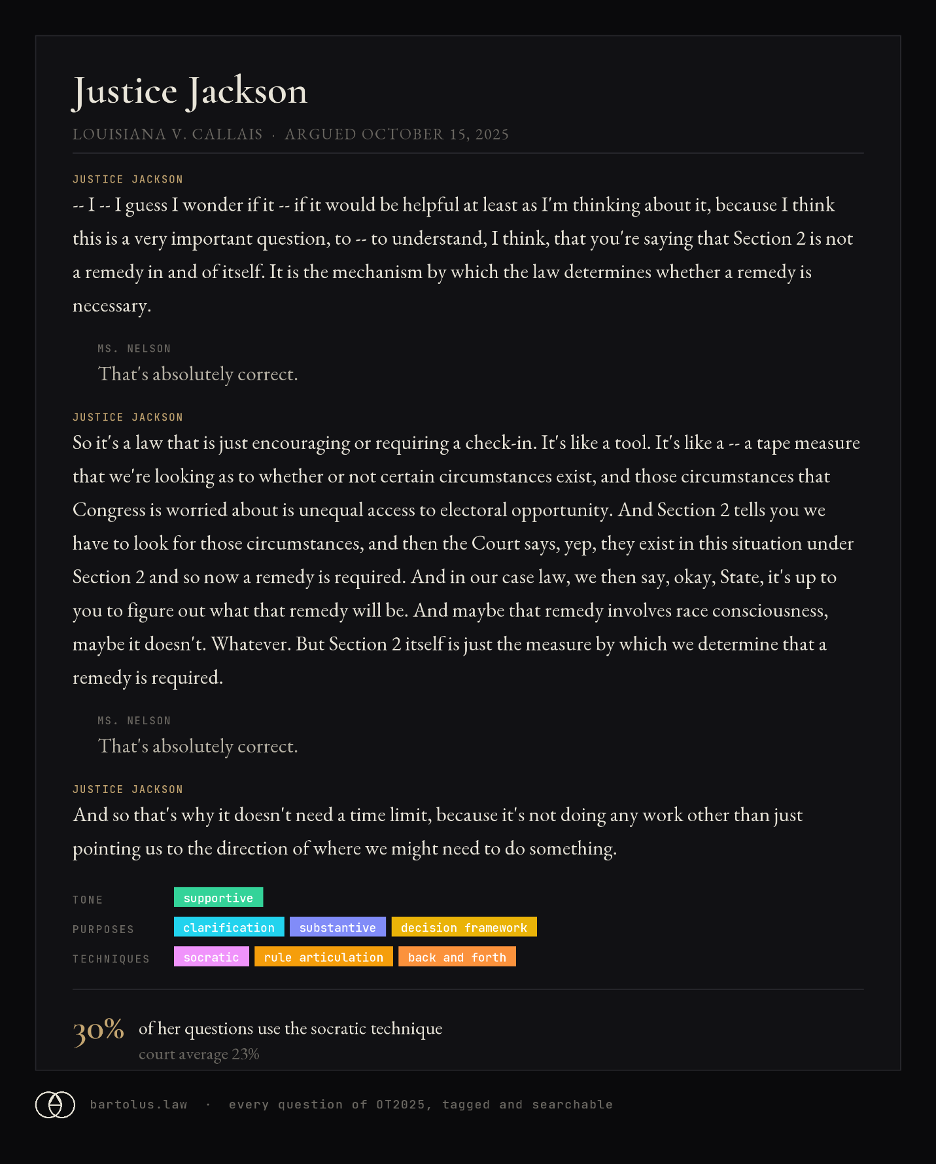
The theory of Section 2 that Jackson was exploring in this back and forth – that it is merely a method for detecting violations and not an independent remedy – resurfaced in Kagan’s dissent.
What does it all tell us?
First, the intuitions of experienced advocates are real: justices (and lower court judges) have patterns in their questioning, and those patterns can be measured. An advocate can expect Roberts to test where a proposed rule stops, Thomas to probe the historical and legal background, Alito to stress-test a rule with hypotheticals, and Sotomayor to demand command of the record. Kavanaugh asks what a rule will do in the real world, while Gorsuch presses for concessions that may narrow or bind a party’s position.
Other justices reveal their priorities through the structure of their questions. Kagan is the most likely to reject an answer outright; Barrett returns to unfinished exchanges and develops questions begun by her colleagues; and Jackson builds multi-step sequences that aim to lead an advocate from a premise toward its legal conclusion. An attorney aiming for a certain justice to “count to five” votes would do well to prepare accordingly.
For more casual court watchers – like many readers of SCOTUSblog – this data can make oral argument even more fascinating. You can appreciate the “signature moves” of each justice, like you do a Patrick Mahomes sidearm pass or a Steph Curry logo three. And you can tell when you encounter a real outlier of a question - Roberts, Kagan, and Barrett, for example, almost never pose questions in a “supportive” tone.
Ultimately, whether one is a court specialist or member of the general public, understanding how oral argument works helps to understand how the court works. Oral argument (besides the opinion itself) is the most public aspect of this body. To return to where we began: Knowing why a justice asks about the limiting principle helps you understand how the court fashions a holding.
Continue reading...
[ H/T SCOTUSblog ]