






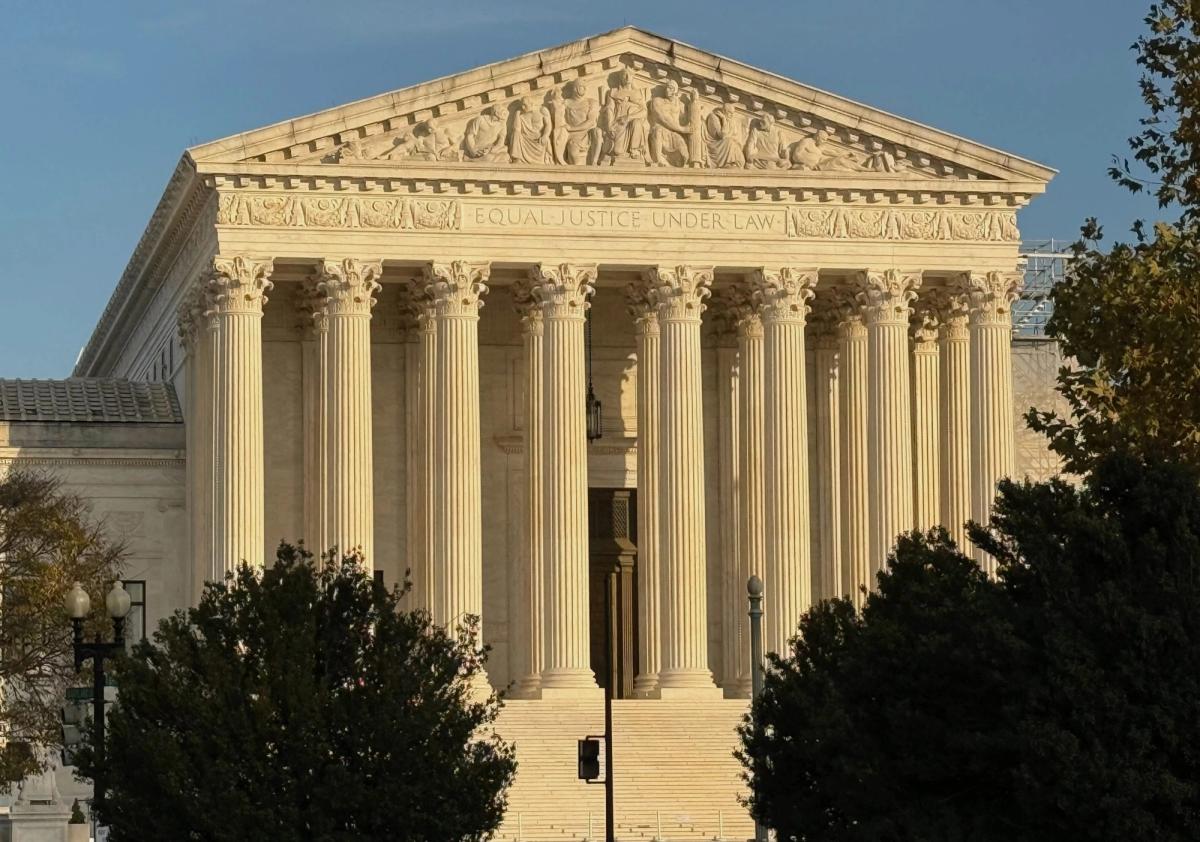
This publication has been inundated with essays by academics critical of Louisiana v. Callais, but has not published a single one in defense of it. So I decided to take it on in my column. After all, I am pretty sure Justice Antonin Scalia would have approved of the decision.
As you will see, I didn’t find the assignment particularly difficult. Which raises a question: why has no one else been willing to defend a 6-3 decision of the Supreme Court? I will tell you the answer with a short story.
When I was thinking about becoming a law professor – I am sorry to say this was something like a quarter century ago now – I went to go see one of my favorite former law professors, Elena Kagan, for advice. She was then the dean at Harvard Law School, but I had known her merely as my Administrative Law professor. She asked me what field I wanted to pursue and I told her race discrimination law. It was the reason I went to law school to begin with. It was what I had written my law school thesis on.
Her response: don’t do it. She explained that, in order to get a job as a race discrimination scholar at any school, I would have to win over the other scholars at that school who worked in that area. Kagan said that at every school the scholars who worked in that area all supported racial preferences. The problem was that I was against racial preferences. She said for that reason alone no one in the field would support hiring me. She told me to choose something else.
So I did. I decided to pursue class action litigation instead. It’s been a perfectly pleasant career. But it also explains why the academy is monolithic – and, frankly, untrustworthy – on race issues: you aren’t allowed to specialize in these issues unless you toe the party line. Today, we call this “ideological capture” of the academy. I think it’s a pretty sad state of affairs and I am not the only one.
The question in Callais was whether Section 2 of the Voting Rights Act could require Louisiana to consider skin color when it drew its voting districts in order to make sure that black voters could elect enough “representatives of their choice.” But the equal protection clause says racial discrimination is almost always illegal – it has to overcome “strict scrutiny” to be legal – and assigning voters to one district or another because of their skin color is racial discrimination. Thus, it is hard to see how Congress could require it. Unsurprisingly, that’s exactly what the court said: we will not interpret Section 2 of the VRA to go beyond what the Constitution allows.
The reason this is a nonstarter in the academy is because academics do not believe that racial discrimination is almost always illegal. Rather, the academy has coalesced around something called the “anti-subordination” view of the equal protection clause: it is not so much about combating discrimination as it is about combating subordination. Thus, racial discrimination to help racial groups that have been historically subordinated is perfectly fine, including discrimination to help black voters.
Anti-subordination may be a perfectly fine theory – although, I admit I am not sure what is supposed to happen when the discrimination to help one historically subordinated group hurts another historically subordinated group, as racial preference programs sometimes do to Asians – but the theory has been rejected by the Supreme Court every single time it has been presented to it, beginning all the way back in 1880. Rather, the court has always said the equal protection clause protects all races, well, equally. For this reason, no one thought the court in Callais was going to say that discrimination to help black voters is not the kind of racial discrimination that must pass strict scrutiny. Rather, the battle was whether the discrimination could pass that scrutiny – i.e., did Congress have a “compelling interest” to require states to consider skin color?
What might such a compelling interest be? The answer: to avoid leaving black voters in control of too small a share of voting districts compared to their share of the state population. Congress didn’t quite have the numbers to outright require “proportional representation” of the races, so, as it often does, it compromised with a muddled provision that tried to compel the gist of it instead. Hence, we might call the compelling interest here “proportionalish representation” rather than “proportional representation.”
But achieving proportional representation of the races has never been thought to be a compelling interest, so why would achieving proportionalish representation be one? Indeed, the court has a special term for this sort of thing: “racial balancing.” Even before Students for Fair Admission v. Harvard, where the court found racial preferences at Harvard and the University of North Carolina to be illegal, racial balancing was a big no-no in university admissions. It has been a big no-no in government contracting for just as long. Should voting be different?
It is true that, unlike university admissions and government contracting, the entire point of voting is to achieve something like proportional representation: if your group has more votes, your group should get more representatives. But why is there a compelling need to require proportional representation for racial groups at the expense of every other group (e.g., farmers, city folk, young people, old people, Republicans, Democrats, etc.)? After all, race is supposed to be the most taboo of considerations, not the most routine. A possible answer is the 15th Amendment: it gives Congress extra power to “enforce” the amendment’s prohibition on racial discrimination in voting. Maybe this enables Congress to forbid states from leaving black voters in control of too few districts compared to their percentage of the population? But, as the court explained in Callais, not so if the effect on black voters is not intentional. The 15th Amendment only prohibits intentional racial discrimination, not unintentional racial effects. Thus, Congress’ extra power only goes to combating intentional discrimination, too.
Are there plenty of other things to fault the court for in Callais? Of course; nothing is perfect. Could the court have been clearer? Yes: it is a poorly written opinion. But things are often poorly written when you have to satisfy the individual demands of a group of people. Could the court have been more honest that it was interpreting Section 2 differently than it had in the past? Yes: the court is loath to admit it is overruling precedent even when it is. But that is a general problem, not a Callais problem. Could the originalists have done some originalism? Yes: many originalists, including Clarence Thomas, have questioned the court’s racial discrimination precedents (e.g., why is Congress bound by the equal protection clause at all?) and none of those questions were answered. But the court has only so much bandwidth in any given case and can’t go back to first principles every single time. Is the decision going to lead to some bad consequences? Yes: it toppled one of the last barriers to unfettered partisan gerrymandering and no one – including me – likes that. But expecting laws about racial discrimination to do something about partisan gerrymandering is expecting too much; if we want to get rid of unfettered partisan gerrymandering, we should enact laws against unfettered partisan gerrymandering.
While we are at it, perhaps there is something else we can work on together: undoing the unfettered partisan gerrymandering of the academy.
Continue reading...
[ H/T SCOTUSblog ]