




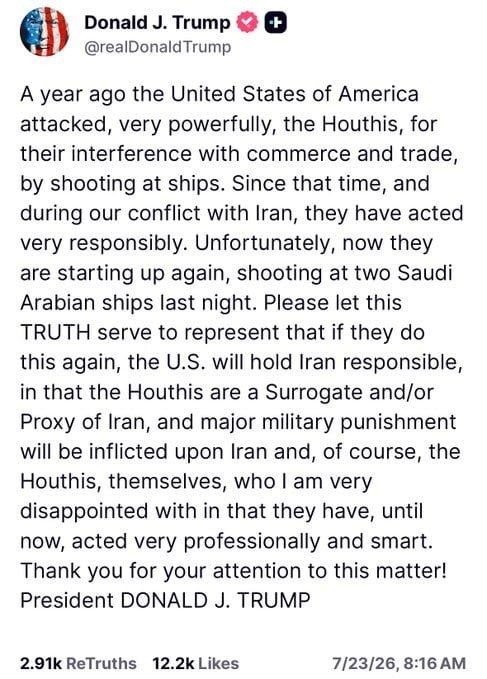


The Los Angeles Times recently published a “News Analysis” headlined: “Trump, long a critic of ‘forever wars,’ may be stumbling into one with Iran.”
The analysis offers legitimate grounds for criticizing President Donald Trump. He has described the objectives of the war against Iran in different ways. He has made changing predictions about its duration. He has repeatedly suggested that an agreement was near, only for negotiations to collapse. He promised no more endless Middle East wars, yet the conflict has continued for months, American servicemembers have died, and the administration has not clearly defined what victory looks like.
All fair questions. But the article omits the most important question of all: Why did the war begin?
Similarly, recent analyses in Time, The Washington Post and Politico raise many of the same objections. Yet, here, too, none addresses the threshold question: Was Iran close to obtaining a nuclear weapon – and if so, how close?
Trump, from the beginning of the war, said the primary purpose is to prevent Iran from obtaining a nuclear weapon. NATO Secretary General Mark Rutte publicly agreed with Trump and said Iran was close to acquiring a nuclear and ballistic-missile capability, “which is posing a threat not only to the region, the Middle East, including posing an existential threat to Israel, it is also posing a huge threat to us here in Europe.”
Was that assessment correct?
The Times quotes three experts who explain why Trump may be “stumbling” into a “forever war.” Yet the article does not ask any of them whether Iran was close to producing a nuclear weapon. It does not ask what Iran might have done with one. And it does not ask what they would have proposed to prevent it.
Suppose Iran was nowhere near a bomb. Suppose its nuclear program posed no imminent danger and could have been contained indefinitely through inspections, sanctions and negotiations. In that case, Trump’s decision to use military force becomes far harder, if not impossible, to defend.
But suppose Trump and Rutte were right. Suppose Iran was approaching the point at which it could produce a nuclear weapon along with increasingly capable missiles. It could intimidate its neighbors, protect its terrorist proxies and trigger a regional nuclear-arms race.
That would not automatically prove that every Trump decision was wise. It would not excuse shifting explanations, unrealistic timelines, failed ceasefires or poor planning, if that was the case. But it would establish that the president did not simply awaken one morning and decide he felt like bombing a country. It would establish that he took action when previous presidents chose not to – an action no other country on earth was willing or able to undertake.
Americans cannot intelligently judge this war when major news organizations discuss its costs while barely mentioning the danger it was intended to prevent.
Michigan Democratic Senate candidate Abdul El-Sayed recently denounced “a war we should have never started.” Yet the interviewer never asked: Was Iran close to a nuclear weapon? If not, what evidence disproves that claim? If so, what would you have done about it, if anything?
Sanctions? Iran endured them for years.
Negotiations? Iranian negotiators broke the memorandum of understanding before the ink was dry.
Inspections? Those work only when inspectors receive genuine access without notice and only if Iran allows the inspectors to inspect.
Containment? That means accepting the risk that the world’s leading state sponsor of terrorism remains determined to acquire a nuclear weapon while hoping deterrence works forever.
That is what serious analysis looks like.
Critics may conclude that military action was unnecessary, disproportionate or counterproductive. But they must confront the alternative. What was the likelihood that Iran would obtain a bomb? How soon? What would the consequences have been if and when Iran achieves this objective? And what nonmilitary policy had a realistic chance of stopping it?
An analysis that calls the conflict a potential forever war, while refusing to analyze the threat that caused the war, is not analysis. It is a prosecution brief.
The public deserves scrutiny of Trump’s inconsistencies, predictions and strategy. But it also deserves scrutiny of Iran’s nuclear progress, intentions and capabilities. This is not too much to ask from a “news analysis.”
Continue reading...
[ H/T WorldNetDaily ]


