




In Focus delivers deeper coverage of the political, cultural, and ideological issues shaping America. Published daily by senior writers and experts, these in-depth pieces go beyond the headlines to give readers the full picture. You can find our full list of In Focus pieces here.
Two bookstores were raided by Hong Kong police last week, with five staff members arrested. They were arrested for what Chinese authorities call “seditious intent” via “inciting others to provoke hatred against the Hong Kong [special administrative region] government, the judiciary, and law enforcement agencies.”
The pro-government Wen Wei Po newspaper declared: “As book sellers, publishers have a responsibility to ensure their content complies with legal requirements, much like food sellers — they must make sure the food doesn’t act like poison that causes stomach pain.”
It’s a striking tell. The Chinese Communist Party believes that allowing individuals to read certain histories, fictions, and philosophies of their own volition is prima facie poisonous. Therefore, human freedom is inherently dangerous and must be resisted.
These latest arrests are only the tip of the iceberg when it comes to China’s steady annihilation of freedom in Hong Kong. But they underline the central concern vis-à-vis China’s pursuit of global hegemony: that freedom will evaporate in tandem with China’s rise.
CHINA’S ‘OPEN SOURCE’ AI ISN’T A GIFT — IT’S A TROJAN HORSE
Hong Kong’s recent history tells a tragic tale.
A British colony until 1997, the city was renowned as one of the world’s greatest metropolitan centers for trade and culture. Under the terms of the Sino-British Joint Declaration, a binding treaty governing the transfer of British sovereignty to China, Beijing committed to maintain the city’s democratic character and rule of law until at least 2047.
Instead, under CCP Chairman and Chinese President Xi Jinping, Hongkongers have seen their rights steadily eviscerated. Following mass protests in 2019-2020 over a law allowing the extradition of criminal suspects to mainland China, Beijing introduced its now-infamous “national security law.” The results have been dramatic.
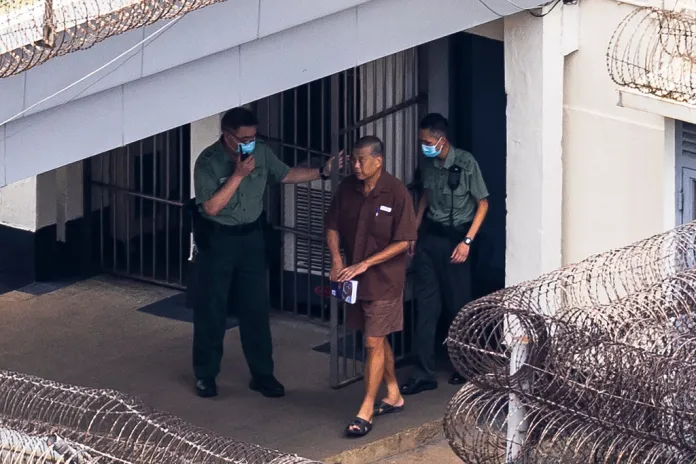
All of the city’s pro-democracy leaders have been imprisoned or forced into exile. Hundreds of activists have been imprisoned for saying, writing, or thinking things that Xi does not approve of. China has also threatened those living abroad that it will act unilaterally to forcibly repatriate them. Independent newspapers have been shuttered and their publishers and staff thrown into prison (most notably, Jimmy Lai). Authorities have even banned an annual candlelight vigil for the victims of the 1989 Tiananmen Square massacre.
But Xi’s strategy doesn’t begin and end with repression. His apparatchiks are equally focused on warping the minds of Hong Kong’s youth.
Hong Kong elementary school children are now taught about the Opium Wars and the struggle against Imperial Japan. This curriculum is not designed for purposes of historical understanding but rather to foster antagonism against the West and to adorn the CCP with an armor of nationalist virtue. The CCP is determined that the party and China be conceived of as one and the same.
In turn, high school students are now required to learn “Xi Jinping Thought,” a catch-all phrase for Xi’s political and economic theories. College students must take similar classes. All of this is designed for the exact opposite purpose of a traditional education.
Rather than help forge open-minded citizens, China wants to corral future generations into unthinking loyalty to the CCP. Students and teachers alike are now required to report on contemporaries who might harbor undesirable views.
This is the stuff of Orwellian nightmares, a condition of oppression only outdone by habitual surveillance and the “social credit” situation on the mainland.
This living nightmare is furnished by certain elements within the West.
Take the former U.K. Supreme Court chief justice, Lord David Neuberger. In exchange for first-class flights from London, $50,000+ in cash, and a five-star hotel room for months at a time, Neuberger has prostituted himself to the crackdown. Serving as a rotating appeals court judge in Hong Kong, Neuberger rejected an appeal by Jimmy Lai in 2024.
Big money also facilitates injustice.
The HSBC banking giant continues to focus heavily on its Hong Kong business. It joins American companies such as Coca-Cola, Pepsi-Cola, Merck, Dell, Amway, HP, and Mars, which proudly preach their commitment to human rights while falling silent when questioned about human rights in Hong Kong.
Similar hypocrisy is found from the American Chamber of Commerce in Hong Kong. It has a great deal to say about LGBT rights but nothing to say about how Xi has turned a great city into a gilded gulag. President Donald Trump’s son, Eric, also indirectly lent respect to Xi’s crackdown when he spoke at a Bitcoin summit in Hong Kong last year.
Their silence reflects their understanding of the CCP’s great sensitivity on these issues. Reflecting as much, a screeching Wen Wei Po editorial defended the bookstore arrests by declaring that, “Unlike the Western countries’ frequent generalization of national security, Hong Kong maintains a high degree of openness while implementing the minimal, moderate, and most defensive legislation that protects human rights and freedoms.”
This claim is laughable on its face. Still, it does underline the absurd disconnect between what the CCP says and what it actually does. After all, how could anyone seriously argue that keeping the ailing Jimmy Lai in prison is a “minimal” response to his crime of publishing the Apple Daily pro-democracy newspaper? For disclosure, I wrote a column for that newspaper.
This injustice deserves greater attention — and action — from the international community.
Advancing Trump’s interest in transactional diplomacy, Secretary of State Marco Rubio has avoided introducing new sanctions on Hong Kong officials. Indeed, the administration last week announced that it was not renewing a designation designed to provide added safeguards on trade with Hong Kong on the basis of the national security law. While the administration believes this will earn Beijing’s reciprocity in trade negotiations, it only suggests to Beijing that there will be no serious pushback to its abuses.
And while the CCP views its pacification of free thinking as an existential requirement, it also fears that international criticism will deter Western businesses from investing in the city. That fear offers a point of leverage that the U.S. and other democracies can exploit. Even if only at the margin, this pressure might lead to slightly improved treatment of Hongkongers.
WHY DESTROYING OR SEIZING KHARG ISLAND IS A BAD IDEA
The U.S. should push Australia, the United Kingdom, and the European Union to speak out more forcefully and collectively against what China is doing. These governments should put pressure on their companies and individuals with interests in Hong Kong. It is absurd that the U.K. remains so weak in the face of China’s destruction of the Sino-British Joint Declaration. While the U.K. is desperate to secure new trade deals with China, its appeasement gives Beijing incentive to believe it can do whatever it wants, wherever it wants, without consequence. This is a dangerous understanding to foster amid other concerns such as Chinese espionage and threats to Taiwan.
Ultimately, this is a question of fundamental values. The days of “one country, two systems” are over. The CCP isn’t simply imprisoning its political opponents in Hong Kong; it is imprisoning the very right to think freely. At the very minimum, the international community should make this activity a little bit more costly for its purveyors.
Continue reading...
[ H/T Washington Examiner ]