







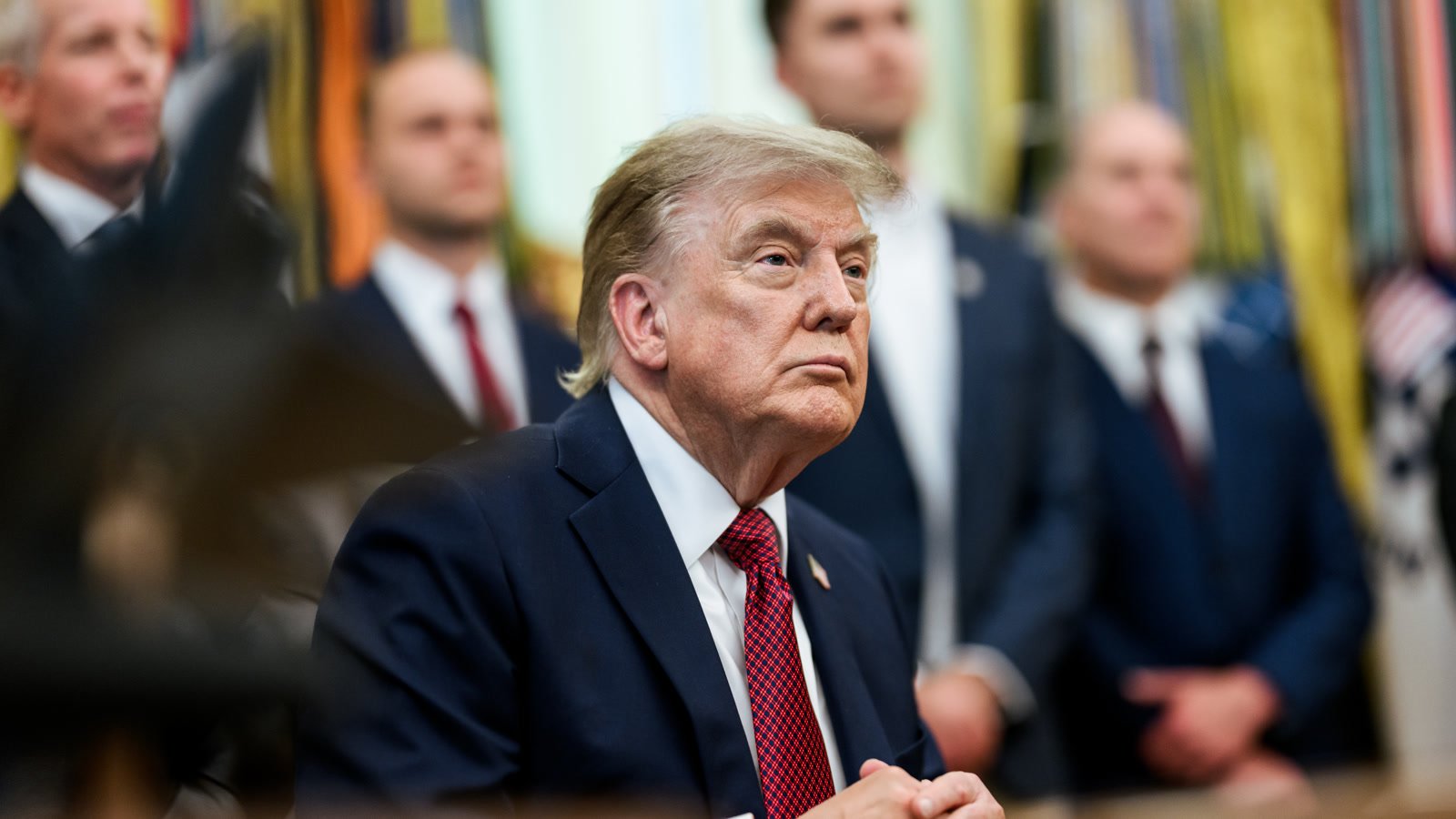
President Trump may have one more card to play if Congress tries to vanish for the summer with his biggest priorities still sitting on the table.
The AP reported Monday that the president told Senate Majority Leader John Thune not to let senators leave Washington until they pass the SAVE America Act—or end the legislative filibuster and clear the way.
Thune’s answer was blunt: Republicans hold 53 seats, most legislation still needs 60 votes to advance, and keeping senators in town does not by itself change the math.
That is true as far as it goes. A longer calendar does not manufacture seven votes, and a president cannot walk onto the Senate floor and order passage of a bill.
But the calendar is also the hiding place. Once senators scatter for more than a month, delay becomes the strategy, accountability gets blurry, and every stalled promise can be pushed into the post-recess pile.
There is a constitutional answer to that move, and it is sitting in Article II, Section 3.
The argument now moving across X is straightforward:
The Power Is Real—But It Is A Pressure Weapon
The Constitution Annotated points directly to the clause allowing the president, “on extraordinary Occasions,” to convene both Houses or either one. A 1989 Department of Justice opinion went further and concluded that this broad authority may be used to bring the Senate back during an intra-session break.
In plain English, President Trump would not have to sit quietly while the Senate takes a long break. He could issue a proclamation naming the date and time for lawmakers to reassemble, including during the scheduled August recess.
He could also convene the Senate alone. That matters because the Senate—not the House—is now the principal roadblock for both the SAVE America Act and the CLARITY Act.
What Article II does not do is let the president write the Senate calendar, choose the exact floor motion, suspend the filibuster, or command a “yes” vote. Each chamber still controls its rules and proceedings, so Thune and Senate Republicans would have to put the legislation on the floor and force the confrontation.
That distinction does not make the power weak. It reveals what the power is actually for: stripping away the excuse that Congress cannot act because Congress is not in Washington.
Cancel The Escape Route
The official U.S. Senate calendar lists August 10 through September 11 as a state work period, while current reporting says senators expect to finish floor work and begin leaving after August 7. That is more than a month in which the two bills could lose momentum heading into the midterms.
The House has already begun its own extended summer break. A presidential proclamation could bring back one chamber or both, depending on what is needed to finish the job.
If the Senate changes either bill, the House may have to return to accept the changes or reconcile competing versions. Calling both Houses would prevent one chamber from becoming the next excuse after the other finally acts.
Most importantly, a special session would convert a scheduling dispute into a national test of leadership. Every senator would know exactly why the chamber had been summoned, and every procedural maneuver would occur under a much brighter spotlight.
Senator Mike Lee is already making the first part of that strategy real by objecting to an easy August adjournment and demanding a recorded vote:
That is the political pressure point.
Do Democrats want to vote against citizenship verification and voter identification, then vote to leave town? Do wavering Republicans want to explain why a five-week break mattered more than putting President Trump’s top election-integrity bill on the record?
The same question applies to CLARITY. Do senators who claim to support American financial innovation want to leave a bipartisan digital-asset framework unfinished because the beach calendar won?
Harry Truman Already Showed How This Works
The U.S. Senate records the most famous modern example: President Harry Truman called the Republican-controlled 80th Congress back in July 1948 after it had adjourned with major business unfinished. He gave lawmakers a list of measures and challenged them to prove they were not the “do-nothing Congress” he had accused them of becoming.
Congress did not suddenly become Truman’s obedient servant. Lawmakers returned, rejected much of his program, and passed only a pair of bills during the 11-day “Turnip Day” session.
Yet Truman still won the confrontation. Republicans had to act under his timetable, their choices became campaign material, and the president turned congressional resistance into one of the defining arguments of his upset victory.
That is the lesson for President Trump. A special session cannot produce 60 votes on command.
It can force the opposition to stop hiding behind the calendar and start producing votes that can be shown to the country.
The SAVE Act Math Is Difficult—Not Hopeless
A March U.S. Senate roll call shows a 49-41 failure to invoke cloture on an amendment tied to the SAVE America Act. The AP reported that the House-passed package cleared that chamber 218-213 and would require documentary proof of citizenship for federal voter registration along with photo identification at the polls.
The March roll call tested cloture on an amendment tied to the bill; it was not final passage of the House package. It still exposed the central obstacle.
With the filibuster intact, Republicans need Democratic help, a rules change, a standing-filibuster strategy, or a different legislative vehicle that can survive Senate procedure.
Thune says the chamber has already taken multiple runs at the legislation and still lacks a path. Senator John Kennedy offered the better answer this week: at some point, you have to vote.
A special session would not solve the procedural puzzle by itself. It would give President Trump time and maximum leverage to solve it while every senator’s travel plans, endorsements, committee ambitions, fundraising network, and political future are suddenly part of the conversation.
This is where President Trump is strongest. He can call senators, work the holdouts, force Republicans to defend their position to the base, and make carefully chosen Democrats decide whether opposing voter ID is really the vote they want attached to their names in an election year.
CLARITY Is Even Closer To The Finish Line
The House Clerk records that the CLARITY Act passed the House 294-134 in July 2025. The Senate Banking Committee then advanced its version 15-9 in May 2026, and Bloomberg Law reported that Thune committed to a vote during the current work period.
Those numbers matter. CLARITY already has a demonstrated bipartisan base, and the Senate committee vote shows that at least some Democrats are willing to help move it forward.
The bill would establish clearer lines between securities and commodities regulation, create rules for digital-asset intermediaries, and bring more of the crypto market under federal disclosure, anti-fraud, and illicit-finance requirements. It is not a fringe messaging bill waiting for its first serious hearing.
The remaining fight is over floor time, final language, ethics provisions, developer protections, and the coalition needed for 60 votes. Those are difficult negotiations, but they are exactly the kind President Trump’s personal pressure and dealmaking can move.
Senator Cynthia Lummis made clear Monday that the push is still very much alive:
My Bet: Force The Vote, And Both Bills Pass
Here is my read: if President Trump actually invokes Article II, calls Congress back, and couples that move with a full political pressure campaign, both bills have a real chance to reach his desk.
CLARITY is the easier lift because the bipartisan foundation already exists. The SAVE America Act is the harder fight, but it is also the bill on which Trump can apply the most painful kind of election-year pressure.
No senator wants to be dragged back to Washington after making vacation plans. No vulnerable Democrat wants a month of ads asking why he or she refused to prove only citizens are registering for federal elections.
And no Republican wants President Trump telling the MAGA base that one more RINO chose the August recess over election integrity.
Could Congress return and try to adjourn again? Yes.
Each chamber still controls its own rules, so lawmakers could return and move to adjourn.
Another rush for the exits would trigger another public showdown, another recorded maneuver, and potentially another presidential summons. The legal power creates the room; Trump’s leverage is what turns that room into a pressure cooker.
Thune keeps asking for the picture of victory.
Here it is: cancel the escape route, bring them back, put the bills on the floor, and make every Democrat and every RINO cast the vote where America can see it.
Article II, Section 3 cannot vote for the SAVE Act or the CLARITY Act. It can make sure the people who can vote are standing exactly where they belong when the moment comes.
Continue reading...
[ H/T WLT Report ]