




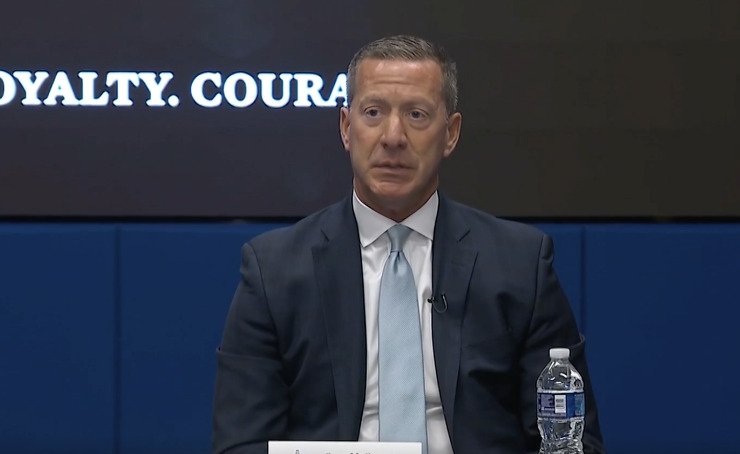

Speaker Mike Johnson just survived the kind of House vote that can wreck an entire legislative strategy.
After two days of threats from Republican holdouts, the House adopted a new budget framework by a razor-thin 216-214 vote.
Johnson secured the framework that can give President Trump’s election-integrity agenda a path around the Senate’s 60-vote roadblock.
Two votes were all that separated the plan from collapse.
What The House Actually Passed
Precision matters here.
The House did not enact the SAVE America Act on Wednesday. It adopted House Concurrent Resolution 113, a budget resolution that starts a third reconciliation drive.
The measure instructs four House committees to write the next bill.
The U.S. House Clerk recorded the final tally at 216-214, with the resolution officially adopted at 4:57 p.m. Eastern on Wednesday after the final roll call.
Republicans Warren Davidson of Ohio and Thomas Massie of Kentucky voted no, while 216 Republicans voted yes. No Democrat supported the resolution; 211 voted against it, one did not vote, and the chamber’s lone independent also voted no.
That is why the margin matters. A single additional member switching from yes to no would have produced a 215-215 tie, and a tied House vote fails.
Reps. Chip Roy and Eric Burlison had publicly raised doubts before the vote, but both ultimately joined the Republican majority and kept the threatened revolt from reaching the fatal third defection.
That left Johnson with 216 votes—the exact number he needed to overcome the 214 members voting against the plan.
The House result was a victory, but it was also a warning. The same internal fight can erupt again when lawmakers have to vote on the actual reconciliation bill.
GovInfo carries the official reported text, not a leadership summary. It directs the House Agriculture, Armed Services, Intelligence and Administration committees to submit recommendations to the Budget Committee by September 11.
The instructions permit up to $12 billion in additional deficit impact from Agriculture, $60 billion from Armed Services, $13 billion from Intelligence and $10 billion from House Administration across the 2027-2036 budget window.
That is a combined ceiling of $95 billion, not a command that every committee spend its entire allocation.
The resolution does not itself spend that money, impose a federal voter-ID requirement or require documentary proof of citizenship. It starts the process and creates the budget lane in which Republicans will now try to write those provisions.
Speaker Johnson called the package “Reconciliation 3.0 — the SAVE and Protect America Act.” His post-vote statement made the sequence clear.
The Senate must first pass the budget resolution. Only then will House committees begin drafting the actual bill.
The distinction is not a technicality. The House won the right to attempt the maneuver.
It did not finish the maneuver.
The Republican Rebellion Nearly Sank It
The danger came from inside Johnson’s own conference.
Fiscal conservatives objected to creating as much as $95 billion in new deficit room without offsets. They also feared Senate Republicans would take the defense and agriculture pieces, strip down the election provisions, and send the House another watered-down product.
Rep. Chip Roy publicly withheld his support until the final stretch. His demands were blunt: the finished bill had to contain mandatory SAVE provisions, future legislation had to account for the new spending, and Congress needed greater clarity about the mission behind the defense request.
Rep. Eric Burlison voiced similar doubts about trusting the Senate to preserve the election language.
Both men ultimately voted yes.
Davidson and Massie did not. Davidson contrasted the unoffset package with a veterans measure that had stalled over funding, while Massie remained a consistent opponent of the new spending.
Johnson’s victory was holding the Republican revolt to two members after the White House backed the plan.
Why President Trump Wanted This Vote
The White House backed House Concurrent Resolution 113 as a crucial first step toward advancing election-integrity measures alongside urgent national-defense and food-supply priorities.
The administration’s policy statement backs the resolution’s full scope rather than limiting its support to the election instructions. It argues that Congress must also replenish military capabilities and reinforce the country’s food supply.
That broader mission explains why the framework spreads its $95 billion ceiling across the Armed Services, Intelligence, Agriculture and House Administration committees instead of placing the entire package under one panel.
On elections, the administration wants documentary proof of U.S. citizenship for federal voter registration, photo identification for federal elections, stronger voter-roll maintenance and new federal enforcement tools.
The White House also describes the budget vote as the beginning of that effort rather than the finished law. The administration still needs the Senate to adopt the framework and Congress to write legislation that can survive reconciliation review.
The political objective is clear even though the final text is not. Republicans want to turn a budget mechanism into a vehicle for as much of the election package as Senate rules will allow.
Congress.gov shows that the Senate originally passed Senate Bill 1383 as a veterans bill. That is the legislative shell the House used for the election package.
The House replaced the Senate text with the SAVE America Act, approved its amendment on February 11 by 218-213, and returned the amended bill to the Senate.
That legislation would require documentary proof of citizenship for federal voter registration and photo identification for federal voting. It also contains absentee-ballot identification requirements, voter-list maintenance provisions and enforcement measures aimed at keeping noncitizens off the rolls.
Wednesday’s vote did not repeat that House action or send the full SAVE text to President Trump. It created a second route for the parts Republicans believe can survive the Senate’s reconciliation rules.
That route is attractive because qualifying reconciliation legislation can pass the Senate with a simple majority instead of the 60 votes normally needed to defeat a filibuster on ordinary legislation.
But reconciliation is not a magic wand.
Under the Senate’s Byrd Rule, provisions whose budget effects are merely incidental to their policy impact can be removed. Overriding that determination requires 60 votes—the same barrier Republicans are trying to escape.
The Senate recorded one warning sign on June 5. A motion to waive the budget rules for a prior SAVE-style amendment received 50 votes to 49 but failed because three-fifths was required.
That history explains why Johnson describes the new plan as the best chance to enact as much of SAVE as possible, not a guarantee that every provision will become law.
Two Tracks, One Senate Test
House Republicans have now put their election bill on two tracks.
The House separately adopted House Resolution 1438 by 214-211, directing the Clerk to add the House-passed SAVE text to the annual defense authorization bill upon engrossment.
The budget resolution creates the parallel reconciliation track for election-related provisions with a defensible budget impact.
Either route can be changed, narrowed or blocked in the Senate.
The next immediate step is Senate adoption of the same budget framework. If that happens, the instructed House committees can draft their portions of the reconciliation bill before the September deadline.
Only then will lawmakers find out how much of the election package survives the parliamentarian, the holdouts and a second round of floor votes.
For now, Johnson won the battle in front of him.
He kept the Republican rebellion from spreading, held the line by two votes and gave President Trump’s top election priority a path that looked close to disappearing only hours earlier.
The House opened the door.
Now the Senate decides how much can walk through it.
Continue reading...
[ H/T WLT Report ]
