



Welcome to Friday’s edition of Washington Secrets, where we are readying for the White House Correspondents’ Association dinner redux. It is meant, in part, to be a celebration of the First Amendment, so will anyone bring up the president’s attempt to subpoena New York Times reporters to find out their sources? In the meantime, we bring you our regular look at the White House week.
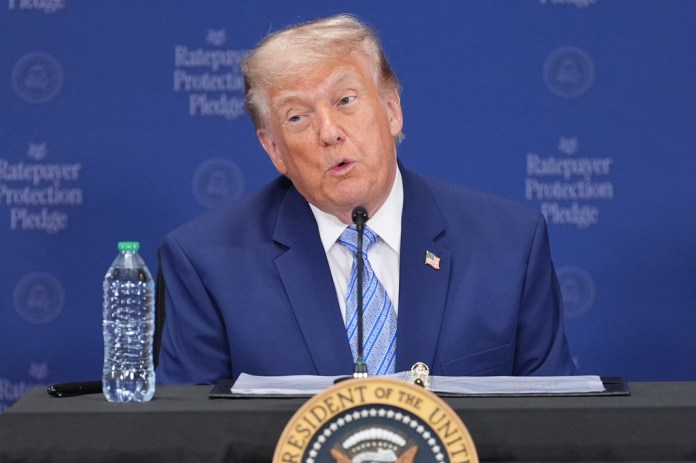
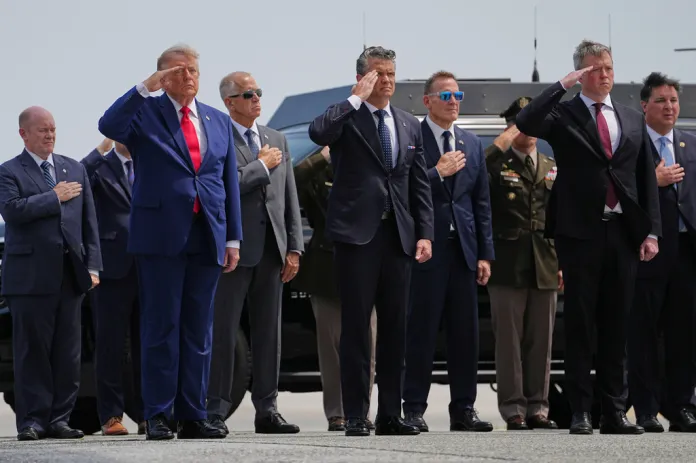
It was another split-screen week for Donald Trump, mixing the pageantry and spectacle of a major sporting event with one of the most somber of presidential duties: receiving the caskets of fallen military personnel as they arrive back on American soil.
On Sunday, the president handed the World Cup to Spain’s victorious soccer players after they overcame Argentina in the final in New Jersey. In typical style, he inserted himself into the Spanish celebrations and had to be nudged to the side as photographers snapped away. He returned to the White House as American forces continued hitting targets in Iran for the ninth consecutive night.
A day later, the extent of American casualties became clear. The Pentagon revealed that almost 100 service members had been wounded so far this month.
On Tuesday, the president threatened an escalation, warning Iran that the U.S. would destroy an Iranian bridge or power plant at any time its forces attacked a ship in the Strait of Hormuz. The price of oil began rising in response, sending jitters through the president’s Republican Party.
Trump flew to Dover Air Force Base on Wednesday to pay tribute to four young soldiers who had been killed in the conflict. Their deaths bring the total killed to 18.
“All of them said very strongly, ‘We cannot let Iran have a nuclear weapon,’” he told reporters beforehand.
Afterward, he flew to Georgia for a political rally, where he touted “Trump Accounts” and tax cuts ahead of the midterm elections while attacking Democratic Sen. Jon Ossoff (D-GA).
The U.S. and Saudi Arabia signed a landmark civil nuclear deal that could eventually let Riyadh enrich uranium, much to the consternation of Israel. Trump quickly upended everything, however, by announcing on social media that Saudi Arabia would have to join the Abraham Accords, normalizing relations in Israel, for the deal to go into effect.
Oil went past the $100 a barrel mark on Thursday as Iran-backed Houthis struck Saudi tankers in the Red Sea, opening a fresh front. Trump said he was considering a “massive attack… bigger than ever before.”
In the meantime, the U.S. Trade Representative announced tariffs of 10% to 12.5% on 60 economies over forced-labor enforcement failures. They were introduced to replace Trump’s expiring global 10% tariff at midnight.
So what did our two political strategies make of it all?
John Zogby: Grade F
Twenty-one weeks of war and no end in sight. The war zone is expanding, U.S. casualties are mounting, the Strait of Hormuz is very closed, and now the Houthi rebels in Yemen have threatened to blockade the Red Sea.
The military said we are running out of missiles, and the administration requested a $67 billion allotment for the war. The Senate response from both parties was chilly.
Only 29% approve of the president’s handling of the war, and Iran is now mocking the U.S., saying it would welcome a ground invasion as it continues to attack U.S. bases in the region, now including Jordan.
For the first time we are hearing the term “quagmire”, a word used in late Vietnam.
Oil is now over $100 a barrel, and fuel at the pump has spiked. Trump, who campaigned in 2024 on no foreign wars and no entangling alliances, is now engaged and entangled in seven countries’ wars, with number eight possibly being sending troops to Mali to put down an Islamic rebellion.
And more tariffs? 50% on Canadian goods?
He signed a deal enabling the Kingdom of Saudi Arabia to develop nuclear weapons.
On the more personal side: Trump’s lawyers actually requested that columnist E. Jean Carroll return the $5.6 million she received from him just last week. And he was airbrushed out of celebratory World Cup pictures.
John Zogby (@ZogbyStrategies) is the founder of the Zogby Survey and senior partner at John Zogby Strategies. His latest book is Beyond the Horse Race: How to Read Polls and Why We Should. His podcast with son, managing partner, and pollster Jeremy Zogby, can be heard here.
Jed Babbin: Grade C+
President Trump had a big week, if not a good one, slapping tariffs on countries that don’t control forced labor, the Iran war is still going on, and a nuclear deal with Saudi Arabia is in the works.
The nuke deal with the Saudis prohibits them from making nuclear weapons (which they may or may not do) and is supposedly contingent on their joining the Abraham Accords to normalize relations with Israel. The Saudis have previously refused to join the Abraham Accords unless the Israelis guarantee a Palestinian nation with all the trimmings. The Saudis aren’t likely to join the accords until then, if ever.
Trump has launched tariffs on goods, ranging up to 12.5%, on about 60 nations because they haven’t controlled forced labor. This seems to be shocking for countries like the United Kingdom and multinational groups such as the European Union, but they’re being hit nevertheless. He has also threatened Canada with tariffs up to 50% due to its uncontrolled wildfires, the smoke from which blanketed the Northeast down to the Mid-Atlantic states.
With four U.S. soldiers killed in action by Iranian missiles and drones — three in Jordan and one in Iraq — the news on the Iran war isn’t good. Iran is evidently rebuilding the damage we’ve done quickly, but the nightly air attacks continue, now almost at their two-week anniversary.
Iran’s secondary proxy, the Houthis, have said that they’re going to begin raiding Red Sea shipping again. This comes while the Strait of Hormuz is not open to shipping and the price of oil is over $100 a barrel. Trump is tired of a war he thought would last no more than three weeks, but can’t get out of it because the Iranians make deals, intending not to live up to their obligations.
In this war and others with enemies like Iran, Trump can’t just declare victory and come home. The world — and the Democrats — won’t let him off that easily. Iran, despite what the president says, isn’t interested in a deal. They’re interested in stringing us along in endless negotiations.
Jed Babbin (@jedbabbin) is a Washington Examiner contributor and former deputy undersecretary of defense in the administration of President George H.W. Bush.
Conservative groups send warning to Brendan Carr
A string of conservative and free-market groups has written to the Federal Communications Commission asking it to stick to predictable rules for renewing broadcasting licenses, with a presumption that they will be granted.
“We ask that the FCC avoid steps that would transform renewal from the largely ministerial process Congress designed into a discretionary checkpoint that would invite the politicization that conservatives, free-market advocates and others have long condemned,” reads the letter, which was organized by the Center for Individual Freedom.
It goes on to say that the signatories take no position on the merits of any particular renewal application or pending matter. But they don’t want to see any precedent that would allow a future administration to justify moves against conservative or religious broadcasters.
What can they mean?
Well, the FCC, under chairman Brendan Carr, has ordered an unprecedented early license review for Disney’s eight ABC television stations, years ahead of their scheduled expirations. The commission cited investigations into Disney’s diversity, equity, and inclusion practices.
And, on the same day the letter was written, Carr made clear his political intentions by saying his review would take into account ABC‘s decision to not carry a live broadcast of President Donald Trump‘s July 16 speech about U.S. election security.
So, although the 14 signatories say they are not talking about “any particular renewal application,” their message is clear.
You can read their letter here.
Lunchtime reading
Marco Rubio Takes Aim at Globalists and the Left: Is Rubio making his move on 2028, setting out an international agenda that will play well with a domestic audience?
Abdul El-Sayed’s slippery argument about Israel’s right to exist: The Michigan Senate candidate is trying to have his cake and eat it too.
You are reading Washington Secrets, a guide to power and politics in D.C. and beyond. It is written by Rob Crilly, who you can reach at [email protected] with your comments, story tips, and suggestions. If a friend sent you this and you’d like to sign up, click here.
Continue reading...
[ H/T Washington Examiner ]