




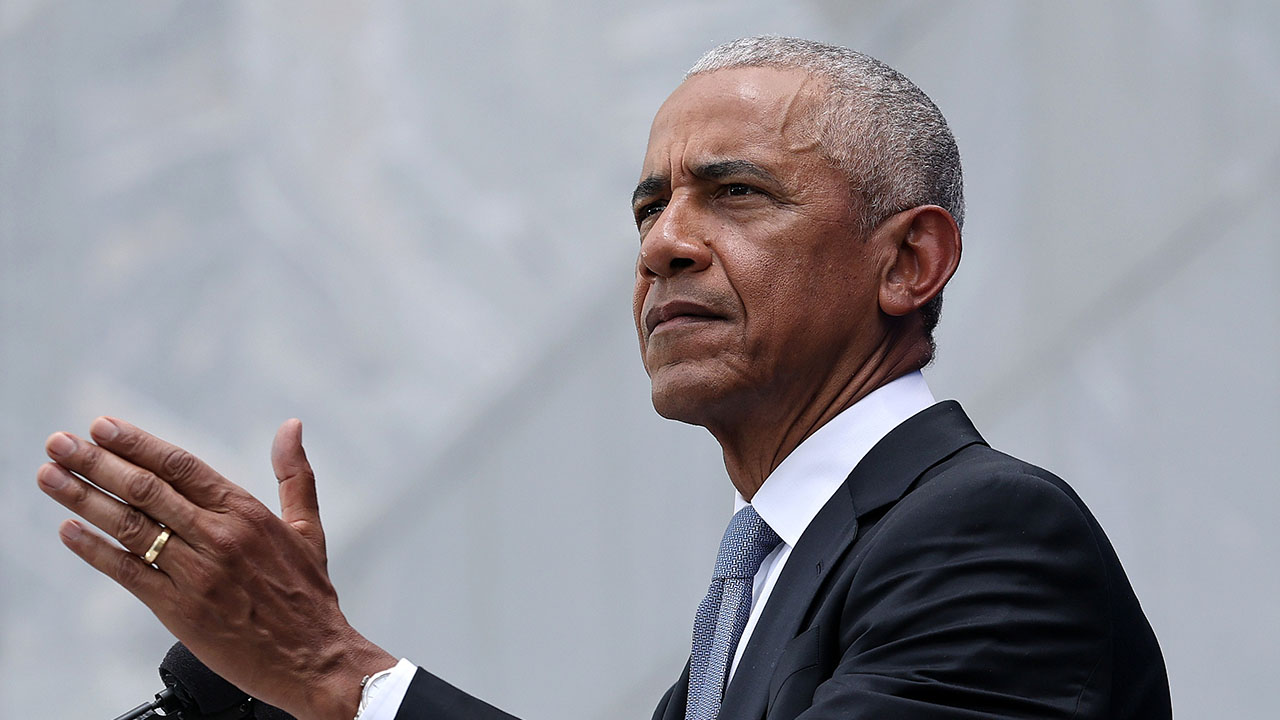
Former President Barack Obama recently gave America another reminder of how his presidency—once expected to bring the country together—left us more divided on race.
Obama compared America under President Donald Trump to the tumultuous period after the Civil War that gave birth to the Ku Klux Klan. He said the U.S. is “having the same arguments” we did in the 1860s and 1870s, when Union troops occupied the former Confederacy and attempted to secure real freedom for former slaves.
“These issues are still here,” Obama told author Malcolm Gladwell in an interview for the podcast “Reconstruction: The Unfinished Promise.”
“How are we going to help the freed people who’ve been enslaved?” he asked. “What are we going to give them to allow them to have a go at life? You trace that debate, of ’40 acres and a mule’ and public education, and you can trace it all the way through to debates about welfare, and debates about now DEI, and do we as a society have an obligation to address past injustices that have been institutionalized or left a legacy of poverty? We’re having that argument.”
Obama didn’t stop there. “You got a Supreme Court that has systematically weakened the possibilities of enforcing voting rights in our democracy,” he said. “And we have a politics now that, at least one of our major parties has been captured by a politics that is not that subtle about suggesting that ‘we the people’ means a certain kind of people.”
He attacked Vice President JD Vance, claiming Vance gave “a speech that is basically a ‘blood and soil’ version of ‘we, the people,’ that it matters who your parents were, how long they’ve been here, despite him being married to the daughter of an immigrant himself.”
“That goes back to ideas about who gets to be a citizen, who belongs,” Obama added.
Critical Race Theory
Beefs with Vance aside, Obama’s remarks echo the claims of critical race theory, the idea that America is systemically racist and requires fundamental change.
While no president single-handedly shapes public attitudes on race, Obama entered office with unique moral authority on the issue. His rhetoric and his policies breathed life into the idea of “systemic racism” and set the stage for the mass protests of 2020.
The Reconstruction Podcast
Obama rightly noted that Americans don’t fully appreciate the history of Reconstruction, but he went too far in suggesting we still face the same issues that led to the rise of the Klan.
He recalled the “Lost Cause” mythology, which suggested that the Confederacy had been in the right all along. “It had to do with a very specific cultural project, which was to justify, solidify, rationalize the maintenance of a caste system, and that never fully went away” (emphasis added).
Obama said the “really hard questions” coming out of slavery “were never fully processed” or resolved.
He called for Americans to wrestle with “not some rosy-eyed sanitized version of American history, but a clear-eyed understanding of, yes, we took land from previous occupants. America was built on violence and subjugation, and chicanery, and confidence men, and shenanigans, and corruption, but it is also this amazing expression of human possibility.”
Obama’s Divisive Record
Americans hoped for a “post-racial” society under Obama, and ended up with the opposite.
In 2010, only 13% of Americans said they worried about race relations “a great deal,” but by 2016, that number had risen to 35%, according to Gallup. A Rasmussen poll in 2016 found that 60% of Americans said “race relations have gotten worse since Obama’s election.”
Obama’s Justice Department weaponized race in policy, dropping a voter intimidation case against the New Black Panther Party while condemning Texas’ voter ID law as racist.
Yet the president’s rhetoric arguably made a larger impact.
The president rushed to condemn racial profiling when Cambridge police arrested Henry Louis Gates in 2009.
After the 2012 shooting of Trayvon Martin, the president said, “If I had a son, he’d look like Trayvon.” Even after a jury acquitted George Zimmerman, the neighborhood watch coordinator who said he’d shot Martin in self-defense, the Justice Department investigated him for three years before concluding there was no evidence he violated Martin’s rights.
Responding to the death of Eric Garner at the hands of police in 2014, Obama said racism is “deeply rooted” in America: “I’m pretty explicit about my concern, this is a systemic problem, that black folks aren’t making this up.”
Amid the COVID-19 pandemic and following the death of George Floyd, the riots that grew out of Black Lives Matter protests in the summer of 2020 reportedly resulted in more than $2 billion in insurance payouts and cost the lives of at least 26 Americans. While Obama deserves some credit for condemning the violence, his rhetoric arguably contributed to the polarization that fueled the protests.
Obama is correct that America should reexamine its history on Reconstruction, but the United States today bears little resemblance to the era that gave birth to the Klan—and his own presidency conclusively demonstrates that.
Obama is brilliant. He knows how to expertly play the statesman, advancing radical and divisive ideas while appearing to call for unity and patriotism.
Unfortunately, racial and cultural divisions seem to be his most lasting legacy.
Continue reading...
[ H/T The Daily Signal ]