






The year: 1986. Two global superpowers have nuclear warheads pointed at each other. Many fear imminent war.
“Two vivid characters meet over a weekend, on a desolate and windswept island, in a reputedly haunted house with rain lashing against its windowpanes, where they experience the most amazing things,” wrote Ken Adelman, President Ronald Reagan’s arms control director.
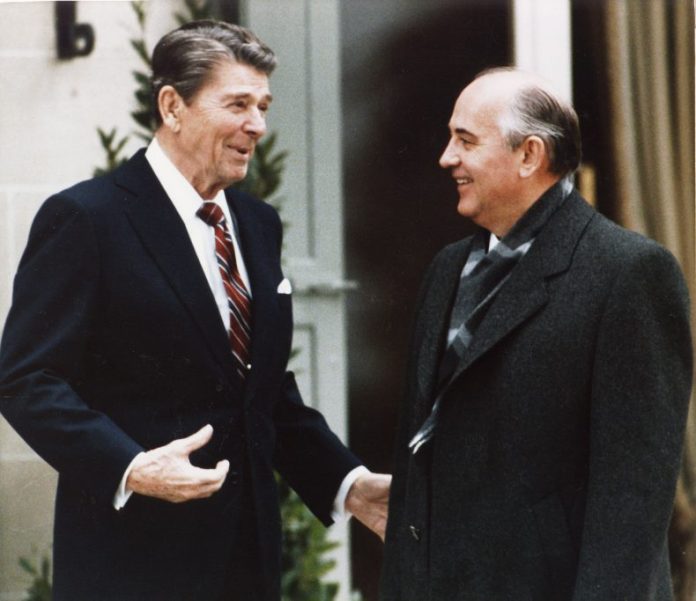
In a small house in Reykjavik, Iceland, Reagan and Soviet General Secretary Mikhail Gorbachev — with some aides — gathered for 48 tension-filled hours seeking to prevent nuclear war. Many now call that pivotal in helping end the Cold War. What happened?
The Brink of War stars Jeff Daniels as Reagan, Jared Harris as Gorbachev, and J.K. Simmons as Reagan’s Secretary of State George Shultz.
In 1986, the superpowers’ arms race had nuclear weapons and missiles proliferating. Reagan’s Strategic Defense Initiative, “Star Wars,” envisioned a shield to destroy incoming missiles. Gorbachev feared SDI would render Russia vulnerable.
Adelman attended Reykjavik and other summits. His book Reagan at Reykjavik: Forty-Eight Hours That Ended the Cold War provides an extensively researched eyewitness account. He compares the summit to an Agatha Christie thriller. I concur. Plenty of mystery, conflict, plot twists — an emotional roller coaster.
Adelman says that for 10-and-a-half hours, Reagan and Gorbachev interacted directly one-on-one. Gorbachev claimed that “truly Shakespearean passions ran under the thin veneer of polite and diplomatically restrained negotiations.”
Years later, Gorbachev called Reykjavik the turning point in the Cold War’s end, “because,” he told George Shultz, “for the first time the two leaders talked directly, over an extended period in a real conversation, about key issues.”
Not all agree on Reykjavik’s Cold War-ending influence. The summit ended in disappointment: no agreement was signed. Former President Richard Nixon felt it greatly “threatened Western interests.” Others point to the weak Soviet economy’s role in communism’s demise, which was, of course, crucial. But Adelman’s book and the film present sound arguments that Reykjavik was a turning point, opening the door to future settlements.
A 1987 treaty limited intermediate missiles. By 1991, over 5,500 Soviet nuclear warheads had been destroyed. A “ban the bomb” movement grew. Gorbachev was Time magazine’s 1987 “Man of the Year” and “Man of the Decade” for the 1980s. He won the 1990 Nobel Peace Prize.
Reagan and Gorbachev interacted on several other occasions. Michael Reagan, Ronald’s son, indicated that their friendship developed in fascinating ways. Michael first met Gorbachev at the Reagan ranch in 1992. The Soviet Union had collapsed. Gorbachev was a private citizen and “my father’s friend.”
Michael noted faith’s role in their interaction. Ronald became a follower of Jesus at age 11. In 1981, after surviving a gunman’s bullet, he told his son, “I believe God spared me for a purpose.… I’ve decided to commit the rest of my life, and … of my presidency, to God.”
Michael continued, “At each of their summit meetings, my father would open with a prayer for guidance, and Gorbachev would close with the words, ‘If it’s God’s will.’ … Dad had long suspected Gorbachev of being a ‘closet Christian.'” Gorbachev told Michael that his Christian grandmother prayed for him. In 2008, the Telegraph ran a story called “Mikhail Gorbachev admits he is a Christian” about Gorbachev’s visit to pray at St. Francis of Assisi’s tomb in Italy.
Gorbachev later denied he had become a Christian, but left the door open enough to cause Grove City College political scientist Paul Kengor to continue to wonder.
MAGAZINE: JAMES TALARICO SAID HE ‘HATES CHRISTIANITY.’ HERE’S WHY
In any case, many analysts see the Cold War’s end and the Soviet Union’s collapse as having providential characteristics. Perhaps the two protagonists were really on the same faith side from the beginning.
The Brink of War clearly presents the Reykjavik part of this drama and alludes to the spiritual implications of the entire story, which is well worth understanding now, 40 years later, given today’s nuclear threats.
Rusty Wright is an author and lecturer who has spoken on six continents. He holds a Bachelor of Science in psychology and a Master of Theology degree from Duke and Oxford universities, respectively.
Continue reading...
[ H/T Washington Examiner ]