






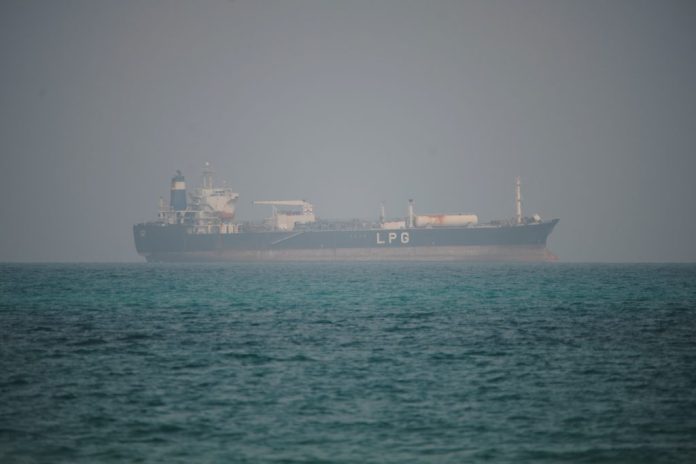
The Bab el-Mandeb Strait, a crucial trade route into the Red Sea, is now also feeling the squeeze of the escalating war in Iran as vessels looking to pass through the waterway are facing the risk of strikes from the Iranian-backed terrorist group known as the Houthis, sending oil prices soaring past $100 a barrel for the first time in two months.
More ships have started to avoid the strait, signaling that the monthslong disruptions to global trade of oil and other products are not just limited to the Strait of Hormuz and could very likely grow worse amid prolonged fighting between the United States and Iran.
What is the Bab el-Mandeb?
The Bab el-Mandeb Strait separates the Red Sea and the Gulf of Aden, and is the only entry point of the Red Sea from the Indian Ocean.
Map of the Bab el-Mandeb Strait chokepoint. Source: European Council on Foreign Relations; Graphic by Grace Hagerman/Washington Examiner
" data-large-file="https://www.washingtonexaminer.com/...26/07/Bab-el-Mandeb-chokepoint-map.webp?w=696" src="https://www.washingtonexaminer.com/...26/07/Bab-el-Mandeb-chokepoint-map.webp?w=696" alt="Map of the Bab el-Mandeb Strait chokepoint. Source: European Council on Foreign Relations; Graphic by Grace Hagerman/Washington Examiner" class="wp-image-4660962" srcset="https://www.washingtonexaminer.com/wp-content/uploads/2026/07/Bab-el-Mandeb-chokepoint-map.webp 696w, https://www.washingtonexaminer.com/...-el-Mandeb-chokepoint-map.webp?resize=300,200 300w, https://www.washingtonexaminer.com/...-el-Mandeb-chokepoint-map.webp?resize=150,100 150w" sizes="(max-width: 696px) 100vw, 696px">
Map of the Bab el-Mandeb Strait chokepoint. Source: European Council on Foreign Relations; Graphic by Grace Hagerman/Washington Examiner
Through the Suez Canal, on the other side of the Red Sea, it also connects the Indian Ocean to the Mediterranean Sea.
Given its strategic location, the Bab el-Mandeb is considered one of the most crucial chokepoints for global trade in crude oil, similar to the Strait of Hormuz, Strait of Malacca, and Suez Canal.
On one side of the Red Sea is the African coastline of Egypt, Sudan, and Eritrea, while on the other side is Saudi Arabia and Yemen. Millions of barrels per day of crude oil and other petroleum products pass through the strait. Approximately 4.2 million barrels per day transited the strait in the first half of 2025, according to the Energy Information Administration.
For comparison, about 20.9 million barrels per day transited through the Strait of Hormuz during the first half of last year.
Risks in the region
The Iranian-backed rebels in Yemen, the Houthis, began attacking commercial vessels traveling through the strait in November 2023.
This was in the immediate aftermath of the Hamas attacks in southern Israel on Oct. 7, 2023, and the subsequent war in Gaza that followed.
At the time, the Houthis targeting the ships said they were doing so in solidarity with Gaza. The attacks stopped after a ceasefire agreement was made.
Throughout the war in Iran, the Houthis have repeatedly threatened to attack tankers traversing through the Red Sea and effectively close the strait.
Earlier this week, the Houthis said they would be imposing a naval blockade on ships from Saudi Arabia attempting to travel through the Bab el-Mandeb. Since then, Houthi militia have launched attacks against several Saudi Arabian tankers sailing through the Red Sea.
At least two were attacked on Thursday, according to Reuters.
The threat of attacks caused several vessels to turn around before reaching the strait.
The Institute for the Study of War said that at least seven ships changed course to avoid transiting through the Bab el-Mandeb. The European Union Naval Force has also warned ships with ties to the U.S., Israel, and Saudi Arabia to avoid sailing through the Red Sea and Gulf of Aden.
Commercial shipping traffic hasn’t come to a complete halt, as ship tracking data reviewed by the ISW found that 30 commercial vessels passed through late Tuesday into Wednesday. This is a significant drop from the 64 commercial ships recorded Monday and Tuesday.
Pressure on prices
Any threat to a ship’s ability to safely transit through a waterway such as Bab el-Mandeb is going to put upward pressure on oil prices, as was seen during the extended traffic disruptions in the Strait of Hormuz.
(Graphic by Grace Hagerman/Washington Examiner)
" data-large-file="https://www.washingtonexaminer.com/wp-content/uploads/2026/05/chokepoints3-e1779310379759.jpg?w=696" src="https://www.washingtonexaminer.com/wp-content/uploads/2026/05/chokepoints3-e1779310379759.jpg?w=696" alt="Map of major chokepoints, ports and trade routes" class="wp-image-4576988" srcset="https://www.washingtonexaminer.com/wp-content/uploads/2026/05/chokepoints3-e1779310379759.jpg 700w, https://www.washingtonexaminer.com/...hokepoints3-e1779310379759.jpg?resize=300,194 300w, https://www.washingtonexaminer.com/...chokepoints3-e1779310379759.jpg?resize=150,97 150w, https://www.washingtonexaminer.com/...hokepoints3-e1779310379759.jpg?resize=696,449 696w" sizes="(max-width: 700px) 100vw, 700px">
(Graphic by Grace Hagerman/Washington Examiner)
Prices for international and domestic crude rose rapidly on Thursday over fears that the increased attacks in the Red Sea could result in an effective closure of a second major trade chokepoint.
Thursday morning, international benchmark Brent crude soared by 6.58%, past $100 a barrel for the first time in months.
West Texas Intermediate was also steadily rising by 5.18% and was selling at $91.33 a barrel.
While markets saw some price relief in June and July, in the wake of the U.S.-Iranian memorandum of understanding signing, analysts have insisted that prices will not fall to and remain at pre-war levels until normal traffic through waterways such as the Strait of Hormuz resumes.
Another closure of a second strait could be a massive setback for Western nations, including the U.S., that released a record amount of emergency crude to address supply shortages and prevent oil and gas prices from surging even further.
FIRST, THE STRAIT OF HORMUZ — WHAT CHOKE POINT COULD BE NEXT?
Even if traffic through the strait continues, Simon-Peter Massabni, head of business development at XS.com, warned there are other factors that will put more upward pressure on prices, such as insurance premiums and higher transportation costs.
“I believe the oil market has entered a new era in which geopolitical developments carry greater influence than many traditional economic indicators,” he said. “Understanding today’s oil market requires more than monitoring supply-and-demand data; it demands close attention to geopolitical shifts and their implications for global energy security.”
Continue reading...
[ H/T Washington Examiner ]