









Dr. Alan Grant did not like children, did not trust computers, and did not believe, even after the raptors and the brachiosaurus had made his skepticism obsolete, that dinosaurs and human beings belonged on the same island. He was the rare blockbuster hero who spent much of his own franchise being proven right about how badly the whole enterprise would go, saved less by bravado than by a weary, watchful decency that made audiences trust him anyway. That same mixture of doubt and quiet moral seriousness ran through the 50 years of work turned in by the actor who played him. Sam Neill, who died July 13 at his home in Sydney at the age of 78, spent his career being the smartest, wariest person in rooms full of submarines, storms, spies, and dinosaurs, and somehow made wariness look like a virtue.
He was born Nigel John Dermot Neill in Omagh, Northern Ireland, in 1947, the son of a British Army officer from a New Zealand family and an English mother. The family returned to New Zealand when he was 7, and Neill grew up in Christchurch, attending Christ’s College before studying English literature at the University of Canterbury, where he first acted in student theater. He joined the National Film Unit, New Zealand’s state documentary agency, in the early 1970s, learning the craft from the ground up as a trainee and director before landing his first substantial screen role in the 1977 thriller Sleeping Dogs, a film that helped announce a New Zealand film industry the world had barely noticed existed.
Neill’s international rise came through Australia and Britain rather than Hollywood. He starred opposite Judy Davis in Gillian Armstrong’s My Brilliant Career (1979), then, in 1983, played the master spy Sidney Reilly in the British miniseries Reilly, Ace of Spies, a performance so controlled and magnetic that it earned him a Golden Globe nomination and a reputation in Europe that Hollywood eventually noticed. He appeared in Andrzej Zulawski’s cult horror film Possession (1981) and starred alongside Meryl Streep in A Cry in the Dark (1988), based on the Azaria Chamberlain case. Then came the run that made him a movie star in the conventional sense: the taut three-hander Dead Calm (1989), opposite a young Nicole Kidman, and The Hunt for Red October (1990), in which Neill’s doomed Soviet first officer gave the submarine thriller its moral center.
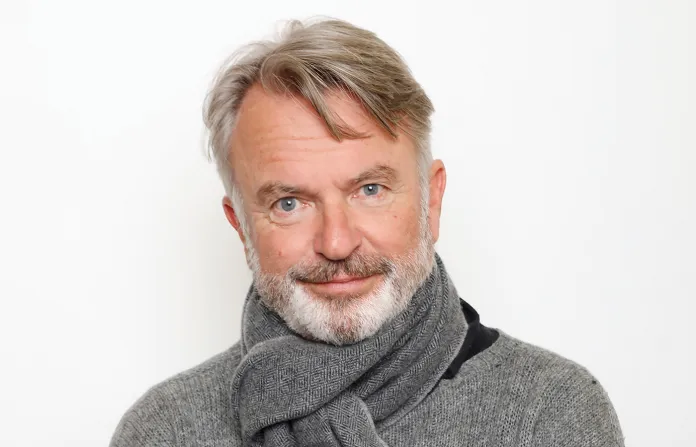
Sam Neill. (Matt Sayles/Invision/AP)
" data-large-file="https://www.washingtonexaminer.com/wp-content/uploads/2026/07/Obit.072926.jpg?w=696" height="658" width="1024" src="https://www.washingtonexaminer.com/wp-content/uploads/2026/07/Obit.072926.jpg?w=696" alt="Sam Neill. (Matt Sayles/Invision/AP)" class="wp-image-4661861" srcset="https://www.washingtonexaminer.com/wp-content/uploads/2026/07/Obit.072926.jpg 1400w, https://www.washingtonexaminer.com/wp-content/uploads/2026/07/Obit.072926.jpg?resize=300,193 300w, https://www.washingtonexaminer.com/wp-content/uploads/2026/07/Obit.072926.jpg?resize=768,494 768w, https://www.washingtonexaminer.com/wp-content/uploads/2026/07/Obit.072926.jpg?resize=1024,658 1024w, https://www.washingtonexaminer.com/wp-content/uploads/2026/07/Obit.072926.jpg?resize=150,96 150w, https://www.washingtonexaminer.com/wp-content/uploads/2026/07/Obit.072926.jpg?resize=696,447 696w, https://www.washingtonexaminer.com/wp-content/uploads/2026/07/Obit.072926.jpg?resize=1068,687 1068w" sizes="auto, (max-width: 1024px) 100vw, 1024px">
Sam Neill prioritized acting over stardom. (Matt Sayles/Invision/AP)
But it was 1993 that made Neill’s career, in the way one year occasionally does for an actor who has already spent 15 years doing serious work. He played the reserved landowner and intended husband Alisdair Stewart in Jane Campion’s The Piano, and, the same year, Dr. Alan Grant in Steven Spielberg’s Jurassic Park, a role that would define his public identity for the rest of his life, whether he liked it or not, and by most accounts he mostly did. He returned to the character in Jurassic Park III (2001) and, in 2022, Jurassic World Dominion (a movie I reviewed in these pages), bookending a franchise that ran nearly three decades.
Between the Jurassic Park sequels, Neill kept working at a pace that suggested he never much cared about being a movie star as opposed to simply being an actor. He unsettled audiences in John Carpenter’s In the Mouth of Madness (1994) and Event Horizon (1997), played a robotics executive in Bicentennial Man (1999), and turned up as the magician Merlin in the 1998 miniseries of the same name, as Thomas Jefferson in the miniseries Sally Hemings: An American Scandal (2000), as Cardinal Wolsey in first season of The Tudors (2007), and as the icy gangster Chester Campbell on Peaky Blinders, a late-career role that introduced him to a younger generation raised on streaming television rather than dinosaur movies. In 2016, he found one of the most purely charming performances of his career as the gruff bushman Hec in Taika Waititi‘s Hunt for the Wilderpeople, which became the highest-grossing New Zealand film of all time.
OBITUARY: DANIEL OLIVER, 1939-2026
What ran through nearly all of it was Neill’s gift for wry understatement, a New Zealand dryness that made even his villains and cowards seem like men worth listening to. He was knighted in New Zealand in 2022 and, in his final years, became almost as well known for his farm outside Queenstown and his habit of naming its animals after Hollywood friends as for any single role, a hobby he pursued on social media with the same deadpan good humor he brought to his acting (though I still wonder how much Helena Bonham Carter really appreciated that Neill had named a cow after her).
Neill liked to undercut his own fame before anyone else could. Accepting a Screen Legend Award at last year’s New Zealand Screen Awards, he offered this backhanded tribute to himself: “If you stick around long enough, you probably, you know, qualify, and I’ve been just sort of sticking around.”
Daniel Ross Goodman (@DanRossGoodman) is a Washington Examiner contributing writer and teaches theology and religious studies at St. John’s University. His next book, Dante’s Guide to Life: How The Divine Comedy Can Change Our Fortunes, Our World, and Ourselves, will be published this fall by Angelico Press.
Continue reading...
[ H/T Washington Examiner ]