








Oil Tanker Makes Red Sea U-Turn After Houthi Threats, Reroutes Around Africa In Costly Transit
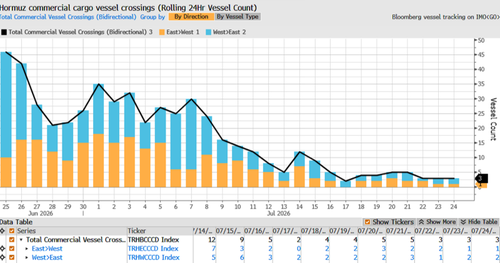
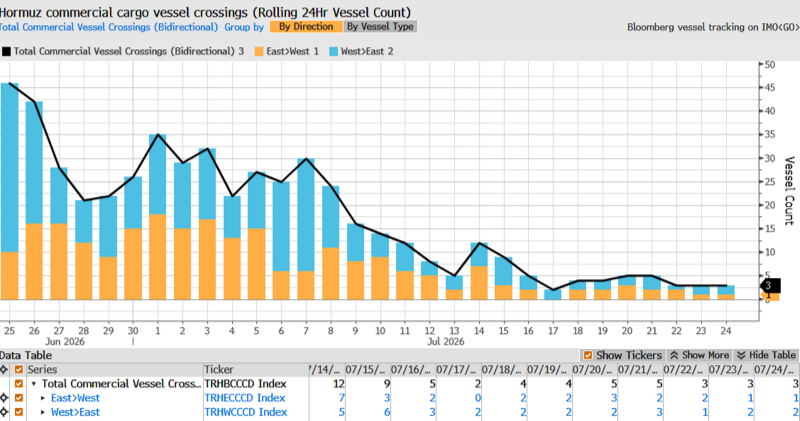
ING's Singapore-based head of commodities, Warren Patterson, was asked during a recent webinar what it would take for Brent crude to exceed $120 a barrel. His answer was "not much," warning that prices could soar well into triple-digit territory if the Strait of Hormuz remains blocked through August and threats to Red Sea shipping intensify.
Patterson's warning about disruptions at the Strait of Hormuz and the Bab el-Mandeb Strait echoes concerns voiced across commodity desks this week: the longer these critical chokepoints remain impaired, the greater the upside risk to Brent, WTI, and fuel prices at the pump.
Strait of Hormuz Crossings
Bab el-Mandeb Crossings
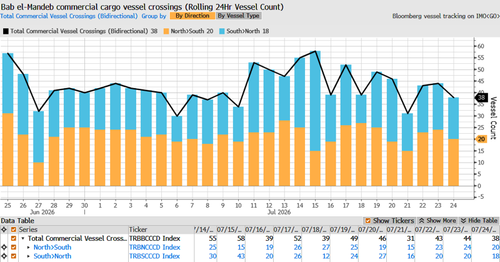
The latest signs of trouble in the southern Red Sea come from a Reuters report stating that the Danish-flagged tanker Torm Innovation was rerouted from Yanbu, Saudi Arabia, through the Suez Canal and around the Cape of Good Hope as an alternative to the Bab el-Mandeb Strait after two Saudi tankers were hit with projectiles by the Iran-backed Houthis earlier this week.
"Given the security situation in the southern part of the Red Sea, the vessel is sailing via the Suez Canal and around the Cape to Asia. This reflects our cautious approach to crew safety, which remains our highest priority," a Torm spokesperson told the outlet.
Rerouting around the Cape of Good Hope instead of transiting Bab el-Mandeb adds weeks of sailing time and sharply increases freight, fuel and insurance costs.
Longer voyages also tie up vessels for extended periods, effectively reducing available tanker capacity and tightening energy markets. The result will be higher tanker rates.
The rerouted tanker is carrying a 500,000-barrel cargo of Saudi naphtha from Yanbu to Japan.
One question we have is whether this marks the beginning of a tanker exodus from the southern Red Sea, or whether surging gasoline and diesel prices at US pumps force the Trump administration to pursue a diplomatic off-ramp with Tehran to break the tit-for-tat strike cycle and restore order on critical maritime chokepoints to mitigate an energy shock.
Tyler Durden Fri, 07/24/2026 - 13:40
Continue reading...
[ H/T ZeroHedge ]
ING's Singapore-based head of commodities, Warren Patterson, was asked during a recent webinar what it would take for Brent crude to exceed $120 a barrel. His answer was "not much," warning that prices could soar well into triple-digit territory if the Strait of Hormuz remains blocked through August and threats to Red Sea shipping intensify.
Patterson's warning about disruptions at the Strait of Hormuz and the Bab el-Mandeb Strait echoes concerns voiced across commodity desks this week: the longer these critical chokepoints remain impaired, the greater the upside risk to Brent, WTI, and fuel prices at the pump.
Strait of Hormuz Crossings
Bab el-Mandeb Crossings
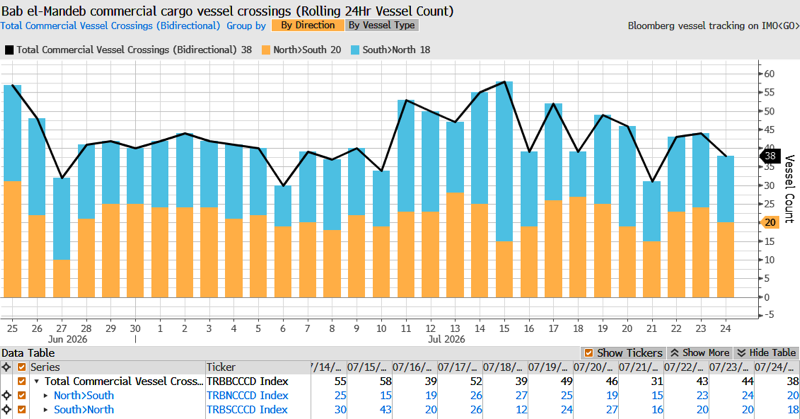
The latest signs of trouble in the southern Red Sea come from a Reuters report stating that the Danish-flagged tanker Torm Innovation was rerouted from Yanbu, Saudi Arabia, through the Suez Canal and around the Cape of Good Hope as an alternative to the Bab el-Mandeb Strait after two Saudi tankers were hit with projectiles by the Iran-backed Houthis earlier this week.
"Given the security situation in the southern part of the Red Sea, the vessel is sailing via the Suez Canal and around the Cape to Asia. This reflects our cautious approach to crew safety, which remains our highest priority," a Torm spokesperson told the outlet.
Rerouting around the Cape of Good Hope instead of transiting Bab el-Mandeb adds weeks of sailing time and sharply increases freight, fuel and insurance costs.
Longer voyages also tie up vessels for extended periods, effectively reducing available tanker capacity and tightening energy markets. The result will be higher tanker rates.
The rerouted tanker is carrying a 500,000-barrel cargo of Saudi naphtha from Yanbu to Japan.
Saudi Arabia's escape route from Hormuz is now being REROUTED again.
After shifting exports to Yanbu and Bab el Mandeb, Houthi attacks are forcing Asian cargoes north through Suez and then around Africa.
A Yanbu to Taiwan voyage jumps from
19 to 48 days.
Fuel costs rise… pic.twitter.com/eaViElkW6d
— Jack Prandelli (@jackprandelli) July 24, 2026
One question we have is whether this marks the beginning of a tanker exodus from the southern Red Sea, or whether surging gasoline and diesel prices at US pumps force the Trump administration to pursue a diplomatic off-ramp with Tehran to break the tit-for-tat strike cycle and restore order on critical maritime chokepoints to mitigate an energy shock.
Tyler Durden Fri, 07/24/2026 - 13:40
Continue reading...
[ H/T ZeroHedge ]