




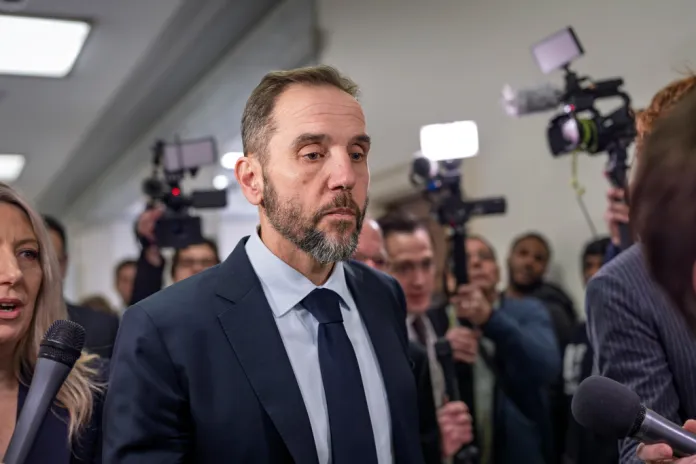
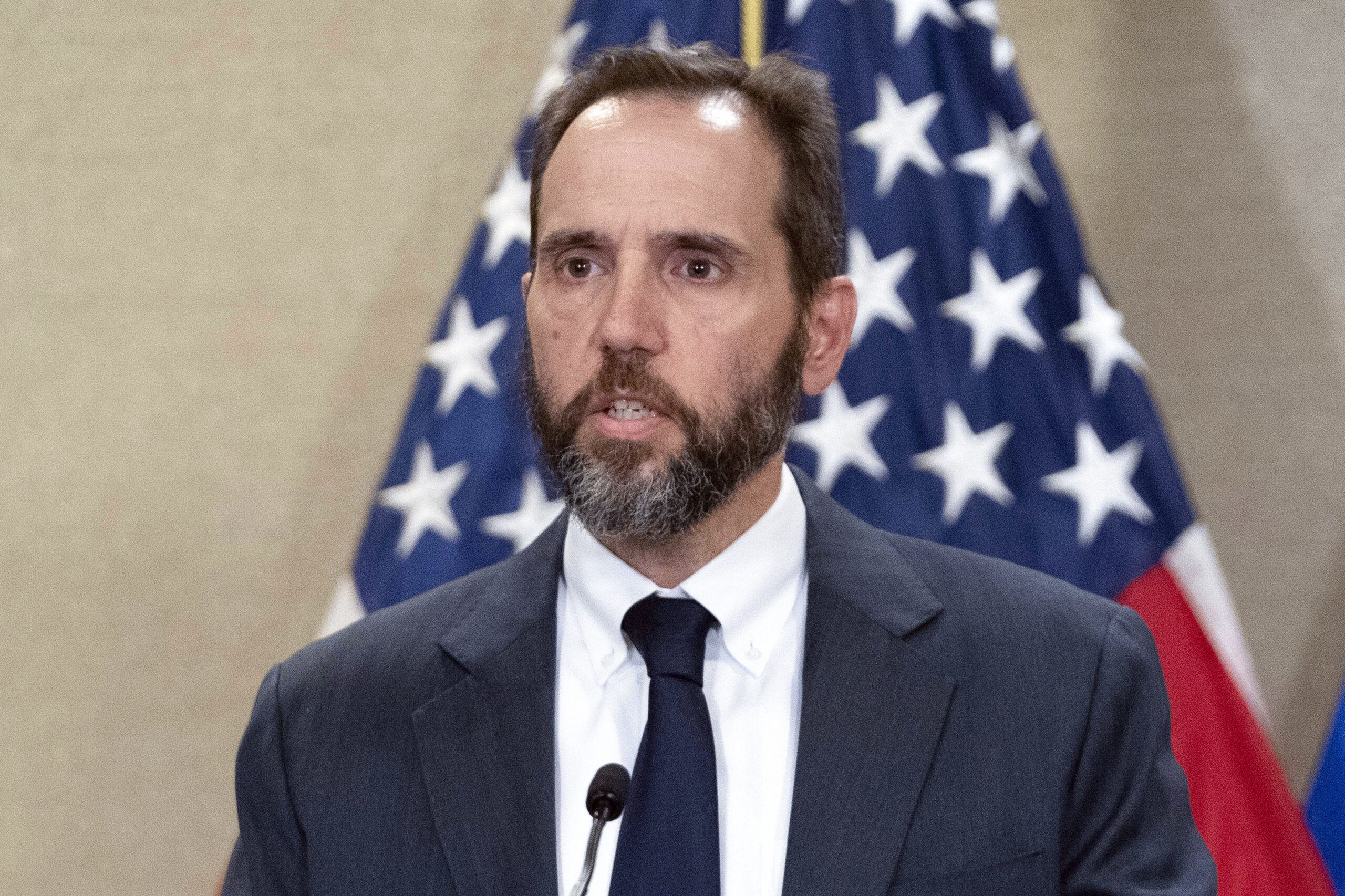
Former Special Counsel Jack Smith, who led the witch-hunt against President Trump, could be brought to justice very soon.
On Wednesday, Rep. Jim Jordan referred Jack Smith to the Department of Justice for criminal prosecution.
In a letter to Acting AG Todd Blanche, Rep. Jordan alleged that Smith made false statements before Congress about the scope of his investigation into President Trump.
Here are the details:
CRIMINAL REFERRAL: House Judiciary Chairman Jim Jordan refers former special counsel Jack Smith to the DOJ for allegedly making false statements to Congress about accessing lawmakers' text messages during his Trump investigations.
Jordan argues Smith told his committee under… pic.twitter.com/RSraBnOxg1
— Fox News Politics (@foxnewspolitics) July 23, 2026
CRIMINAL REFERRAL: House Judiciary Chairman Jim Jordan refers former special counsel Jack Smith to the DOJ for allegedly making false statements to Congress about accessing lawmakers’ text messages during his Trump investigations.
Jordan argues Smith told his committee under oath that his team never accessed the content of congressional members’ privileged texts — but documents released last week by Sen. Chuck Grassley show Smith’s team read messages from 44 members of Congress from both parties, including Jordan himself, Grassley, the late Sen. Lindsey Graham, Sen. Susan Collins, and House Majority Leader Steve Scalise.
The referral asks AG Todd Blanche to examine whether Smith’s conduct warrants charges under 18 U.S.C. § 1001 — the federal statute covering false statements to Congress.
Last Tuesday, Senate Judiciary Chairman Chuck Grassley exposed Jack Smith for spying on dozens of Congress members.
He presented evidence that Jack Smith read the text messages of 44 members of Congress.
However, Jack Smith previously testified under oath that he never read any Congress members’ text messages — a blatant lie!
Fox News has more:
The referral comes after Smith faced mounting scrutiny from Republicans over allegedly weaponizing the Justice Department and violating constitutional privacy protections during his investigations into alleged interference during the 2020 election and Trump’s handling of classified documents.
He has denied any wrongdoing.
Senate Judiciary Committee Chairman Chuck Grassley, R-Iowa, released documents last week showing Smith’s team read the text messages of 44 members of Congress from both parties and White House staff during its investigation.
Targeted lawmakers included Jordan and Grassley in addition to the late Sen. Lindsey Graham, R-S.C.; Sen. Susan Collins, R-Maine; House Majority Leader Steve Scalise, R-La.; and Sen. Cory Booker, D-N.J.
Trump officials affected included former Vice President Mike Pence, White House deputy chief of staff Stephen Miller, FBI Director Kash Patel and Ivanka Trump, among others in the president’s orbit during his first term.
Grassley’s office also found that Smith’s team appeared to violate investigative protocols by accessing text messages that had not been reviewed by a “filter team,” a safeguard designed to prevent investigators from accessing privileged information, according to the documents.
When Smith was asked by congressional investigators if he examined the contents of lawmakers’ text messages during his probe, he said, “no.”
He told the House Judiciary Committee his team only sought telephone toll records.
“Toll records were sought for historical telephone routing information, collected after calls had taken place, identifying the incoming and outgoing call numbers, the time of the calls and their duration,” Smith testified in December. “Toll records do not include the content of calls.”
For reference, here’s the clip of Jack Smith brazenly lying under oath:
December 2025: Jack Smith swore under oath that he didn't spy on text messages belonging to members of Congress.
Today: New evidence confirms he spied on dozens of members of Congress, myself included.
This is a blatant abuse of power, and exactly what our Founders warned… pic.twitter.com/3eqwiylLXI
— Rand Paul (@RandPaul) July 14, 2026
The House Judiciary shared Rep. Jordan’s full letter to Acting AG Blanche:
Read the full letter: https://t.co/L73QljjRGv pic.twitter.com/wRP7nDTxFQ
— House Judiciary GOP (@JudiciaryGOP) July 23, 2026
Here’s the full text of Rep. Jordan’s letter:
Dear Acting Attorney General Blanche:
The Committee on the Judiciary writes to refer strong evidence that appears to show Jack Smith, former Special Counsel, knowingly made false statements during his December 17, 2025, deposition. While testifying under oath, Mr. Smith seemingly made willfully and intentionally false statements of material fact that contradict new documents obtained by the Committee from the Department of Justice (DOJ). The Committee is providing this information for the DOJ to investigate a potential violation of 18 U.S.C. § 1001.
During the Biden-Harris DOJ’s investigation of the 2020 election, codenamed Arctic Frost, and the subsequent Special Counsel investigation, investigators unconstitutionally subpoenaed phone records for over a dozen Republican Members of Congress and obtained gag orders to prevent the Members from knowing that the Biden-Harris Administration had obtained these records. In May 2022, investigators in the U.S. Attorney’s Office for the District of Columbia began seeking subpoenas for Members’ phone records because these Members spoke with certain Executive Branch officials. On August 9, 2022, the Federal Bureau of Investigation (FBI) and DOJ Office of Inspector General agents seized Representative Scott Perry’s cell phone, capturing a full image of the contents of his phone.
In the months following Jack Smith’s appointment as Special Counsel, Mr. Smith’s team proposed over a dozen additional toll record subpoenas for Republican Members of Congress, with Mr. Smith approving the vast majority of these subpoenas. Mr. Smith and the Biden-Harris DOJ barely considered the Constitution as they seized these records of Congressional Republicans—and to the extent that they did, subject matter experts within DOJ warned that their subpoenas might be unconstitutional. However, instead of carefully considering the constitutional implications of their actions, these DOJ prosecutors obtained non-disclosure orders to try to prevent the Members from ever learning that the Biden-Harris Administration had seized their records.
The Committee has been conducting oversight of Mr. Smith’s politicized investigation, including its violations of the Speech or Debate Clause in obtaining privileged information from Members of Congress. On October 14, 2025, the Committee requested that Mr. Smith testify before the Committee about his investigation. Among other things, the Committee noted that it sought Mr. Smith’s testimony concerning his office’s “surveillance of sitting Members of Congress,” noting specific interests in “how many other members of Congress were investigated as part of the Arctic Frost investigation and Jack Smith investigation” and if “additional Members of Congress that were swept up” in the investigation. The Committee subsequently issued a deposition subpoena for Mr. Smith.
During the deposition on December 17, the Committee advised Mr. Smith that he was obliged to provide all necessary information that would make his responses truthful and to avoid half-truths or incomplete answers. The Committee questioned Mr. Smith about the toll records subpoenas relating to the private records of Members of Congress. The Committee sought to understand, in particular, whether Mr. Smith, or members of his team, ever received or reviewed the content of Members’ communications. During his deposition, Mr. Smith testified that he did not receive the content of Members’ text messages. He testified:
Q. Did you seek a search warrant for the content of any text messages from Members?
A. From Members?
Q. Yes.
A. No, I don’t recall that.
Q. Okay. It was just toll records?
A. Correct.
Q. Did the toll records that you requested from the Senators, did they include the content of the phone calls?
A. No.
Q. Did the records that you requested, the toll records from the Member of Congress, include the content of text messages?
A. No.
The responses provided by Mr. Smith gave the impression that neither Mr. Smith nor his team had access to the content of Members’ privileged text messages. We now know this to be false.
Under 18 U.S.C. § 1001, a witness commits a crime if the witness “knowingly and willfully” makes “any material false, fictitious, or fraudulent statement or representation” with respect to “any investigation under review, conducted pursuant to the authority of any committee . . . of the Congress.” Congress cannot perform its oversight function if witnesses who appear before its committees do not provide truthful testimony. False statements before Congress are crimes that undermine the integrity of the Constitutional duty to conduct oversight and inquiries.
New information obtained by the Committee reveals how Mr. Smith likely circumvented key constitutional protections, including the Speech or Debate Clause, to spy on Members of Congress. On July 14, 2026, the DOJ produced documents to the Committee revealing that Mr. Smith’s team obtained text messages of 44 Members of Congress—implicating both Republicans and Democrats in both chambers of Congress—that may have included privileged content. This information calls into question the completeness and accuracy of statements that Mr. Smith made under oath to the Committee regarding his team’s access to the content of Members’ text messages.
The new information received on July 14 showed that Mr. Smith’s team likely violated DOJ’s own internal policy and obtained text messages between Members of Congress and Executive Branch officials that may have included privileged content, without any screening by a filter team for potential privileges.
The filter team procedures state that “[n]o materials shall be disclosed to the investigative team without approval of a filter team attorney.”
Despite this, on August 21, 2023, Senior Assistant Special Counsel Thomas Windom received an email from the General Counsel of the National Archives and Records Administration (NARA) in response to the Special Counsel Office’s June 2, 2023 request, for NARA to produce “Presidential records of the Trump administration . . . .” In that email, NARA attached “54 spreadsheets containing requested custodians’ text messages” from White House phones. Windom then reviewed the text messages and proceeded to forward the content of the texts to fellow prosecutors on the investigative team.
Windom, as a member of Smith’s investigative team, should not have had access to the content of those text messages until after they were reviewed by the filter team.
Based on this new information, there is cause for investigation to determine whether Mr. Smith knowingly made false statements to obstruct the Committee’s oversight. Under relevant federal statutes, a witness makes a false statement when the witness provides a half-truth or excludes information necessary to make statements accurate.
A half-truth includes selectively providing information while affirmatively representing that the disclosed information is complete. A statement containing some truthful information becomes affirmatively false when it represents that the partial information is complete.
During his deposition, Mr. Smith was advised of his obligation to provide all necessary information that would make his responses truthful. The Committee specifically instructed him that he could not tell half-truths or exclude information necessary to make statements accurate, and that a deliberate failure to disclose information could constitute a false statement.
Despite this admonition, when the Committee inquired about whether Mr. Smith’s office received content of text messages sent or received by Members of Congress, Mr. Smith’s answers excluded information that was highly relevant to the Committee’s examination of violations of the Speech or Debate Clause. In particular, while Mr. Smith testified that he did not seek a search warrant from telecommunications carriers for the content of Members’ text messages, he failed to disclose that his office received text message content from NARA relating to White House personnel phone records.
Mr. Smith’s failure to disclose this information amounts to strong evidence that Mr. Smith made material false statements about his office’s receipt of the content of text messages sent or received by Members of Congress.Mr. Smith “knowingly and willfully” made false statements to the Committee during his deposition. An individual acts knowingly and willfully if he makes statements deliberately and with knowledge that the statement was false. The individual must only act with knowledge of the falsity and need not have any intent to defraud. Further, the act is done “willfully” if done deliberately and voluntarily. Mr. Smith’s conduct during the deposition evidences that he acted “knowingly and willfully” in making false statements to the Committee.
In light of the new information detailing that Mr. Smith’s team did have access to content of Members’ text messages and the fact that Mr. Smith made false statements regarding this information during his deposition, suggests that he willingly and knowingly made false representations to the Committee.
The Supreme Court has recognized that Congress has a “broad and indispensable” power to conduct oversight that “encompasses inquiries into the administration of existing laws, studies of proposed laws, and surveys in our social, economic or political system for the purpose of enabling Congress to remedy them.” Pursuant to rule X of the Rules of the House of Representatives, the Committee has jurisdiction over federal law enforcement including DOJ and its component entities. Rule XI of the Rules of the House of Representatives authorizes the Committee to require by subpoena the attendance and testimony of witnesses at depositions and hearings to carry out its functions and duties. Pursuant to these authorities, the Committee has been investigating the operations and programs of the DOJ during the Biden-Harris Administration and, as relevant here, Jack Smith’s Office of Special Counsel.
All individuals have an obligation to comply with a duly authorized congressional inquiry. Mr. Smith, a former public servant, is no different. Yet his testimony included intentionally false statements designed to obstruct the Committee’s oversight. His conduct can only be understood as an effort to thwart the Committee’s inquiry by intentionally making false statements and representations before Congress. We therefore believe that sufficient evidence exists for DOJ to examine whether Mr. Smith’s actions warrant a charge for the violation of 18 U.S.C. § 1001. For your reference, we have enclosed documentation of the above-described conduct.
Thank you for your prompt attention to this matter.
cc:
Enclosure
The Honorable Jamie Raskin, Ranking Member
Sincerely, Jim Jordan
Chairman
What do you think?
Should Jack Smith face prosecution for lying before Congress?
Continue reading...
[ H/T WLT Report ]