





Futures Rebound As Brent Dips Below $100
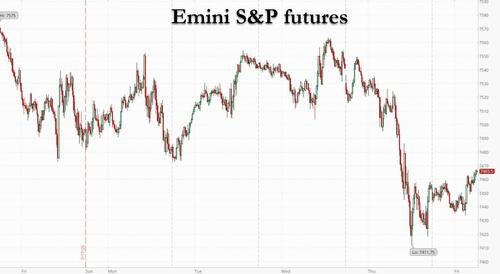
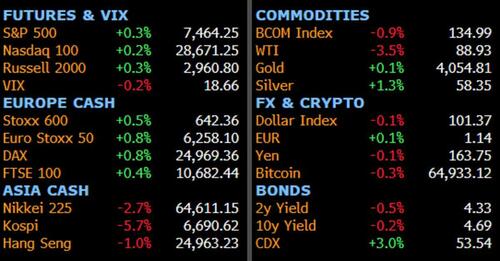
US equity futures are seeing a modest rebound after posting their biggest drop this month, as Brent crude dropped back under $100 a barrel, and bond yields and rate hike odds - which track the price of oil one to one - halted their ascent. As of 6:00am ET, S&P 500 futures rose 0.3%, with the index still on track for its first back-to-back weekly loss since the early stages of the Iran war. Tech stocks remained under pressure as South Korea’s memory and Japanese chip giants were pummeled. Treasury yields hovered just below their highest levels this year, while Brent fell more than 3% toward $97 a barrel.
In premarket trading, Tesla leads gains among Mag 7 stocks after the electric vehicle maker plunged about 15% on Thursday (Tesla +1.3%, Microsoft +1.1%, Alphabet +0.7%, Meta +0.7%, Amazon +0.5%, Apple +0.2%, Nvidia -0.4%)
In other corporate news, SpaceX is said to have started to turn away satellite operators seeking dedicated rides to orbit aboard its staple Falcon 9 rocket beyond 2028, underscoring the massive bet Elon Musk is making on its unproven Starship. The pause on Paramount Skydance’s takeover of Warner Bros. Discovery has been extended two weeks to Aug. 17 by the federal judge in California
PayPal shares fell in extended trading following a Wall Street Journal report that Stripe is in talks to acquire startup OpenRouter
JPMorgan is said to have moved more than 30 quant researchers from mainland China to Singapore and Hong Kong.
Traders are moving cautiously after a week in which stocks and bonds were rattled by the intensifying war in Iran, soaring oil prices and fresh concerns over whether massive investments in AI will pay off. Investors are now bracing for a weekend that could bring further escalation in the Middle East, ahead of a stack of earnings from AI hyperscalers next week.
Michael Hewson, analyst at iForex, said he was surprised by how well markets are holding up despite the sharp increase in oil prices. As for earnings, “next week is a really big week and it could be make-or-break in terms of where markets go next,” he said. “There’s an awful lot more nervousness now about capex, particularly when you’re talking about AI and where’s the return on investment coming.”
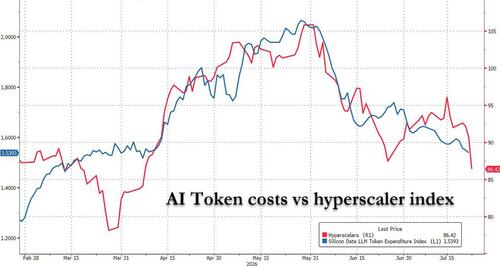
To be sure, investors are contending with a growing wall of worry over AI spending, rising competition from Chinese frontier models, and increasingly crowded positioning. Amid soaring Chinese competition with open models which some accuse of being offered at dumping prices, the cost of tokens has tumbled and erased the entire recent "agentic" surge; not surprisingly, stock prices of hyperscalers have followed suit.
Die-hard tech bulls got some good news on Thursday when Intel delivered a revenue forecast that shattered Wall Street estimates as booming data center spending fuels a long-awaited turnaround. The company forecast sales of $15.8 billion to $16.8 billion in the third quarter, with even the low end of that range easily clearing the $15.1 billion average analyst estimate.
On Thursday, Brent surged above $100, Oil headed for a weekly surge with Brent trading above $100. President Trump said damage to ships and cargo would be paid for by Iranian funds frozen by the US after new strikes by Houthi rebels. Trump also threatened to step up strikes on Iran.
“Were it not for the resurgence of the conflict in the Middle East, the picture would have looked encouraging,” wrote ING economist Bert Colijn. “As uncertainty returns, renewed (though mild) stagflationary pressures are likely to weigh on the euro-zone economy over summer.”
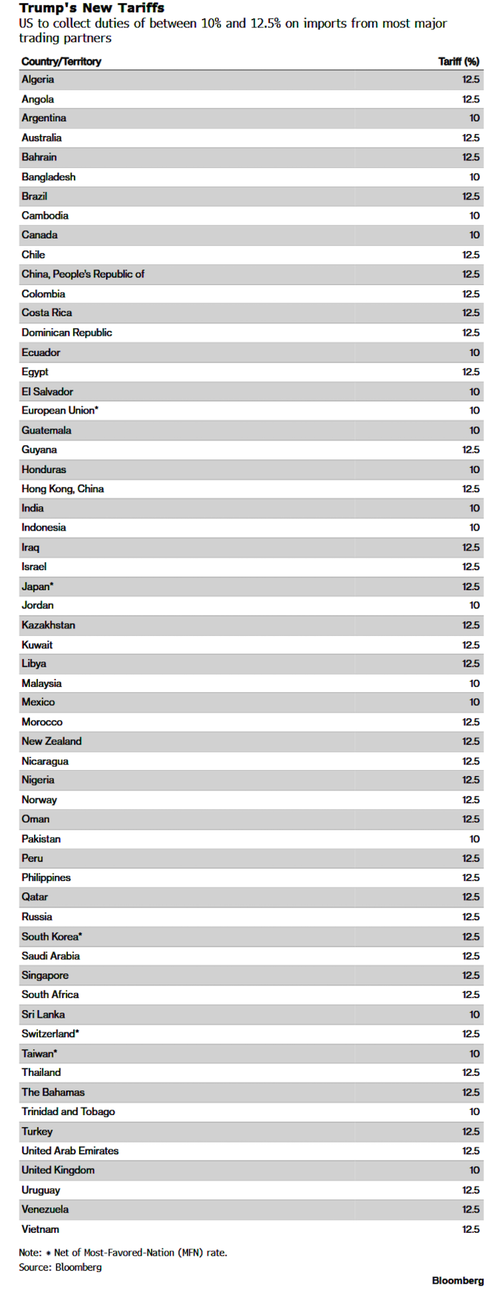
In tariff-related news, the US will collect duties of between 10% and 12.5% on imports from most major trading partners, its biggest move yet to reconstruct Trump’s tariff wall - this time under Section 301 of the Trade Act of 1974 - that was pierced by the Supreme Court, which nullified Section 122 duties that expire today.
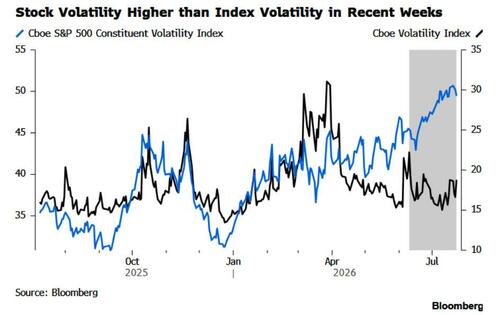
Elsewhere, volatility dispersion has performed well since the end of March given a crush in implied correlation. The S&P 500’s top 50 basket has been one expression of the trade which tactical and systematic players entered prior to earnings reports for the first quarter. However, extremely low implied-correlation levels have some investors concerned about a reversal. Hence, there has been some unwinding of positions and, indeed, contrarians entering tactical "reverse dispersion" trades — buying index volatility, and selling single-stock volatility.
Sebastian Raedler, head of European strategy at Bank of America, cautions the global equity picture is “not bullish,” and investors aren’t being compensated for risk. “Margin expectations at an all-time high, you’ve expected five-year forward earnings growth at an all-time high, you’ve got market cap-to-GDP globally at an all-time high and you’ve got risk premia at a 20-year low — what the market is pricing is a scenario where everything goes right and there are no risks,” Raedler said in a Bloomberg TV interview.
A quick note on earnings: EPS growth in the US and Europe is looking better than expected at this early stage of the reporting season, according to JPMorgan strategists. With about a quarter of companies having reported, JPM's Mislav Matejka says earnings growth is at +23% y/y in the US, and +22% y/y in Europe. That implies a positive surprise factor of 13% and 2%, respectively. Looking at actual beats and misses, of the 129 S&P 500 companies to have reported thus far, 85% have beaten analysts’ forecasts, while 11% have missed. 71% of companies have positively surprised on sales, while 14% have missed. Around 170 index constituents are due to release earnings next week which will be the busiest of earnings season.
In Europe, the Stoxx 600 climbed 0.5%, led by gains in software stocks after SAP SE reported better-than-expected sales for cloud products; SAP was the region’s most significant outperformer on its latest results, while Finland’s Valmet surged after announcing it is mulling a demerger. Here are the biggest movers Friday:
Sentiment got a boost after UK consumer confidence climbed six points to minus 17, the largest increase since November 2023, according to GfK’s indicator. Sentiment is now back to levels last seen in January. Meanwhile, bond traders, economists and even BOE staff are warning of QT’s impact, as pressure mounts on gilts from the return of hostilities in the Middle East and the arrival of a new prime minister with big spending promises. Still, escalating tensions in the Middle East threaten to scupper the optimism once again.
Asian tech shares fall sharply following Thursday’s Mag7 selloff amid growing doubts on popular AI trade’s durability. Kospi plunged about 5%, led by another crash in SK Hynix, and Nikkei falls almost 3%. The MSCI Asia Pacific Index fell as much as 2.5%, paring its gain for the week to 0.9%.
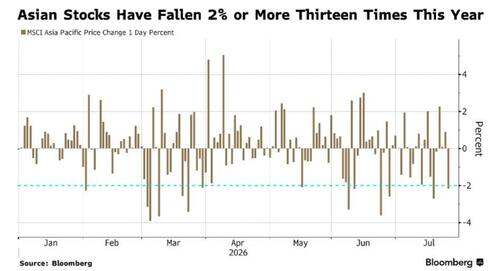
Elsewhere, Hang Seng, Shanghai Composite and Taiex indexes all tumbled. Samsung and SK Hynix dropped almost 8% each, among the biggest drags on the gauge along with TSMC and Kioxia. A look at the past 10 days of SK Hynix trading in Korea shows just how broken "price discovery" has become:
The losses tracked declines in the Magnificent Seven overnight on worries over the durability of the AI trade. “A second wave of geopolitical tension and tariffs landing back on the table just when markets had convinced themselves the worst was over is reviving inflation and growth concerns simultaneously, while the AI, chip and technology trade has lost much of the momentum that previously helped hold the region together,” said Hebe Chen, a senior market analyst for Vantage Global Prime.
In FX, the dollar is tightly rangebound against most majors. The yen hovered around 163.80/USD.
In rates, treasury 10-year yield adds a basis point to 4.71% as sovereign bonds remain under pressure. Australian 3-year yield jumps more than 10 bps. JGB futures decline following Japan inflation uptick. European bonds across the region staged a rebound after days of losses. The average yield on the Bloomberg Global Treasury Index — which tracks investment-grade government bonds — surged to 3.68%, surpassing a peak from three years ago to reach the highest since the global financial crisis in 2008. Treasury 10-year yields rose a basis point to 4.70%, while bonds fell in Japan, Australia and New Zealand.
Asian stocks fell, with the Kospi index sliding more than 4%, and benchmarks in Japan and Taiwan also dropping more than 2%. The Magnificent Seven technology behemoths suffered their biggest one-day drop since the tariff tantrum in April 2025 on Thursday. Intel shares rose in US post-market trading after its revenue forecast shattered estimates, indicating that booming data center spending is helping fuel a long-awaited turnaround.
In commodities, WTI crude futures hover around $91.50 while Brent contracts remain above $100 a barrel. Gold eases to near $4,030 an ounce.
Market Snapshot
Top Overnight News
A more detailed look at global markets courtesy of Newsquawk
APAC stocks followed suit to the losses on Wall Street where the Nasdaq was heavily pressured following Alphabet and Tesla earnings, while sentiment was also weighed on by rising oil prices and yields as geopolitical escalation continues. ASX 200 retreated with underperformance in tech and miners leading the downside, while the improvement in Australian flash PMIs did little to spur a rebound. Nikkei 225 fell beneath the 65,000 level with tech stocks heavily pressured and over-represented in the list of worst performers, while inflation data did little to shift the dial and printed in line with expectations. KOSPI suffered the brunt of the tech selling with sidecars activated on the KOSPI and KOSDAQ. Hang Seng and Shanghai Comp conformed to the broad downbeat mood with notable pressure in miners and tech stocks.
Top Asian News
European bourses start the final trading day entirely in the green, with outperformance in the IBEX 35 and DAX 40, given positive earnings from SAP and the rebound in European banks. Supporting the equity space is the lower energy prices, possibly as investors take profits heading into the weekend. On the data front, flash PMIs surprised to the upside across the EZ and the UK. The commentary broadly highlighted the cooling of cost pressures, however, while noting that inflationary pressures remain elevated. Another caveat is that the survey period was between the 9th-22nd July, which doesn't include the recent return of Brent above USD 100/bbl. Sectors point to a mixed, but slightly positive, picture. Tech tops the sector pile, with Financial Services and Banks rounding out the top 3 sectors. Telecoms is the sector laggard, followed by Energy and Autos. Two of Germany's biggest companies reported earnings before the market open. Starting with SAP, its Q2 revenue and cloud revenue beat estimates, with its cloud business increasing 24% Y/Y. This is driving the majority of gains, printing gains in excess of 6%. In terms of guidance, its FY adj. operating profit shifted EUR 100mln lower to 11.8-12.2bln (prev. guided 11.9-12.3bln). On the other hand, Volkswagen reported its Q2 metrics. Revenue beat estimates; however, the Co. cut its FY revenue guidance to between -3% and 0% (prev. guided 0-3%). Co. execs highlighted the increased competitiveness in China, with vehicle sales falling 31.6% in the region. The CFO also stated that current planned initiatives are not sufficient to compete in China. As such, shares have fallen by over 1.5%.
Top European News
FX
Fixed Income
Commodities
Trade/Tariffs
Central Banks
Geopolitics: Middle East
Geopolitics: Russia-Ukraine
Geopolitics: Other
US Event Calendar
DB's Jim Reid concludes the overnight wrap
I'm coming to terms with the fact that my wife and kids are this morning leaving me for 5 days to go camping on a mums and kids only trip. How will I cope with the pain and sadness of being alone for such a long time? The answer: Golf tonight, tomorrow morning, tomorrow afternoon, Sunday morning, Sunday afternoon, and maybe Monday and Tuesday evening after work. If I can walk on Wednesday, I'll be impressed. My wife genuinely thinks I won't be able to cope on my own and has left a meal plan and dossier of instructions. I'm not quite sure how she thought I coped in the 36 years I lived on the planet before we met.
As we approach my lost weekend, the two big themes in financial markets all year, namely Iran and AI, have combined in a negative direction to leave a challenging 24 hours for markets and potentially threatening time spent on the beach for many in the days ahead, and remaining weeks of Summer. The sell-off certainly wasn't helped by Brent crude surging back above $100/bbl as peace in Iran looks distant for now.
The latest is that Trump said to Axios that he was “considering a massive attack” and was “close to making a decision”. And earlier on, he posted that if the Houthis continued to make strikes, then “major military punishment will be inflicted upon Iran” as well. In turn, Tehran warned that it would retaliate, including against energy facilities in the region, if Trump followed through on his threat to target Iranian bridges and power plants. The escalatory rhetoric raised fears of a more prolonged stagflationary shock and drove some big losses across global markets, with yields hitting multi-year highs on both sides of the Atlantic. Indeed, the 10yr bund yield (+3.1bps) hit a post-2011 high yesterday of 3.20%, whilst the 30yr real yield in the US (+2.8bps) hit a post-2008 high of 2.96%.
The most obvious impact of the escalation could be seen in energy prices, with Brent crude (+7.04%) posting another big daily increase to close at $100.69/bbl, its highest level since May. This morning we're just a couple of tenths of a percent lower and still above $100. That stands in stark contrast to where we began the month, with Brent at around $72/bbl after the interim deal was signed and there were initial indications that the Strait of Hormuz was beginning to reopen. The jump in the 6-month Brent future (+1.80% to $83.21/bbl) was more modest, but this is now up by more than $10/bbl since early July as investors price in a more lasting shock. In the one piece of slightly better energy news, European natural gas futures (-1.02%) dipped slightly from Wednesday’s high, closing at €61.90/MWh.
That jump for oil prices and fears of stagflation put serious pressure on global equities, with the S&P 500 (-1.21%) and Nasdaq (-2.15%) both sliding yesterday. Matters weren’t helped by Tesla (-14.52%) and Alphabet (-7.13%), which both saw large declines after their earnings release the previous day. So that drove a big loss for the Mag 7 (-4.78%) index, which posted its biggest daily decline since the week of the Liberation Day turmoil in 2025. The two big problems for the big tech companies are that capex is no longer being funded out of free cash flow alone (see page 15 of the WOW! pack here for more) and that cheaper open-source AI is seriously threatening the business model of the US AI-stack. See Adrian Cox's piece here at the DBRI on the open-source versus proprietary model battle and my CoTD here from yesterday comparing it to the Betamax versus VHS battle 40-plus years ago.
The sell-off wasn't just in the US, as Europe was hit hard by the oil shock, with the STOXX 600 down -1.18% as the CAC 40 (-1.64%), DAX (-1.56%), and FTSE MIB (-2.80%) all posted large declines.
The risk-off mood was also visible in other asset classes, with US HY credit spreads (+9bps) seeing their biggest widening since March, while the dollar index (+0.32%) had its best day in a month.
The ongoing surge in oil prices also meant that inflation expectations crept up yesterday. In fact, the 1yr Euro inflation swap rose a further +10.9bps to 2.75%, whilst the 1yr US inflation swap (+1.9bps) was up to 2.07%. So that led to ongoing speculation that the Fed might still be about to hike as soon as next week, with the futures-implied probability of that up to 34% by the close. And it was a similar story in Europe, where 47bps of further hikes are now priced from the ECB by the December meeting up +1.1bps on the day.
Staying with the ECB, in their latest policy decision yesterday they kept their deposit rate at 2.25% as widely expected, while implying that further hikes were still likely. Both the short decision statement and Lagarde’s press conference noted that the latest outlook was broadly unchanged relative to the ECB’s June baseline scenario which had been predicated on market pricing of three hikes this cycle (so two more after the June hike). Lagarde also said yesterday that the ECB’s reaction function was "very well understood" by markets, showing no desire to push back on market pricing. Our European economists now see a September hike to 2.50% as a near done deal. Risks are clearly skewed towards a further hike thereafter, but this would require persistently elevated energy prices and/or evidence of second-round effects. See their full reaction here.
With inflation fears mounting, sovereign bond yields hit fresh multi-year highs yesterday on both sides of the Atlantic. In the US, the 10yr Treasury yield (+3.8bps) rose to 4.69%, its highest since January 2025, whilst the 2yr yield (+4.9bps) rose to 4.34%. The gains were even clearer for real yields, where the 10yr real yield (+5.7bps) closed at 2.42%, its highest since October 2023, whilst the 30yr real yield (+2.8bps) was up to 2.96%, which is its highest level since autumn 2008 at the height of the GFC. Meanwhile in Europe, there were also several records, with the 10yr bund yield (+3.1bps) at a post-2011 high of 3.20%, whilst the 10yr OAT yield (+4.7bps) hit a post-2009 high of 4.01%.
In trade news, overnight the Trump administration finalized the details of the new Section 301 tariffs covering some 60 of the US’ trading partners. Largely in line with what was signaled when the investigations into alleged forced labour practices in supply chains concluded last month, most of the largest trading partners including the EU, UK, Canada and Mexico will face a tariff of 10%, while others including Japan, South Korea and Australia will face a 12.5% levy. As a reminder, these duties arrive as today sees the expiry of the temporary 10% Section 122 tariffs, which themselves were announced after the Supreme Court in February struck down tariffs introduced under the International Economic Emergency Powers Act.
In Asia the negative mood continues but US equity futures are more stable. The KOSPI (-5.62%) is again leading declines and is poised to wipe out gains made earlier this week as major chipmakers follow weakness seen among their US counterparts. Japan’s Nikkei (-2.87%) is also sharply lower, extending its losing streak into a third consecutive week. In China, the CSI 300 (-1.17%) remains on course to break a four-week run of weekly losses despite today’s decline. Hong Kong’s Hang Seng (-1.27%) is also trading lower but is still positioned to record a fourth straight week of gains. The S&P/ASX 200 (-0.93%) is also lower. S&P 500 futures are down -0.08% with the Nasdaq equivalent -0.34% lower. The tech cycle mood improved a bit after a stellar earnings report from Intel which forecast that revenue in Q3 will be $15.8-16.8bn, well above the $15.1bn average estimate. Intel’s shares rose by +4.5% in after-hours trading.
Data released earlier this morning showed that Japan’s inflation remained broadly in line with expectations in June. Core CPI rose 1.6% year-on-year, matching forecasts, while the closely watched “core-core” CPI measure eased to 1.7% from 1.8% in May, remaining below the Bank of Japan’s inflation objective and a touch below expectations. Headline CPI accelerated as expected to 1.7% year-on-year from 1.5% previously, marking its highest reading so far this year.
In Australia, private-sector activity expanded at a stronger pace in July, with the S&P Global Flash Composite PMI increasing to 52.6 from 50.4 in June, recording a second consecutive month of growth and its strongest level since the start of the year. The services PMI improved to 53.0 from 50.5, while the manufacturing PMI edged up to 51.7 from 51.5, indicating continued expansion across both sectors.
Finally, there wasn’t much data yesterday, but the US weekly initial jobless claims fell to just 187k (vs. 210k expected) in the week ending July 18, which is their lowest level since 1969. So that reassured investors about the state of the labour market moving into the summer, and kept up the hawkish pressure on Fed pricing.
To the day ahead now we’ll get the July flash PMIs from around the world, US June new home sales, July Kansas City Fed services activity, UK June retail sales, Germany August GfK consumer confidence, Canada June industrial product price index, raw materials price index. Central bank events include the ECB’s June consumer expectations survey and the BoE’s DMP survey, whilst the ECB’s Lane will also speak. Earnings include American Express, NextEra energy, Verizon Communications, HCA Healthcare, and SLB.
Tyler Durden Fri, 07/24/2026 - 07:37
Continue reading...
[ H/T ZeroHedge ]
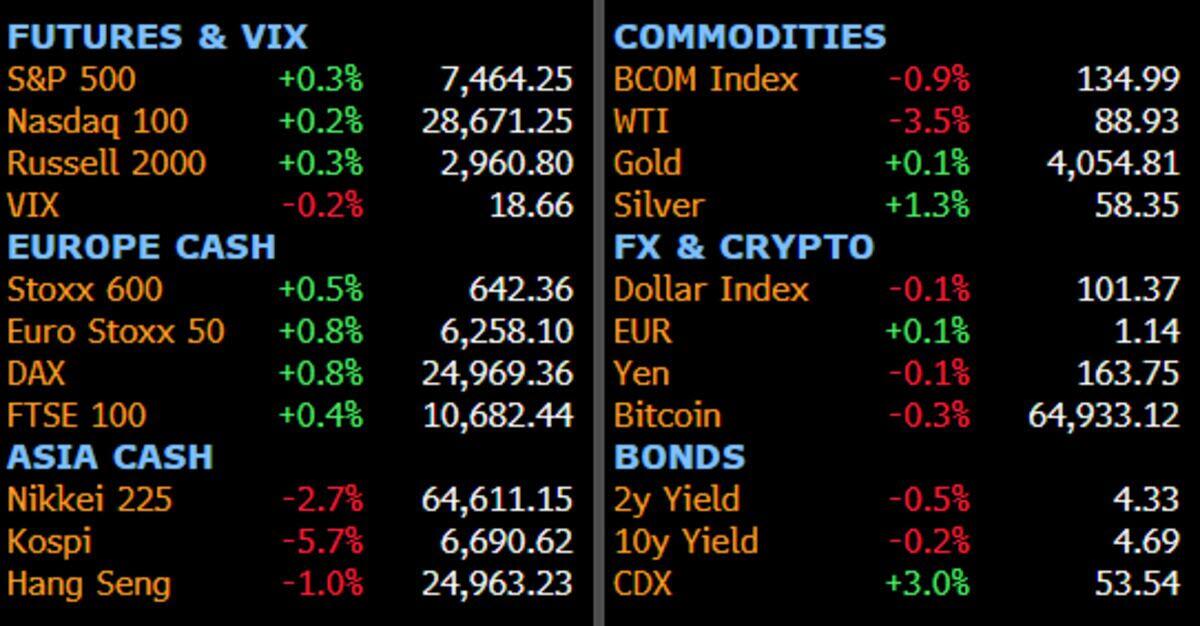
US equity futures are seeing a modest rebound after posting their biggest drop this month, as Brent crude dropped back under $100 a barrel, and bond yields and rate hike odds - which track the price of oil one to one - halted their ascent. As of 6:00am ET, S&P 500 futures rose 0.3%, with the index still on track for its first back-to-back weekly loss since the early stages of the Iran war. Tech stocks remained under pressure as South Korea’s memory and Japanese chip giants were pummeled. Treasury yields hovered just below their highest levels this year, while Brent fell more than 3% toward $97 a barrel.
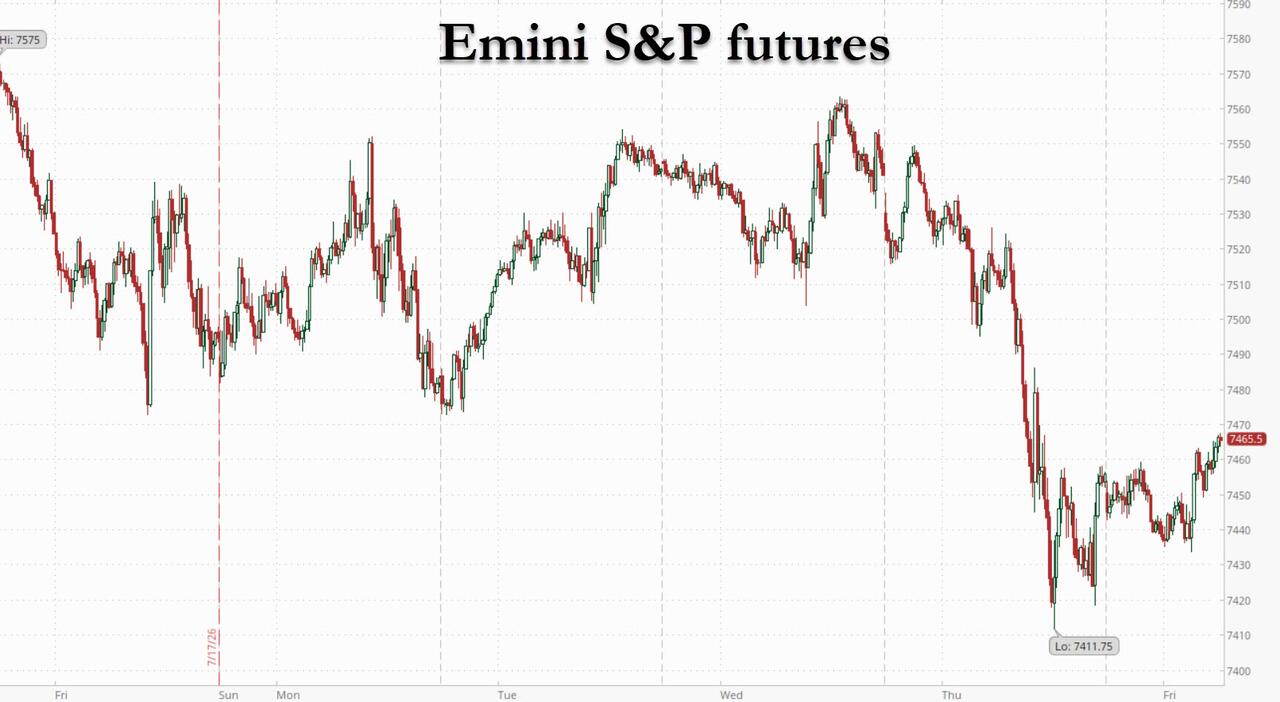
In premarket trading, Tesla leads gains among Mag 7 stocks after the electric vehicle maker plunged about 15% on Thursday (Tesla +1.3%, Microsoft +1.1%, Alphabet +0.7%, Meta +0.7%, Amazon +0.5%, Apple +0.2%, Nvidia -0.4%)
- Amkor Technology (AMKR) rallies 11% after the company announced a $1.5 billion multi-year binding agreement with Nvidia to develop advanced semiconductor packaging and test technologies for next-generation AI and accelerated computing platforms.
- Intel (INTC) gains 4% (well below the kneejerk surge 12% higher) after the chipmaker’s third-quarter forecast was much stronger than analysts’ expectations. The results highlighted both the durability of AI-related demand, as well as the success of Intel’s turnaround.
- MaxLinear (MXL) slides 11% after the semiconductor device company reported second-quarter results that were only modestly ahead of expectations. While its third-quarter revenue forecast was stronger than expected, its view for adjusted gross margin was largely in line at the midpoint of the range.
- Oracle (ORCL) is up 2.6% after the software company said it had been awarded a 10-year IDIQ contract by the US Department of Defense under its Enterprise Software Initiative. The contract is valued at $3.31 billion for the first five years and up to $6.99 billion if options are exercised.
In other corporate news, SpaceX is said to have started to turn away satellite operators seeking dedicated rides to orbit aboard its staple Falcon 9 rocket beyond 2028, underscoring the massive bet Elon Musk is making on its unproven Starship. The pause on Paramount Skydance’s takeover of Warner Bros. Discovery has been extended two weeks to Aug. 17 by the federal judge in California
PayPal shares fell in extended trading following a Wall Street Journal report that Stripe is in talks to acquire startup OpenRouter
JPMorgan is said to have moved more than 30 quant researchers from mainland China to Singapore and Hong Kong.
Traders are moving cautiously after a week in which stocks and bonds were rattled by the intensifying war in Iran, soaring oil prices and fresh concerns over whether massive investments in AI will pay off. Investors are now bracing for a weekend that could bring further escalation in the Middle East, ahead of a stack of earnings from AI hyperscalers next week.
Michael Hewson, analyst at iForex, said he was surprised by how well markets are holding up despite the sharp increase in oil prices. As for earnings, “next week is a really big week and it could be make-or-break in terms of where markets go next,” he said. “There’s an awful lot more nervousness now about capex, particularly when you’re talking about AI and where’s the return on investment coming.”
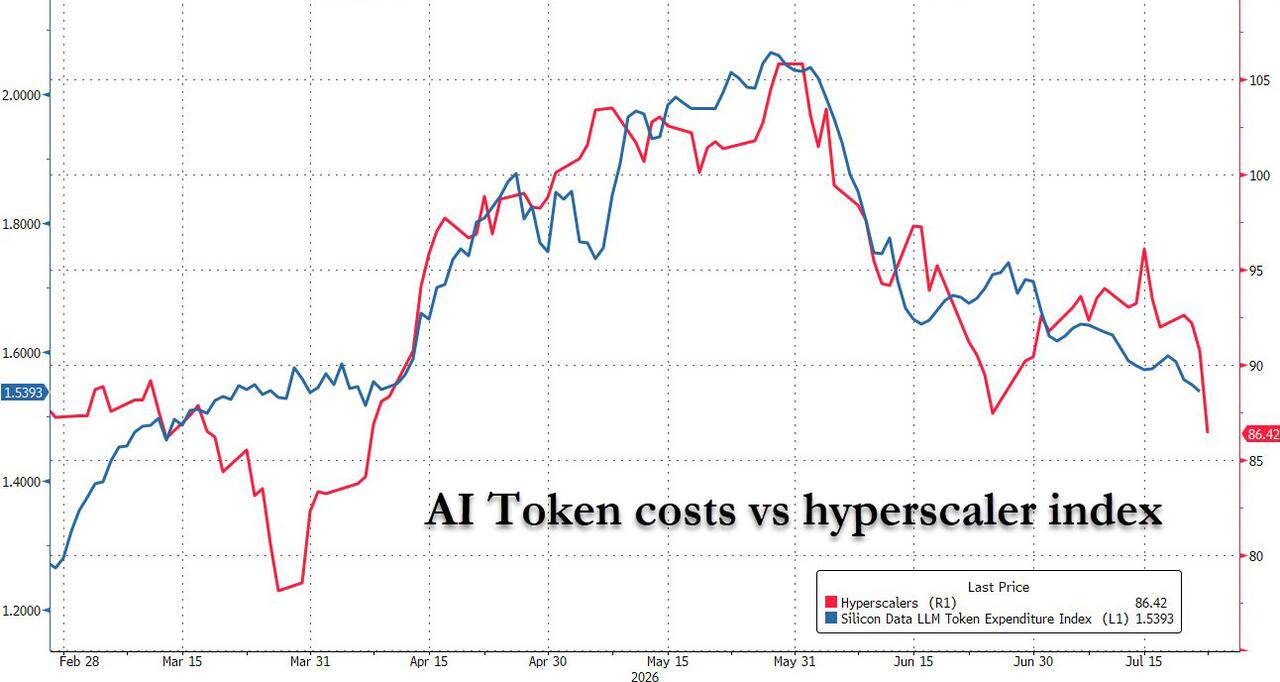
To be sure, investors are contending with a growing wall of worry over AI spending, rising competition from Chinese frontier models, and increasingly crowded positioning. Amid soaring Chinese competition with open models which some accuse of being offered at dumping prices, the cost of tokens has tumbled and erased the entire recent "agentic" surge; not surprisingly, stock prices of hyperscalers have followed suit.
Die-hard tech bulls got some good news on Thursday when Intel delivered a revenue forecast that shattered Wall Street estimates as booming data center spending fuels a long-awaited turnaround. The company forecast sales of $15.8 billion to $16.8 billion in the third quarter, with even the low end of that range easily clearing the $15.1 billion average analyst estimate.
On Thursday, Brent surged above $100, Oil headed for a weekly surge with Brent trading above $100. President Trump said damage to ships and cargo would be paid for by Iranian funds frozen by the US after new strikes by Houthi rebels. Trump also threatened to step up strikes on Iran.
“Were it not for the resurgence of the conflict in the Middle East, the picture would have looked encouraging,” wrote ING economist Bert Colijn. “As uncertainty returns, renewed (though mild) stagflationary pressures are likely to weigh on the euro-zone economy over summer.”
In tariff-related news, the US will collect duties of between 10% and 12.5% on imports from most major trading partners, its biggest move yet to reconstruct Trump’s tariff wall - this time under Section 301 of the Trade Act of 1974 - that was pierced by the Supreme Court, which nullified Section 122 duties that expire today.
Elsewhere, volatility dispersion has performed well since the end of March given a crush in implied correlation. The S&P 500’s top 50 basket has been one expression of the trade which tactical and systematic players entered prior to earnings reports for the first quarter. However, extremely low implied-correlation levels have some investors concerned about a reversal. Hence, there has been some unwinding of positions and, indeed, contrarians entering tactical "reverse dispersion" trades — buying index volatility, and selling single-stock volatility.
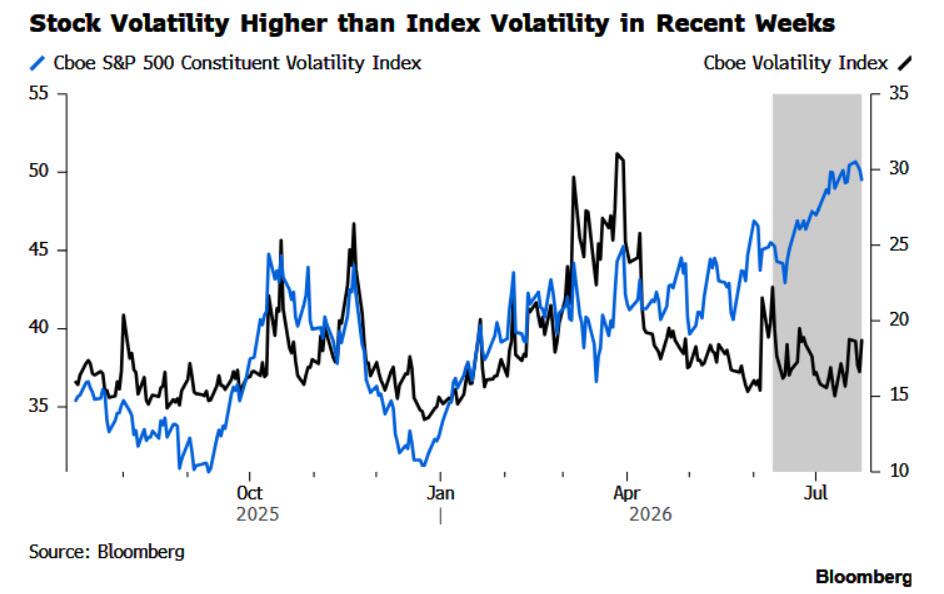
Sebastian Raedler, head of European strategy at Bank of America, cautions the global equity picture is “not bullish,” and investors aren’t being compensated for risk. “Margin expectations at an all-time high, you’ve expected five-year forward earnings growth at an all-time high, you’ve got market cap-to-GDP globally at an all-time high and you’ve got risk premia at a 20-year low — what the market is pricing is a scenario where everything goes right and there are no risks,” Raedler said in a Bloomberg TV interview.
A quick note on earnings: EPS growth in the US and Europe is looking better than expected at this early stage of the reporting season, according to JPMorgan strategists. With about a quarter of companies having reported, JPM's Mislav Matejka says earnings growth is at +23% y/y in the US, and +22% y/y in Europe. That implies a positive surprise factor of 13% and 2%, respectively. Looking at actual beats and misses, of the 129 S&P 500 companies to have reported thus far, 85% have beaten analysts’ forecasts, while 11% have missed. 71% of companies have positively surprised on sales, while 14% have missed. Around 170 index constituents are due to release earnings next week which will be the busiest of earnings season.
In Europe, the Stoxx 600 climbed 0.5%, led by gains in software stocks after SAP SE reported better-than-expected sales for cloud products; SAP was the region’s most significant outperformer on its latest results, while Finland’s Valmet surged after announcing it is mulling a demerger. Here are the biggest movers Friday:
- SAP shares rise as much as 6.8%, bouncing back from a more than 30% drop since the start of the year, after the software company reported 2Q cloud backlog growth that beat estimates
- Valmet surges as much as 29%, the most on record, after the Finnish process technology firm announced it is evaluating a potential separation of its two core businesses into two standalone publicly listed companies
- Acerinox shares rise as much as 10%, hitting their highest level since 2008, after the stainless steel firm reported second-quarter earnings that comfortably beat expectations and outlined guidance for the third quarter
- Metso shares rise as much as 6.7% after the industrial machinery maker reported better order intake from its Minerals arm than expected, with Jefferies flagging the figure was much stronger than what has been reported by its peers
- Atoss Software shares rise as much as 7.5%, with Jefferies analysts saying the workforce management software company delivered earnings ahead of expectations in the first half and raised its Ebit margin goal for 2027
- Arcadis shares rose as much as 12% to €44.08 on Friday after the Dutch engineering firm said it is reviewing a second unsolicited proposal from WSP Global for all outstanding shares at a price of €51.50 per share in cash and WSP stock
- Volkswagen shares fall as much as 3.2% after the German carmaker cut its revenue forecast for the full year and after posting what Morgan Stanley described as a tough quarter
- Carrefour shares fall as much as 7.8%, the most since June 2025, after the French supermarket operator reported recurring operating income for the first half-year that missed the average analyst estimate
- Mapfre shares declined as much as 6.1%, most since March, after the Spanish insurer reported net income for the first half-year that missed the average analyst estimate. The insurer has also announced an acquisition in the US
- Neste falls as much as 11% after the Finnish energy company reported disappointing second-quarter earnings. Analysts say adjusted Ebitda was 2% below consensus, but the performance for its Renewable Products division was a bright spot
- Ipsen shares fall as much as 4.3% after the French biopharma company said its experimental treatment for a rare infant liver disease failed to meet the primary endpoint in a late-stage trial
- Sanofi shares drop as much as 3% after the French pharmaceutical company ended clinical development of amlitelimab, an experimental drug for atopic dermatitis
Sentiment got a boost after UK consumer confidence climbed six points to minus 17, the largest increase since November 2023, according to GfK’s indicator. Sentiment is now back to levels last seen in January. Meanwhile, bond traders, economists and even BOE staff are warning of QT’s impact, as pressure mounts on gilts from the return of hostilities in the Middle East and the arrival of a new prime minister with big spending promises. Still, escalating tensions in the Middle East threaten to scupper the optimism once again.
Asian tech shares fall sharply following Thursday’s Mag7 selloff amid growing doubts on popular AI trade’s durability. Kospi plunged about 5%, led by another crash in SK Hynix, and Nikkei falls almost 3%. The MSCI Asia Pacific Index fell as much as 2.5%, paring its gain for the week to 0.9%.
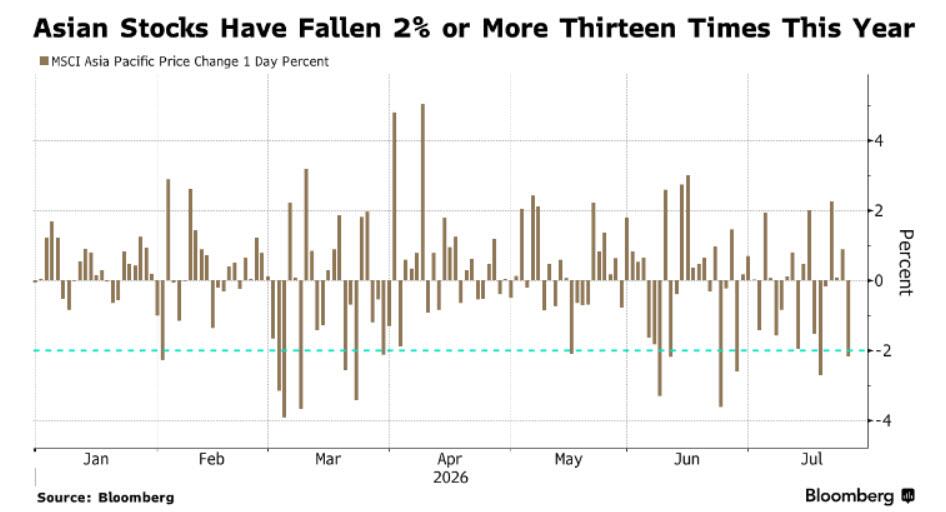
Elsewhere, Hang Seng, Shanghai Composite and Taiex indexes all tumbled. Samsung and SK Hynix dropped almost 8% each, among the biggest drags on the gauge along with TSMC and Kioxia. A look at the past 10 days of SK Hynix trading in Korea shows just how broken "price discovery" has become:
- 7/12: -2.31%
- 7/13: -16.95%
- 7/14: +6.18%
- 7/15: +4.17%
- 7/16: -9.50%
- 7/20: +0.60%
- 7/21: +1.68%
- 7/22: -2.24%
- 7/23: +6.39%
- 7/24: -8.12%
The losses tracked declines in the Magnificent Seven overnight on worries over the durability of the AI trade. “A second wave of geopolitical tension and tariffs landing back on the table just when markets had convinced themselves the worst was over is reviving inflation and growth concerns simultaneously, while the AI, chip and technology trade has lost much of the momentum that previously helped hold the region together,” said Hebe Chen, a senior market analyst for Vantage Global Prime.
In FX, the dollar is tightly rangebound against most majors. The yen hovered around 163.80/USD.
In rates, treasury 10-year yield adds a basis point to 4.71% as sovereign bonds remain under pressure. Australian 3-year yield jumps more than 10 bps. JGB futures decline following Japan inflation uptick. European bonds across the region staged a rebound after days of losses. The average yield on the Bloomberg Global Treasury Index — which tracks investment-grade government bonds — surged to 3.68%, surpassing a peak from three years ago to reach the highest since the global financial crisis in 2008. Treasury 10-year yields rose a basis point to 4.70%, while bonds fell in Japan, Australia and New Zealand.
Asian stocks fell, with the Kospi index sliding more than 4%, and benchmarks in Japan and Taiwan also dropping more than 2%. The Magnificent Seven technology behemoths suffered their biggest one-day drop since the tariff tantrum in April 2025 on Thursday. Intel shares rose in US post-market trading after its revenue forecast shattered estimates, indicating that booming data center spending is helping fuel a long-awaited turnaround.
In commodities, WTI crude futures hover around $91.50 while Brent contracts remain above $100 a barrel. Gold eases to near $4,030 an ounce.
Market Snapshot
Top Overnight News
- Trump imposes forced labor tariffs, drawing protests from trading partners. EU's Kallas questions US rationale for tariffs on bloc, seeks clarification. Brazil says US tariffs related to forced labor are 'arbitrary' and 'unjustified': RTRS
- Stocks Get Some Relief as Brent Slips Below $100: BBG
- Trump Is Losing Patience Over an Iran War With No Clear End in Sight: WSJ
- Trump vows to punish Iran and Houthis for attacks in Red Sea: AP
- Iran flew IRGC commanders, missile gear to Yemen's Houthis: RTRS
- The Houthis Have Opened a New Front in the U.S.‑Iran War: WSJ
- UK says armed forces ready to defend country after Iran warns over US bombers: RTRS
- Iran strikes on CIA facilities prompt questions about possible Russian role: RTRS
- US to Use Iran’s Frozen Funds to Pay for Ship Damage, Trump Says: BBG
- SpaceX Is Turning Away Falcon Customers in Major Bet on Starship: BBG
- Inside China’s All-Out Push to Catch Up With American AI Chips: WSJ
- Canada to mark Gordie Howe bridge opening without US after trade war deepens: RTRS
- Overseas Buyers In Hot Pursuit of US Crude as Wars Escalate: BBG
- Samsung, SK Hynix to Ink Large Chip Supply Deals With US Firms: BBG
- ECB Officials Avoid Clear Hints on Possible Hike for Now: BBG
- VW Sees Another Sales Drop as China Decline Complicates Turnaround: BBG
A more detailed look at global markets courtesy of Newsquawk
APAC stocks followed suit to the losses on Wall Street where the Nasdaq was heavily pressured following Alphabet and Tesla earnings, while sentiment was also weighed on by rising oil prices and yields as geopolitical escalation continues. ASX 200 retreated with underperformance in tech and miners leading the downside, while the improvement in Australian flash PMIs did little to spur a rebound. Nikkei 225 fell beneath the 65,000 level with tech stocks heavily pressured and over-represented in the list of worst performers, while inflation data did little to shift the dial and printed in line with expectations. KOSPI suffered the brunt of the tech selling with sidecars activated on the KOSPI and KOSDAQ. Hang Seng and Shanghai Comp conformed to the broad downbeat mood with notable pressure in miners and tech stocks.
Top Asian News
- Japanese Inflation Rate YoY (Jun) Y/Y 1.7% vs. Exp. 1.7% (Prev. 1.5%).
- Japanese Core Inflation Rate YoY (Jun) Y/Y 1.6% vs. Exp. 1.6% (Prev. 1.4%).
- Japanese Inflation Rate Ex-Food and Energy YoY (Jun) Y/Y 1.7% vs. Exp. 2% (Prev. 1.8%).
- Japanese Inflation Rate MoM (Jun) M/M 0.3% vs. Exp. 0.2% (Prev. 0.4%).
- Japanese S&P Global Composite PMI Flash (Jul) 53.10 vs. Exp. 52.8 (Prev. 52.8).
- Japanese S&P Global Manufacturing PMI Flash (Jul) 54.7 vs. Exp. 54.5 (Prev. 54.8).
- Japanese S&P Global Services PMI Flash (Jul) 51.9 vs. Exp. 53 (Prev. 52.2).
- Australian S&P Global Composite PMI Flash (Jul) 52.6 vs. Exp. 50.1 (Prev. 50.4).
- Australian S&P Global Manufacturing PMI Flash (Jul) 51.7 vs. Exp. 51.1 (Prev. 51.5).
- Australian S&P Global Services PMI Flash (Jul) 53.0 vs. Exp. 50.2 (Prev. 50.5).
European bourses start the final trading day entirely in the green, with outperformance in the IBEX 35 and DAX 40, given positive earnings from SAP and the rebound in European banks. Supporting the equity space is the lower energy prices, possibly as investors take profits heading into the weekend. On the data front, flash PMIs surprised to the upside across the EZ and the UK. The commentary broadly highlighted the cooling of cost pressures, however, while noting that inflationary pressures remain elevated. Another caveat is that the survey period was between the 9th-22nd July, which doesn't include the recent return of Brent above USD 100/bbl. Sectors point to a mixed, but slightly positive, picture. Tech tops the sector pile, with Financial Services and Banks rounding out the top 3 sectors. Telecoms is the sector laggard, followed by Energy and Autos. Two of Germany's biggest companies reported earnings before the market open. Starting with SAP, its Q2 revenue and cloud revenue beat estimates, with its cloud business increasing 24% Y/Y. This is driving the majority of gains, printing gains in excess of 6%. In terms of guidance, its FY adj. operating profit shifted EUR 100mln lower to 11.8-12.2bln (prev. guided 11.9-12.3bln). On the other hand, Volkswagen reported its Q2 metrics. Revenue beat estimates; however, the Co. cut its FY revenue guidance to between -3% and 0% (prev. guided 0-3%). Co. execs highlighted the increased competitiveness in China, with vehicle sales falling 31.6% in the region. The CFO also stated that current planned initiatives are not sufficient to compete in China. As such, shares have fallen by over 1.5%.
Top European News
- German Chancellor Merz said Nina Warken will be appointed chief of staff and Linnemann will be appointed health minister. Merz added that further cabinet changes in the future, but will take more time.
FX
- G10s are entirely firmer (excl. NOK) against the Buck, which has been offered throughout the morning, likely due to some profit-taking after gains in energy on Thursday. Generally a risk-on environment with high-beta Antipodeans outperforming.
- DXY weakened throughout the morning as crude succumbed to profit-taking after Brent Sept'26 gained c. 7%, and DXY saw gains of 0.3% on Thursday. Another factor potentially is the fresh US tariffs being lower than feared, also exempting oil, gas, fertiliser and foodstuffs. DXY fell from its 101.46 session high to a trough of 101.25. The 21DMA is below at 101.05 before support at 101. The US calendar is light, with the first read for July's PMI scheduled, where EZ figures released this morning were stronger than expected.
- EZ PMIs saw modest EUR strength following the French figure, which was extended by a couple of pips after Germany; Bunds were unreactive. EUR was lacklustre overnight in the wake of the ECB, though attempted a bounce towards 1.14 following the strong PMI read, foiled just above that level.
- Much stronger than expected UK Retail Sales had little follow-through to Sterling amid World Cup/weather related demand, with the purchase of Fans and Football shirts influencing the figure. Pantheon Macro still looks for consumer spending to ease to 0.1% quarter-to-quarter across H2, with a reversal in the aforementioned components likely to weigh. Elsewhere, UK composite PMI surprisingly rose to expansionary by a decent margin, though the strong caveats of the data not encompassing the recent geopolitical escalation saw the handful of pips strength in EUR/GBP pared. GBP/USD lifted from the 1.33 mark to a session high of around 1.3350.
- Barclays' month-end rebalancing model indicates a weak USD buying signal against most majors by month-end. The model suggests moderate bearish signals for CAD and GBP.
- US Treasury said no major US trading partner manipulated its currency to gain an unfair trade advantage in 2025, while 10 leading trading partners remain on a list for enhanced monitoring of their foreign exchange practice. The Treasury added that yen weakness has persisted despite narrowing of US-Japan interest rate differentials and excess volatility in the yen is unwanted.
Fixed Income
- A contained start for most benchmarks as Brent held at just over USD 100/bbl throughout APAC trade and into the European morning. Thereafter, as energy pulled back from highs taking Brent down to a USD 98/bbl handle, yields followed suit and by extension fixed lifted.
- At most, USTs to a 108-09 peak, notably shy of Thursday’s 108-15 best and while firmer by c. five ticks today, it remains near enough a full point lower WTD. Ahead, we have Flash PMIs which will help to inform the debate around the Fed tightening this year or not, though as we have seemingly seen with the EZ figures it is perhaps too early for the energy resurgence to be fully visible in the flash data.
- Bunds lifted to a 124.46 peak around the cash equity open, spurred by the mentioned energy move and as the German Cabinet reshuffle was relatively limited and as expected. Since, a kneejerk lower occurred on the French flash figures before more pronounced pressure after the German and EZ metrics. Albeit, energy continues to trim and and the c. 10 tick pullback has unwound, with Bunds back at highs and firmer by over 20 ticks.
- Moving to Gilts, the morning’s stronger than expected Retail Sales were overshadowed by the mentioned pullback in energy and as such Gilts opened on the front foot by 17 ticks and have since extended another 30 to a 86.36 peak, where it remains.
- On the morning’s data, the EZ PMIs were firmer across the board aside from France’s Manufacturing. Commentary was encouraging and pointed to a rebound after a “largely stagnant” Q2 (reminder, Flash Prelim. EZ GDP next week) and cost pressures “cooling sharply”. However, the survey period only runs until the 22nd of July, and as such misses out on around USD 6/bbl of additional Brent upside if we assume that day’s USD 95.63/bbl close was captured, but equally the open that session was USD 91.50/bbl which may more closely align with the responses being provided, and would equate to around USD 10/bbl of upside being missed out on since.
- A similar point can be made for the UK Flash PMIs and also the DMP. As such, the Final reads will draw more scrutiny than usual to see how respondents' views changed once the energy extension to over USD 100/bbl was accounted for.
- Australia sells AUD 900mln 3.25% April 2029 bonds b/c 3.56, avg yield 4.6752%.
Commodities
- Geopolitics have shown no signs of abating, although a fresh escalation outside of the daily strikes is yet to occur. To briefly recap the main geopolitical points, the US and Iran continued to exchange strikes, with CENTCOM conducting a 13th night of attacks on Iranian military targets and Iran targeting neighbours. US President Trump said Iran wants to reach an agreement but is not yet ready. Further, Iran reportedly rejected a US ceasefire proposal presented by Iraq’s PM, while Tehran also refused to amend a separate 10-day ceasefire plan linked to discussions over the Strait of Hormuz. Crude has been pulling back from yesterday’s extremes despite a lack of a clear driver during the European morning. Against the backdrop of a lack of fresh escalation today, traders could be booking profits in oil heading into another uncertain weekend. Further adding to the downside could be trade war woes after the Trump administration imposed new tariffs of 10-12.5% on imports from 60 countries over claims that they had failed to prevent forced labour, with China condemning unilateral tariffs this morning.
- WTI and Brent futures are softer by over 3% after surging some 6-7% intraday yesterday, with the former toward the lower end of a USD 88.75-90.66/bbl range and the latter back under USD 100/bbl in a USD 96.51-101.19/bbl range. Dutch TTF is choppy but ultimately flat at the time of writing around the EUR 62/MWh mark after finding support at EUR 61/MWh.
- Precious metals see some reprieve from the pullback in the energy space. Spot gold rebounded from a USD 4,022/oz intraday low and currently resides towards session highs of USD 4,053/oz. Spot silver sees more momentum after hitting a low near USD 57/oz yesterday before rebounding to a current USD 58.42/oz peak today.
- Base metals are flat/mixed and fail to benefit from the pullback in energy amid pressure from tariff woes. 3M LME copper resides in a narrow USD 13,574.88- 13,683.63/t range.
- South Korea extended fuel tax cuts through to September 30th, with the government maintaining 15% gasoline and 25% diesel tax reductions.
Trade/Tariffs
- US Trade Representative Greer announced 10 to 12.5% new tariffs related to forced labour, while exempting oil, gas, fertiliser and food stuffs from the labour tariffs. Countries that implemented forced labour prohibition get 10% tariff rate, those that have not get 12.5%.
- China's Foreign Ministry said it opposes all unilateral tariffs, saying its position on China-US economic and trade issues are clear.
- EU's Kallas said the new US tariffs on EU goods are not really grounded, and questioned the forced labour rationale, while she stated the US tariff move is a negative surprise after the EU kept its side of the trade deal. Furthermore, she said the EU was not expecting to be included in new US tariffs and that officials will seek clarifications from Washington on the new tariffs.
- Mexico's President Sheinbaum said Mexico and the US are making progress regarding the USMCA review, while Mexico's Economy Minister Ebrard said that they see no change in the effective tariff that Mexico pays, following the US announcing new tariffs.
- Brazil's government rejected the US 12.5% tariffs on Brazilian goods related to forced labour, calling the tariffs completely arbitrary and unjustified, while it will start procedures to use its reciprocity law and will take the matter before the WTO's dispute settlement mechanism.
- Japan's Trade Minister Akazawa said the US's latest move on tariffs is regrettable, and confirmed that the US will not go beyond the 2025 tariff deal.
- Canadian PM Carney said everything is on the table if Canada and US fail to reach a deal on the latest US tariff threats, adds Canada has not signed a partial USMCA deal as talks remain focused on critical sectors
Central Banks
- BoJ is expected to keep rates unchanged at its meeting next week, while it is likely to maintain its inflation overshoot warning and is seen signalling easing inflation risks at the July meeting, according to sources. Additionally, the Nikkei reported something similar, stating that the majority of members currently favour a steady approach, citing a desire to monitor the impact of June's hike amid geopolitical tensions and inflation risks and that many suggest that there is no rush to raise rates.
- ECB's Nagel said the ECB is in a good position to closely monitor further developments.
- ECB's Simkus said uncertainty has been evident over the past six weeks and oil over USD 100/bbl will have repercussions. The inflationary environment has increased with risks to the upside. Simkus added that there is no value in rushing but sees a higher probability of a hike than a hold.
- ECB's Kocher said the recent developments in oil markets are concerning and said a 50bps hike was not discussed and hopefully something ECB will not have to consider.
- ECB's Sleijpen told Econostream that the ECB could hike in September even without second-round effects as long as the broader inflation outlook warrants it. He said second-round effects are important, but will assess the entire inflation outlook. There is no evidence of second-round effects yet. Markets understand the reaction function and decision triggers. From a cyclical perspective, the economy has held up reasonably well. Neutral rate estimates are not a decisive factor in setting policy. Conditions are again more consistent with the June baseline.
- ECB Consumer Expectations Survey (Jul): Median consumer perceptions of inflation over the past 12 months decreased significantly, as did the next 12 months.
- BoE Monthly Decision Maker Panel data: Expectations for 1yr-ahead CPI inflation fell to 3.4% in the three months to July (prev. 3.7% in the three months to June); 3yr-ahead CPI inflation expectations was 2.8% in the three months to July (prev. 2.9%).
Geopolitics: Middle East
- US President Trump posted "Please let this statement serve to represent, until further notice, that from this point forth, any and all damages done to Ships, Cargo, or anything related thereto, will be paid for by Iranian Money". However, N12's Ravid commented that it is unclear if Trump has the legal ability to do such a thing, adding the president can freeze Iranian funds in the US, but using them to pay private shipping companies would likely require a court decision or new legislation.
- US President Trump is said to be losing patience over an Iran war with no clear end in sight, while he has grown skeptical of diplomacy and is in ‘revenge mode’ against Tehran, according to a senior administration official cited by WSJ.
- US CENTCOM said forces started another night of strikes against Iranian military targets, adding this is the 13th consecutive night of strikes aimed to hold Iran accountable and diminish threats from the IRGC to commercial shipping.
- Explosions were reported in Iran's Taft, Shirkuh, Isfahan, Jask and Konarek. There were also reports of explosions in Khorramabad, Bandaa Abbas, Qeshm, Larak Island and Hengam.
- Iran's army said it has launched another wave of drone attacks against US military facilities in Kuwait. Earlier, there were reports of explosions at US bases in Jordan and the Sheikh Isa airbase in Bahrain.
- Iran reportedly rejected the US ceasefire deal presented by Iraqi leader, according to the NYT.
- Iranian diplomat said Iran has not closed the door to diplomacy, and messages are still being exchanged through intermediaries, ISNA reported.
- Iran's Foreign Minister Aragchi said seizing another nation's assets to pay for unrelated future claims is an incendiary precedent. He also said that "perhaps before the war a compromise could have been made. But now, for reasons that I do not want to open up too much, compromise has become difficult."
- US President Trump reportedly told Lebanese President Aoun he would seek to curb Israeli escalation in Lebanon and support expanded US assistance to the Lebanese army, Saudi newspaper reported. In other reports in IRIB, US President Trump reportedly gave Lebanese President Aoun an ultimatum during the latter's visit to Washington, stating either coordinate and destroy Hezbollah or return to Netanyahu's nightmare.
Geopolitics: Russia-Ukraine
- Ukrainian President Zelensky told Trump ally Laura Loomer that he may visit Washington next week and plans to meet President Trump again.
- US Senate eyes a vote on Russia sanctions package next week, according to Axios.
Geopolitics: Other
- China's Coast Guard said it imposed control measures on several Philippine vessels operating "illegally" in the waters around Scarborough Shoal.
US Event Calendar
- 9:45 am: Jul P S&P Global US Manufacturing PMI, est. 54.4, prior 53.9
- 9:45 am: Jul P S&P Global US Services PMI, est. 51.5, prior 51.2
- 9:45 am: Jul P S&P Global US Composite PMI, est. 52.15, prior 51.9
- 10:00 am: Jun New Home Sales, est. 607k, prior 580k
DB's Jim Reid concludes the overnight wrap
I'm coming to terms with the fact that my wife and kids are this morning leaving me for 5 days to go camping on a mums and kids only trip. How will I cope with the pain and sadness of being alone for such a long time? The answer: Golf tonight, tomorrow morning, tomorrow afternoon, Sunday morning, Sunday afternoon, and maybe Monday and Tuesday evening after work. If I can walk on Wednesday, I'll be impressed. My wife genuinely thinks I won't be able to cope on my own and has left a meal plan and dossier of instructions. I'm not quite sure how she thought I coped in the 36 years I lived on the planet before we met.
As we approach my lost weekend, the two big themes in financial markets all year, namely Iran and AI, have combined in a negative direction to leave a challenging 24 hours for markets and potentially threatening time spent on the beach for many in the days ahead, and remaining weeks of Summer. The sell-off certainly wasn't helped by Brent crude surging back above $100/bbl as peace in Iran looks distant for now.
The latest is that Trump said to Axios that he was “considering a massive attack” and was “close to making a decision”. And earlier on, he posted that if the Houthis continued to make strikes, then “major military punishment will be inflicted upon Iran” as well. In turn, Tehran warned that it would retaliate, including against energy facilities in the region, if Trump followed through on his threat to target Iranian bridges and power plants. The escalatory rhetoric raised fears of a more prolonged stagflationary shock and drove some big losses across global markets, with yields hitting multi-year highs on both sides of the Atlantic. Indeed, the 10yr bund yield (+3.1bps) hit a post-2011 high yesterday of 3.20%, whilst the 30yr real yield in the US (+2.8bps) hit a post-2008 high of 2.96%.
The most obvious impact of the escalation could be seen in energy prices, with Brent crude (+7.04%) posting another big daily increase to close at $100.69/bbl, its highest level since May. This morning we're just a couple of tenths of a percent lower and still above $100. That stands in stark contrast to where we began the month, with Brent at around $72/bbl after the interim deal was signed and there were initial indications that the Strait of Hormuz was beginning to reopen. The jump in the 6-month Brent future (+1.80% to $83.21/bbl) was more modest, but this is now up by more than $10/bbl since early July as investors price in a more lasting shock. In the one piece of slightly better energy news, European natural gas futures (-1.02%) dipped slightly from Wednesday’s high, closing at €61.90/MWh.
That jump for oil prices and fears of stagflation put serious pressure on global equities, with the S&P 500 (-1.21%) and Nasdaq (-2.15%) both sliding yesterday. Matters weren’t helped by Tesla (-14.52%) and Alphabet (-7.13%), which both saw large declines after their earnings release the previous day. So that drove a big loss for the Mag 7 (-4.78%) index, which posted its biggest daily decline since the week of the Liberation Day turmoil in 2025. The two big problems for the big tech companies are that capex is no longer being funded out of free cash flow alone (see page 15 of the WOW! pack here for more) and that cheaper open-source AI is seriously threatening the business model of the US AI-stack. See Adrian Cox's piece here at the DBRI on the open-source versus proprietary model battle and my CoTD here from yesterday comparing it to the Betamax versus VHS battle 40-plus years ago.
The sell-off wasn't just in the US, as Europe was hit hard by the oil shock, with the STOXX 600 down -1.18% as the CAC 40 (-1.64%), DAX (-1.56%), and FTSE MIB (-2.80%) all posted large declines.
The risk-off mood was also visible in other asset classes, with US HY credit spreads (+9bps) seeing their biggest widening since March, while the dollar index (+0.32%) had its best day in a month.
The ongoing surge in oil prices also meant that inflation expectations crept up yesterday. In fact, the 1yr Euro inflation swap rose a further +10.9bps to 2.75%, whilst the 1yr US inflation swap (+1.9bps) was up to 2.07%. So that led to ongoing speculation that the Fed might still be about to hike as soon as next week, with the futures-implied probability of that up to 34% by the close. And it was a similar story in Europe, where 47bps of further hikes are now priced from the ECB by the December meeting up +1.1bps on the day.
Staying with the ECB, in their latest policy decision yesterday they kept their deposit rate at 2.25% as widely expected, while implying that further hikes were still likely. Both the short decision statement and Lagarde’s press conference noted that the latest outlook was broadly unchanged relative to the ECB’s June baseline scenario which had been predicated on market pricing of three hikes this cycle (so two more after the June hike). Lagarde also said yesterday that the ECB’s reaction function was "very well understood" by markets, showing no desire to push back on market pricing. Our European economists now see a September hike to 2.50% as a near done deal. Risks are clearly skewed towards a further hike thereafter, but this would require persistently elevated energy prices and/or evidence of second-round effects. See their full reaction here.
With inflation fears mounting, sovereign bond yields hit fresh multi-year highs yesterday on both sides of the Atlantic. In the US, the 10yr Treasury yield (+3.8bps) rose to 4.69%, its highest since January 2025, whilst the 2yr yield (+4.9bps) rose to 4.34%. The gains were even clearer for real yields, where the 10yr real yield (+5.7bps) closed at 2.42%, its highest since October 2023, whilst the 30yr real yield (+2.8bps) was up to 2.96%, which is its highest level since autumn 2008 at the height of the GFC. Meanwhile in Europe, there were also several records, with the 10yr bund yield (+3.1bps) at a post-2011 high of 3.20%, whilst the 10yr OAT yield (+4.7bps) hit a post-2009 high of 4.01%.
In trade news, overnight the Trump administration finalized the details of the new Section 301 tariffs covering some 60 of the US’ trading partners. Largely in line with what was signaled when the investigations into alleged forced labour practices in supply chains concluded last month, most of the largest trading partners including the EU, UK, Canada and Mexico will face a tariff of 10%, while others including Japan, South Korea and Australia will face a 12.5% levy. As a reminder, these duties arrive as today sees the expiry of the temporary 10% Section 122 tariffs, which themselves were announced after the Supreme Court in February struck down tariffs introduced under the International Economic Emergency Powers Act.
In Asia the negative mood continues but US equity futures are more stable. The KOSPI (-5.62%) is again leading declines and is poised to wipe out gains made earlier this week as major chipmakers follow weakness seen among their US counterparts. Japan’s Nikkei (-2.87%) is also sharply lower, extending its losing streak into a third consecutive week. In China, the CSI 300 (-1.17%) remains on course to break a four-week run of weekly losses despite today’s decline. Hong Kong’s Hang Seng (-1.27%) is also trading lower but is still positioned to record a fourth straight week of gains. The S&P/ASX 200 (-0.93%) is also lower. S&P 500 futures are down -0.08% with the Nasdaq equivalent -0.34% lower. The tech cycle mood improved a bit after a stellar earnings report from Intel which forecast that revenue in Q3 will be $15.8-16.8bn, well above the $15.1bn average estimate. Intel’s shares rose by +4.5% in after-hours trading.
Data released earlier this morning showed that Japan’s inflation remained broadly in line with expectations in June. Core CPI rose 1.6% year-on-year, matching forecasts, while the closely watched “core-core” CPI measure eased to 1.7% from 1.8% in May, remaining below the Bank of Japan’s inflation objective and a touch below expectations. Headline CPI accelerated as expected to 1.7% year-on-year from 1.5% previously, marking its highest reading so far this year.
In Australia, private-sector activity expanded at a stronger pace in July, with the S&P Global Flash Composite PMI increasing to 52.6 from 50.4 in June, recording a second consecutive month of growth and its strongest level since the start of the year. The services PMI improved to 53.0 from 50.5, while the manufacturing PMI edged up to 51.7 from 51.5, indicating continued expansion across both sectors.
Finally, there wasn’t much data yesterday, but the US weekly initial jobless claims fell to just 187k (vs. 210k expected) in the week ending July 18, which is their lowest level since 1969. So that reassured investors about the state of the labour market moving into the summer, and kept up the hawkish pressure on Fed pricing.
To the day ahead now we’ll get the July flash PMIs from around the world, US June new home sales, July Kansas City Fed services activity, UK June retail sales, Germany August GfK consumer confidence, Canada June industrial product price index, raw materials price index. Central bank events include the ECB’s June consumer expectations survey and the BoE’s DMP survey, whilst the ECB’s Lane will also speak. Earnings include American Express, NextEra energy, Verizon Communications, HCA Healthcare, and SLB.
Tyler Durden Fri, 07/24/2026 - 07:37
Continue reading...
[ H/T ZeroHedge ]