








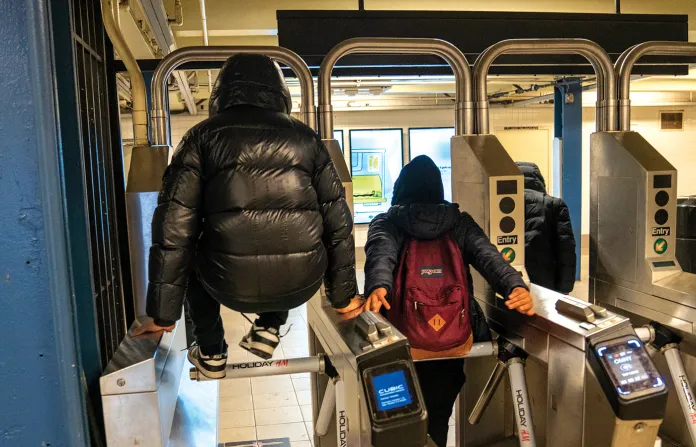
After the woke Era made social-justice heroes out of turnstile-hoppers, subway systems from New York and Washington, D.C. to San Francisco shelled out millions to build higher gates that only the most ambitious and athletic thieves could evade with ease.
Surprising nobody, these more formidable faregates resulted in more fare revenue. They also resulted in less crime. “Virtually every criminal is a fare evader,” the head of New York’s Metropolitan Transportation Authority said.
This is almost a happy story demonstrating to local governments that, as the millennial commentators like to say, “You can just do things.” You can reduce crime by enforcing rules and preventing a slide into general disorder (this used to be called the “broken windows” theory of policing).
Teenagers jump turnstiles at a subway entrance in New York City. (Robert Nickelsberg/Getty Images)
" data-large-file="https://www.washingtonexaminer.com/wp-content/uploads/2026/07/YL.BadNeighbors.072926.jpg?w=696" height="658" width="1024" src="https://www.washingtonexaminer.com/wp-content/uploads/2026/07/YL.BadNeighbors.072926.jpg?w=696" alt="Teenagers jump turnstiles at a subway entrance in New York City. (Robert Nickelsberg/Getty Images)" class="wp-image-4663453" style="width:822px;height:auto" srcset="https://www.washingtonexaminer.com/wp-content/uploads/2026/07/YL.BadNeighbors.072926.jpg 1400w, https://www.washingtonexaminer.com/.../07/YL.BadNeighbors.072926.jpg?resize=300,193 300w, https://www.washingtonexaminer.com/.../07/YL.BadNeighbors.072926.jpg?resize=768,494 768w, https://www.washingtonexaminer.com/...07/YL.BadNeighbors.072926.jpg?resize=1024,658 1024w, https://www.washingtonexaminer.com/...6/07/YL.BadNeighbors.072926.jpg?resize=150,96 150w, https://www.washingtonexaminer.com/.../07/YL.BadNeighbors.072926.jpg?resize=696,447 696w, https://www.washingtonexaminer.com/...07/YL.BadNeighbors.072926.jpg?resize=1068,687 1068w" sizes="(max-width: 1024px) 100vw, 1024px">
Teenagers jump turnstiles at a subway entrance in New York City. (Robert Nickelsberg/Getty Images)
But it was also a sad story. The new, higher (and uglier) faregates stand today as a memorial to their cities’ decline. For decades, D.C. and New York didn’t need unhoppable gates because only a small sliver (of mostly high schoolers) dodged the fares. In D.C., the gates could just be pushed open with some force, meaning Metro operated on something like an honor system.
When you have no honor, though, you can’t have an honor system.
Now a different sort of fence is going up in America’s subways, as transit systems erect new monuments to another problem: People ending up on the tracks.
New York is putting up odd little metal fences along the edge of some platforms. D.C.’s Metro is planning to spend more than $9 million to put 5-foot-high fences and sliding doors down the entire length of the platforms at Red Line stops.
Already in 2026, 84 people have trespassed onto Metro’s tracks, and 10 people have been killed on those tracks — that’s more than the eight killed all of 2025, which was up from six deaths in 2024, and only two in 2023.
Some of these were suicides. Some were unintentional deaths by intentional trespassers. Some were accidental falls from the platform.
TIMOTHY P. CARNEY: PAY YOUR FARE SHARE
The fencing will probably save lives, but like the faregates, they will stand as monuments to societal dysfunction. Over its first 50 years, Metro didn’t feel the need to build these barriers. Yes, people jumped on the tracks or fell in — or even were pushed in. But such incidents were very rare.
Hundreds of millions of people stood on Metro’s platforms with the ability to enter the tracks, and yet almost nobody did. Now we cannot rely on that normalcy anymore, so we need physical barriers.
Continue reading...
[ H/T Washington Examiner ]