










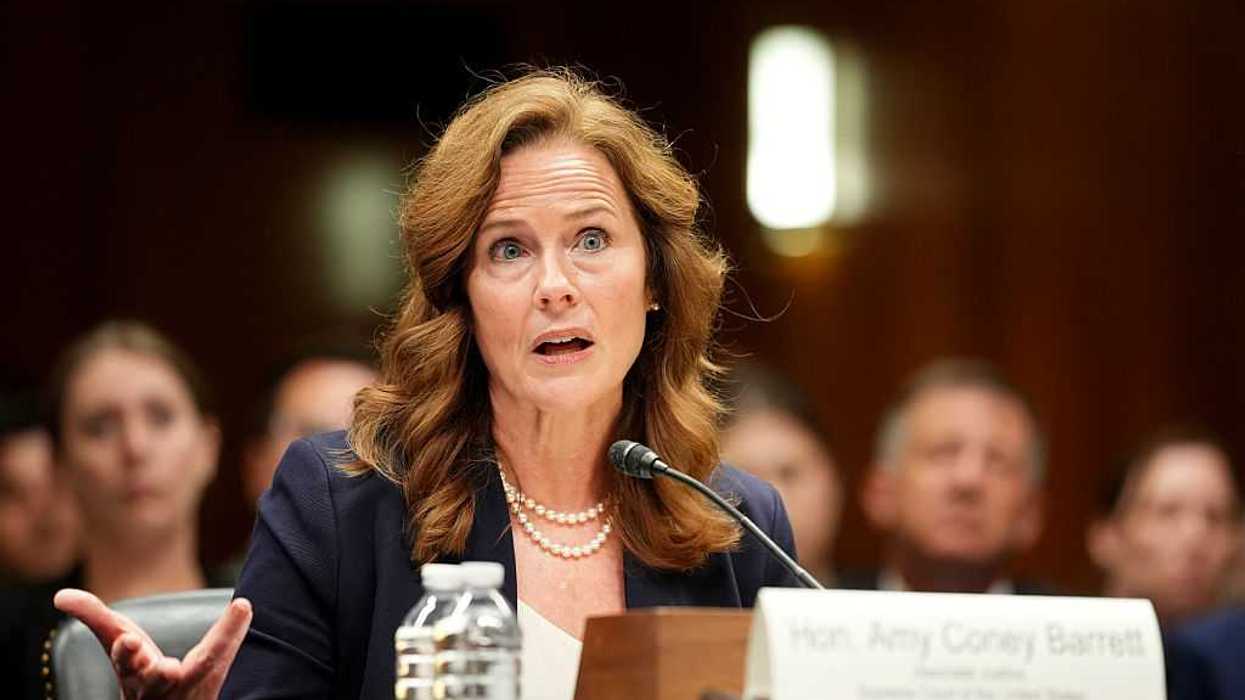
Last week, while testifying before Congress in support of additional funding for Supreme Court security, Justice Amy Coney Barrett described how escalating threats against the justices have affected her family.
She recalled that her then-12-year-old son once asked why she needed to wear a bulletproof vest.
Barrett should not have to defend her integrity because her children are frightened. She did not take an oath to place her family in danger.
Some commentators seized on the story as evidence that threats may have altered Barrett’s judicial outlook. They suggest that fear for her life — and the lives of her family members — has compromised her objectivity or influenced how she approaches cases before the court.
That claim does not withstand scrutiny.
The critics are searching for an explanation for the occasions when Barrett has diverged from Justices Clarence Thomas and Samuel Alito. They point to her positions in cases involving birthright citizenship, Mississippi ballot deadlines, and tariffs.
Those disagreements are fair subjects for criticism. But any serious assessment of Barrett’s record must consider the full body of her work, not a handful of outcomes that frustrated conservatives.
Barrett has frequently joined her conservative colleagues. She was part of the majority in Slaughter, an important constitutional decision affirming executive authority. She has stood firmly behind protections for women’s and girls’ sports. She has also joined decisions upholding immigration enforcement.
Critics may challenge any justice’s reasoning in any case. They should not invent a psychological explanation that ignores the justice’s broader record.
The suggestion that threats have softened Barrett’s jurisprudence also rests on a false comparison.
Some argue that military personnel and law-enforcement officers routinely accept danger as part of their work, so Supreme Court justices should do the same. But soldiers and police officers enter professions in which physical danger is expected. Supreme Court justices do not.
RELATED: Justice Amy Coney Barrett describes SWATTING attack against her family
Context is crucial. Children of military personnel or law-enforcement officers generally understand that their parents’ work carries risk. My father served on a Secret Service protective detail. When he came home and hung his bulletproof vest in the closet, it did not seem unusual.
My mother taught nursery school. Had she been forced to wear a bulletproof vest because of threats against her classroom, that would have been deeply unsettling.
Barrett’s children did not grow up believing that their mother’s judicial service would make her a target. No one should expect them to remain unfazed when she comes home from the Supreme Court wearing body armor. Nor should anyone condemn Barrett for discussing their fear in public.
The underlying situation is disgraceful.
No justice should need a bulletproof vest to perform the duties of the office. Sadly, the days when Justice Antonin Scalia could attend daily Mass alone on Capitol Hill, unnoticed and unbothered, are gone.
Congress will probably approve the court’s request for additional security funding. It should.
Congress can also do more to reduce the political pressure placed on the judiciary.
For decades, lawmakers have avoided difficult policy decisions and allowed major national disputes to migrate into the courts. Congress increasingly leaves questions involving immigration, elections, executive power, abortion, and social policy to judges rather than resolving them through legislation.
That abdication turns every Supreme Court term into a national political showdown. It raises the stakes of each vacancy, each argument, and each ruling. It also encourages activists to treat justices as unelected legislators rather than judges interpreting the law.
Congress cannot eliminate threats by passing more bills. It can, however, reclaim its constitutional responsibility and stop forcing the court to settle every dispute elected lawmakers lack the courage to address.
Resolving contentious questions through the legislative process would not remove controversy from public life. It would reduce the pressure on nine justices to decide matters that properly belong to elected representatives.
Until Congress changes course, the court and its members will need more protection.
Barrett should not have to defend her integrity because her children are frightened. She did not take an oath to place her family in danger. A mother’s concern for her children does not prove judicial weakness.
It proves only that the threats are real.
Continue reading...
[H/T Blaze Media]


