

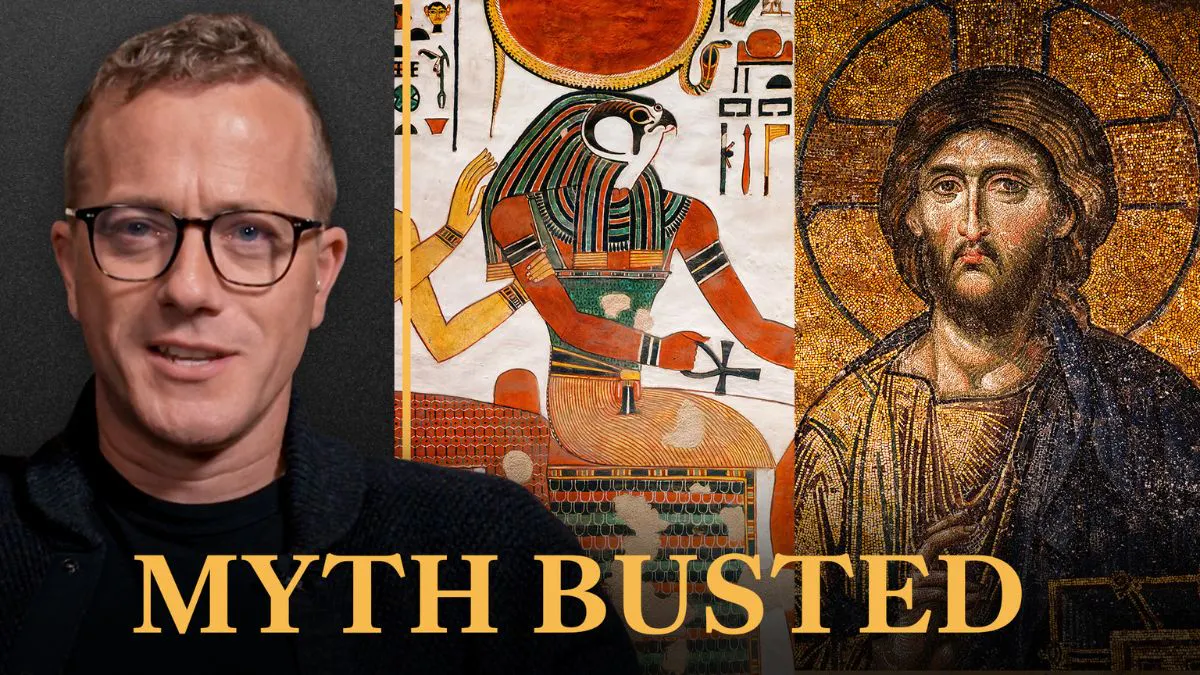
This piece is adapted from the latest episode of Matt Fradd All Access. You can watch the full episode here.
There’s a bit of a meme that’s been going around that claims Jesus was a myth, and an unoriginal one at that.
Jesus, this theory goes, is an amalgamation of various Pagan figures blended into some new Christian invention.
If you’re reading this, you probably got a good laugh from that and rightfully dismissed it. Trust me, I agree with you. But I do think it’s worth taking a deeper look at those claims, their history, and to try and think of the best ways to respond if someone brings them up at your office Christmas party.
Similarity Does Not Imply Dependence
Before we look at some of these alleged parallels between Christianity and paganism, it’s important to note that similarity does not imply dependence. That is, even if Christianity did have beliefs and practices similar to those of earlier religions, it doesn’t follow that there must be a causal connection between them.
Similarities among religions shouldn’t surprise us. Most religions, after all, try to answer the same fundamental questions in life: “Where did we come from?”, “Is there an afterlife?”, “How should we live?” Most religions have rituals, sacred stories, and moral codes. It would be surprising if there weren’t some similarities among them. In fact, you might say that the similarities are a sign that God does exist. If he is real, which he is, you can expect different religions in different eras and cultures to reach many similar conclusions about what he’s like and how to relate to him.
Jesus, Pagan Myth, & Anti-Semitism
Claims that Christian beliefs about Jesus are adapted from pagan cults may be popular on TikTok and Instagram today, but they’ve actually been around a lot longer than you might think.
A school of 19th century German theologians sought to interpret Jesus against a pagan background rather than a Jewish one. Frankly, they weren’t a big fan of Jews, and there was a desire for an “Aryan Jesus,” rather than a Hebrew one. The movement continued into the early 20th century with writers such as J. M. Robertson, William Benjamin Smith, Arthur Drews, and others who sought to deny the historicity of Christ by drawing upon the work of liberal theologians who tended to deny the value of the sources for Jesus outside of the New Testament.
Unfortunately for these critics, their arguments were not taken seriously by mainstream critics, and their work fell into relative obscurity. It was not until a British professor named G.A. Wells rediscovered and translated this German scholarship in the 1970s that the myth argument rose to prominence again. However, it is still a fringe movement, and even Wells has abandoned it and admits there is a historical basis for the stories about Jesus.
The fact is, there is no serious debate among the vast majority of scholars in the fields related to the question of the historicity of Jesus. Even agnostics like Bart Ehrman, who has become popular for his arguments against the reliability of the New Testament, admit that Jesus was a real historical figure. He writes, “The view that Jesus existed is held by virtually every expert on the planet.”
Pagan Deities
Those who claim Jesus’s story was lifted from Pagan myths all follow the same pattern: they choose a Pagan figure — whether Horus, Dionysus, Mithras, or whoever — and claim that there are so many similarities in their stories that Jesus must be a copy.
That might make a good TikTok video. But if you look closer at these so-called similarities, you quickly realize that they’re either completely coincidental, or just plainly fabricated.
Among the many ancient pagan deities of which Christ is said to be a copy, the Egyptian god Horus seems to get the most attention. So let’s take a closer look at the alleged parallels and decide for ourselves.
The first claim is that Horus was born to a virgin mother.
Several different (and contradictory) stories about Horus have developed gradually over the last 3,000 years, but the most common story of his conception espoused by mythicists today involves his father, Osiris, and mother, Isis.
It goes like this: When Osiris was murdered and his body cut up into fourteen pieces, his wife Isis journeyed throughout Egypt collecting them. She was able to find all the pieces except his genitals (not making this up), which had been eaten by catfish at the bottom of the Nile. Isis then makes a prosthetic phallus, gets impregnated by it and along comes Horus.
So, not exactly a virgin birth.
The second claim is that Horus was crucified.
So, how did Horus die? Well, again, that depends on which account you go by. Horus either did not die, or died as a child after having been poisoned by a scorpion. It’s only in the popular mythicist film “Zeitgeist” that we get the claim that Horus was “crucified.”
Debunking this one is easy. Crucifixion was a Roman invention with no Egyptian equivalent. The basis for claims that Horus was crucified? Images depicting him with his arms outstretched. That’s it.
As the film’s study guide explains, “The issue at hand is not a man being thrown to the ground and nailed to a cross, as Jesus is depicted to have been, but the portrayal of gods and goddesses in cruciform, where by the divine figure appears with arms outstretched in a symbolic context.”
By this line of reasoning, we should also conclude that Barney the dinosaur was crucified, since there are many images of him standing with outstretched arms!
The third claim is that Horus rose from the dead.
This one is somewhat true. But the fact is, the dying and revivification of Horus is vastly dissimilar to the death and resurrection of Christ. The idea that the New Testament authors concocted the resurrection story from dying and rising Pagan gods was put to rest by Jonathan Z. Smith in the late 1980s, in his article “Dying-Rising Gods” in the scholarly and authoritative Encyclopedia of Religion. He writes:
“The category of dying and rising gods, once a major topic of scholarly investigation, must be understood to have been largely a misnomer based on imaginative reconstructions and exceedingly late or highly ambiguous texts … All the deities that have been identified as belonging to the class of dying and rising deities can be subsumed under the two larger classes of disappearing deities or dying deities. In the first case the deities return but have not died; in the second case the gods die but do not return. There is no unambiguous instance in the history of religions of a dying and rising deity.”
So, sorry Horus. Doesn’t quite cut it.
What To Tell The Pagans
As I said, Horus isn’t the only pagan entity people claim was the inspiration for Christ. So, should you ever find yourself in dialogue with someone making this argument, here’s what you can do:
Familiarize yourself with the alleged parallels by reading authoritative sources yourself. Then, ask your interlocutor where they are getting their information. If they point you to a particular website or movie, ask them where that website or movie got its information.
Take the parallels one at a time. It’s easy for someone to rattle off a list of alleged parallels making it appear that the evidence is overwhelming, but if you take the time to examine each supposed parallel, you’ll find, as we found above, that they are not very similar at all.
And remember: just because an ancient Japanese boat looks a bit like an American birch-bark canoe, that doesn’t mean they were copying off each other’s paper.
The post <a href=https://www.dailywire.com/news/why-jesus-is-not-a-spinoff-of-pagan-gods target=_blank >Why Jesus Is Not A Spinoff Of Pagan Gods</a> appeared first on Conservative Angle | Conservative Angle - Conservative News Clearing House
Continue reading...