

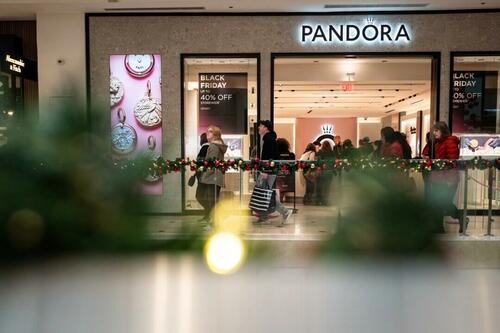
Economic Confidence Slips To 17-Month Low, Holiday Spending Plans Weaken
Authored by Tom Ozimek via The Epoch Times,
A new Gallup poll shows that U.S. consumer confidence deteriorated sharply in November, falling to its weakest level in 17 months as households contended with a protracted federal government shutdown, volatile financial markets, cooling job prospects, and renewed inflation anxiety.
The gloomier mood—reflected in Gallup’s Dec. 4 poll and aligning with several other major sentiment surveys—coincided with a pullback in Americans’ holiday spending plans, raising concerns about softer momentum heading into the final weeks of 2025.
Gallup’s economic confidence index fell seven points to –30 in November, its weakest reading since July 2024. The drop reflected dimmer views of both current conditions and the outlook: 21 percent of Americans called the economy “excellent” or “good,” while 40 percent said it is “poor.”
Expectations slipped further, with just 27 percent saying the economy is improving—down from 31 percent in October—and 68 percent saying it is getting worse.
The downturn marks a notable reversal from the relative stability seen for much of the year.
After improving through late 2024 on post-election optimism, the index had hovered between –14 and –22 for most of 2025 before slipping in October and then tumbling last month. At -30, November’s sentiment reading is well above the recent low of -58 notched in June 2022, when inflation soared to a recent peak of 9 percent and sent confidence plummeting. The lowest the gauge has ever hit is -72, in October 2008, during the financial crisis.
Historic Pullback in Holiday Spending Plans
Consumers’ heightened economic anxiety in November translated into a far smaller appetite for holiday gift spending than earlier in the season. Gallup found that Americans have cut their expected holiday budgets by $229 since October - the largest midseason drop the organization has ever recorded, surpassing even the $185 decline during the 2008 financial crisis.
Despite the sharp contraction in projected spending, only 29 percent of Americans say they plan to spend less than last year, up from 23 percent in October but still far below the 46 percent who reported plans to cut back in November 2008.
Labor market sentiment also softened meaningfully. Just a third of Americans (33 percent) said it is a good time to find a quality job, the weakest reading since January 2021, when COVID-19 lockdowns were pressuring labor markets. Views on job availability have worsened steadily through the fall, mirroring private-sector payroll data showing a broad pullback in hiring.
ADP Research reported this week that the private sector shed 32,000 jobs in November—the weakest showing since early 2023—driven largely by steep losses at small firms. Wage gains continued to cool, with year-over-year pay growth easing to 4.4 percent in November from the prior month’s 4.5 percent pace of growth.
Other gauges of economic activity suggest a mixed backdrop. The Conference Board’s consumer confidence gauge slid to 88.7, its lowest since April, and expectations remained mired below the recession-warning threshold for a tenth consecutive month.
Michigan’s sentiment survey showed a double-digit plunge in current conditions and weaker buying plans for big-ticket goods. JPMorganChase Institute data showed real household income growth slowed to 1.6 percent in October, leaving consumers heading into the holidays with flat bank balances and limited purchasing-power gains.
These readings reflect sentiment shaped by the 43-day federal government shutdown, which delayed pay for federal workers, disrupted flights, and halted key benefit programs, adding strain to household finances. Michigan’s consumer sentiment index fell to 50.3 in November, its lowest since June 2022, as respondents reported worsening personal finances and growing anxiety about the shutdown’s broader economic fallout.
Retail Spending Cools but Continues to Grow
Retail activity has cooled, though it has continued to expand. The latest government data—interrupted by the shutdown—indicate slower sales in September, and while private-sector card spending figures from the Bank of America Institute show relatively solid year-over-year gains in October, some of that strength was buoyed by higher prices rather than higher volumes.
Despite the sour near-term mood, forecasters remain cautiously optimistic about next year. A recent National Association for Business Economics outlook sees 2026 growth improving to 2 percent, supported by resilient consumer spending and firmer business investment.
Similarly, the Organisation for Economic Co-operation and Development (OECD) has raised its U.S. growth forecast, with the 38-country group saying the upgrade reflects exceptional rates of investment in information processing equipment, software, and data center construction, helping offset cooling job growth and other headwinds.
Tyler Durden
Fri, 12/05/2025 - 08:25
The post <a href=https://www.zerohedge.com/personal-finance/economic-confidence-slips-17-month-low-holiday-spending-plans-weaken target=_blank >Economic Confidence Slips To 17-Month Low, Holiday Spending Plans Weaken</a> appeared first on Conservative Angle | Conservative Angle - Conservative News Clearing House
Continue reading...