
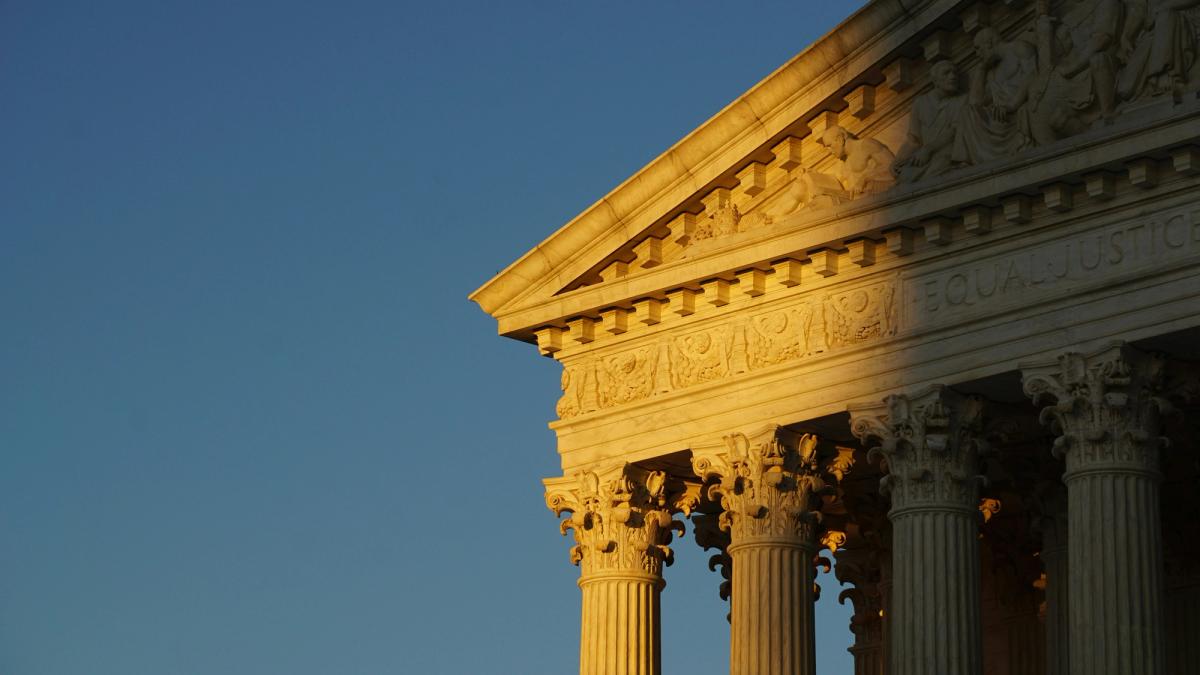
In Dissent is a recurring series by Anastasia Boden on Supreme Court dissents that have shaped (or reshaped) our country.
I. The stars and your medical records
When NASA’s Artemis II crew hurtled back to Earth from their ten-day mission, the four became the first to circle the moon in more than 50 years and travelled farther from this planet than any humans had gone before.
But before those astronauts could strap into the Orion capsule, before the engineers who built that capsule could swipe their badges to enter their labs, and before the scientists who plotted the trajectory could sit down at their desks, what personal information did the government demand from them? What did NASA know about their drug treatment histories, their romantic lives, or their mental health? And what protections were there to keep that information confidential?
In the 2011 case of NASA v. Nelson, the Supreme Court considered whether the people who make our rocket ships, as well as all sorts of other government workers, have any constitutional right to the most intimate details of their private lives. A unanimous court ruled that the government’s interest in this information outweighed any constitutional right to privacy that these workers have. But in a concurrence that reads like a dissent, two justices objected to the idea of “informational privacy” altogether. And Justice Antonin Scalia, famous for judicial restraint, chastised the court for not going far enough.
II. The suitability matrix
Nestled in a small, quiet suburb of Los Angeles, the Jet Propulsion Laboratory is NASA’s premier center for deep-space robotics and communications. Its spacecraft have flown to every planet in the solar system and beyond, and its website boasts that its technology has both brought the Hubble Space Telescope into focus and contributed to the camera on your smartphone.
Many of this country’s iconic unmanned space missions – from the U.S.’s first successful satellite, Explorer 1, in 1958, to each of the five Mars Rovers – were developed by JPL. NASA owns the facility, but the California Institute of Technology operates it under a government contract, meaning that JPL is staffed entirely by contract employees. For more than half a century following JPL’s inception, no background investigation was required of these or other governmental contract employees – except as required by specific contracts. Many employees had therefore worked at the lab for decades, contributing to missions of profound national and scientific importance, without any government agency ever asking them about their personal lives.
That changed in 2004. On the recommendation of the 9/11 Commission, President George W. Bush issued Homeland Security Presidential Directive 12, or HSPD-12, which mandated new, uniform identification standards for both federal civil servants and government contractors. Pursuant to this mandate, the Department of Commerce required contract employees with long-term access to federal facilities to undergo a background check, including those considered low-risk – like those who work at the JPL. The facility then informed employees that anyone who failed to complete the new process by October 2007 would be fired.
The employees became subject to two documents that became the center of a lawsuit. The first was Standard Form 85, or SF-85, a questionnaire for non-sensitive positions. SF-85 asked, among other things, whether employees had used illegal drugs within the past year and, if so, whether they had received treatment or counseling. The second was Form 42, a reference form sent to former employers, schools, landlords, and individuals named by the employee that asked open-ended questions concerning intimate facts about the applicant’s life, including their financial integrity, violations of law, mental or emotional stability, and more. All such records were covered by the Privacy Act, meaning they could not be disclosed without the individual’s written consent. But the act had a slew of loopholes that allowed for some disclosures, and anyway, it only provided for damages if the unauthorized disclosure was intentional or willful rather than negligent, and only if the plaintiff could prove damages.
Then there was the suitability matrix, which set out criteria for evaluating employees based on factors like homosexuality (if a risk for blackmail), sodomy, carnal knowledge, illegitimate children, cohabitation, adultery, mental or emotional issues, and making obscene phone calls. JPL employees had sued over it after the matrix was accidentally posted on an internal server. Nevertheless, at oral argument, Acting Solicitor General Neal Katyal stated that NASA did not and would not use it.
In August 2007, 28 JPL contract scientists and engineers – including lead plaintiff Robert “Half” Nelson, a senior research scientist – sued NASA, Caltech, and the Department of Commerce, alleging that portions of the background check violated their constitutional right to informational privacy. When they were hired, no such checks were required. But now they were forced to choose between surrendering intimate details of their private lives or losing their job.
III. A right in limbo
Nelson relied on the right to “informational privacy,” which the Supreme Court had alluded to but never fully accepted. In the 1977 case of Whalen v. Roe, the court considered a New York program that required pharmacies to report to a state database the names and addresses of patients who were prescribed certain drugs that had both legitimate and illicit uses. The court upheld the program, but in doing so, it described two distinct privacy interests the Constitution might protect: first, an “interest in avoiding disclosure of personal matters,” and second, an interest in making important personal decisions without government interference. That first interest is what some lawyers and scholars came to call “informational privacy” or the “right to data privacy.”
In Whalen, the court neither firmly established nor rejected this right. It simply said that the challenged program had protections against public disclosure that meant the law did not infringe any such interest. Later that same year, in Nixon v. Administrator of General Services, the court again ruled that even if right existed, the challenged action didn’t violate it. For the next 30-plus years, the court was silent on whether a constitutional right to informational privacy existed. Nelson asked the Supreme Court to answer that question.
The U.S. Court of Appeals for the 9th Circuit had ruled that SF-85’s drug-treatment disclosure requirement and Form 42’s open-ended questions were likely unconstitutional because they were not narrowly tailored to the government’s interests in confirming the employees’ identities or ensuring security of the lab. But it upheld the government’s inquiries into recent illegal drug consumption as important to combatting illegal drug use. The 9th Circuit denied rehearing en banc over the dissents of five judges, including Judge Alex Kozinski, who wrote that the lack of clarity over the right to informational privacy had rendered the courts of appeals’ attempts to apply it “a bit like building a dinosaur from a jawbone or a skull fragment, and the result looks more like a turducken.”
The Supreme Court granted certiorari in March 2010.
IV. Standard operating procedure
At oral argument, Acting Solicitor General Neal Katyal argued that background checks are a standard feature of federal employment, one that has been required of civil service employees since the 1950s and had simply been extended to a class of workers who functioned in every relevant respect like civil servants. Katyal told the justices that background checks had been conducted “for millions of employees for dozens of years.” And he emphasized that over the prior five years, only 128 individuals across federal government had been denied credentials due to information provided under SF-85, and none of those denials resulted from the challenged inquiries about drug treatment.
Chief Justice John Roberts asked who the protections were for. Why did the government even need information about drug counseling? Katyal suggested it was “for the good of the employee,” to which the chief responded that “whenever the government comes and says this is for your own good… you have to be little suspicious.” Justice Ruth Bader Ginsburg suggested that if it was good for the employee, then “make it voluntary.”
Most of the tough questions for Katyal prodded the limits of his theory: were there any questions the government couldn’t ask? Katyal didn’t think the justices needed to answer that question, because whatever the limits, they hadn’t been reached here. But when nudged, he answered that there might be some limits if the government asked questions about behavior that implicated fundamental rights, such as the “sexual practices of its employees.”
When attorney Dan Stormer stood up to argue for the employees, he approached a skeptical bench. Scalia said flatly: “I looked at your table of authorities in your brief, and you have cases listed, you have statutes listed; there is not a single citation anywhere in your brief to a provision of the Constitution. What provision of the Constitution are you relying on?”
Before Stormer could answer, Scalia continued:
I think it’s a very nice thing that the government shouldn’t ask intrusive questions. I also think that it’s a nice thing that the government should pay a living wage to its employees, but I don’t feel authorized to go around saying how much the government should pay each of its employees because there is nothing in the Constitution about that, and the question is left to Congress.
Stormer answered that the “[l]iberty to control information about oneself” resided in the Fifth Amendment’s due process clause, which says that the government cannot take away life, liberty, and property without due process of law. Stormer was basing his argument on the concept of substantive due process – the idea that due process protects liberty from arbitrary government action even when proper procedures are followed, and even if a specific right is not explicitly laid out in the Constitution or Bill of Rights. Here, he said, the government was depriving JPL’s contract employees of the liberty to control information about themselves without sufficient reason.
The justices balked. In their view, under Nelson’s theory, any time the government asked a question of its employee, that employee could come to court, force the government to justify itself, and put courts in the position of deciding whether that was proper. Such a regime would open the courthouse to a flood of challenges to routine government information-gathering.
Only Justice Sonia Sotomayor didn’t seem bothered by Nelson’s suggestion. “Do you think there is something wrong with the government having to explain why it seeks information?” she asked. “I mean, I would think that would be fairly simple in virtually every situation.”
V. A right that dare not speak its name
By the time the opinion came out, even Sotomayor had been swayed. The court ruled 8-0 for the government (the court’s newest justice, Elena Kagan, did not participate in the case because she had appeared on the briefs as solicitor general). The majority opinion, written by Alito and joined by Roberts and Justices Anthony Kennedy, Ginsburg, Stephen Breyer, and Sotomayor, assumed without deciding that a right to informational privacy exists, and then held that the background checks did not violate it.
As to the SF-85 drug treatment question, Alito reasoned that “illegal-drug use is both a criminal and a medical issue,” and the government was seeking to “separate out those illegal-drug users who [were] taking steps to address and overcome their problems,” and thus should be credentialed, and those who were not. This framing recast the inquiry as not just permissible, but affirmatively “humane.”
The opinion’s treatment of the employees’ data breach concerns was brief. The court noted that the collected information was subject to the Privacy Act, that privacy protections need not be “ironclad” to satisfy constitutional scrutiny, and that the “mere possibility” of data breaches are always a risk when the government collects information.
In sum, the opinion dismissed any disclosure concerns. It did not confront the suitability matrix, which Katyal had denied was being used for those employees. And it declined to say whether informational privacy is a constitutional right and, if so, what standard courts should apply.
There were no dissents, but Scalia’s concurrence, joined by Justice Clarence Thomas, certainly read like one.
In Scalia’s view there was no constitutional right to informational privacy, and the court should have said so. He called the fact that Stormer hadn’t cited to the Constitution in his briefs “refreshingly honest”:
One who asks us to invent a constitutional right out of whole cloth should spare himself and us the pretense of tying it to some words of the Constitution. Regrettably, this Lincolnesque honesty evaporated at oral argument, when counsel asserted, apparently for the first time in this litigation, that the right to informational privacy emerged from the Due Process Clause of the Fifth Amendment. That counsel invoked the infinitely plastic concept of “substantive” due process does not make this constitutional theory any less invented.
Scalia, a long-time skeptic of substantive due process and a judge with a narrow view of the liberty protected by the due process clause, thought the justices were trying to fit a round peg into a square hole. The collection of information, he said, was covered by the Fourth Amendment’s protections for searches and seizures. But the 9th Circuit had ruled that this was not a search. “That should have been the end of the matter. Courts should not use the Due Process Clause as putty to fill up gaps they deem unsightly in the protections provided by other constitutional provisions.”
Nor did Scalia believe that the decision could be justified based on stare decisis, or the idea that the court should rule one way now because it had “made the same mistake before.” Despite that the majority had called Whalen and Nixon“ ‘seminal’—seminal!—decisions,” neither of them had “supplied any coherent reason why a constitutional right to informational privacy might exist.”
On the majority’s approach of assuming the right existed without actually deciding, Scalia was at his most withering. If no right existed, then the court was “pontificat[ing] upon a matter that is none of its business: the appropriate balance between security and privacy.” If the right really did exist, then the court should say so rather than resorting to an “Alfred Hitchcock line of our jurisprudence” that left everyone in suspense. Avoiding the prerequisite question, he said, “harms our image, if not our self-respect, because it makes no sense.” “Whatever the virtues of judicial minimalism, it cannot justify judicial incoherence.”
VI. They told you so
Less than two years later, on October 31, 2012, a NASA headquarters employee left a laptop in a locked vehicle in Washington, D.C. That laptop, which contained records of sensitive personally identifiable information – Social Security numbers, addresses, and the intimate details gathered through the background checks – was stolen.
The fallout cost taxpayers nearly $960,000 in security upgrades. This fourth serious laptop theft at NASA since March 2011 prompted immediate action to encrypt the hard drives of all agency laptops. (NASA and HP had already agreed by contract to encrypt all new machines by November 2011, but it hadn’t happened.)
Robert Nelson issued a statement: “We warned of this possibility five years ago when we filed our lawsuit. We were ignored by the courts. Now, unfortunately, by virtue of the cavalier behavior of a NASA bureaucrat our argument has been proven.”
Then, in June 2015, the Office of Personnel Management disclosed a catastrophic cyberattack, widely believed to be linked to Chinese state intelligence agencies. Over 20 million records were affected, including SF-85 questionnaires. The “mere possibility” the Court had dismissed had become a certainty.
The rise of digital surveillance, mass data collection, and government databases of unprecedented scale has made the question of informational privacy an immediate practical problem for millions of Americans. Several states have enacted comprehensive data privacy laws and the federal government has updated its cybersecurity requirements. But the fundamental question – whether a person has a constitutional right to be free from the government’s collection and storage of their most intimate personal information – remains unanswered.
Scalia argued that the court’s “restrained” ruling in Nelson was actually its own form of judicial activism. It put the cart before the horse, he said, by allowing the court to resolve a case without first deciding whether the asserted right existed at all. But that critique cuts against Scalia’s approach, too. His reluctance to recognize rights merely because they don’t appear in the text risks refusing to answer a different question that the Constitution asks: What’s the scope, if any, of unenumerated rights? Both questions are worth answering. And refusing to answer either is activist in its own way.
Google Search
