
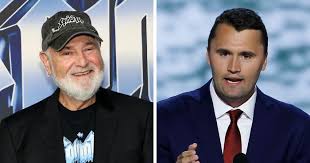
The following article, Two Deaths, One Legacy: Why Charlie Kirk’s Life Mattered and Rob Reiner’s Not So Much, was first published on The Black Sphere.
Before the Left rushed to stitch the deaths of Rob Reiner and Charlie Kirk together, it’s worth stopping them mid-thread and asking a very simple question: why?
Why the urgency to yoke Charlie Kirk and Rob Reiner as if they occupied the same moral or civic plane? The answer isn’t compassion, and it isn’t clarity. It’s narrative control.
When a conservative who actually mattered is assassinated in public, the reflex is to dilute the moment by dragging in a celebrity whose politics were loud, shallow, and safely applauded inside elite rooms. Tragedy becomes camouflage.
This comparison is not organic. It is manufactured.
Charlie Kirk was murdered because he refused to be silent, because he took his ideas directly into hostile territory and challenged a generation to think. Rob Reiner died in a private, familial catastrophe that had nothing to do with courage, public service, or sacrifice. Lumping the two together isn’t about honoring the dead; it’s about blurring the distinction between someone who built a movement and someone who merely commented on one from behind velvet ropes.
So let’s be clear about the premise before the Left rewrites it for us. This is not a meditation on “two lives lost.” It is an examination of two vastly different legacies, two radically different relationships to truth, and two opposite uses of influence. One man stood in the arena and paid the ultimate price. The other spent his later years throwing rhetorical stones from a gated hillside, never once owning the wreckage of the ideas he championed. If the comparison makes anyone uncomfortable, that discomfort isn’t cruelty. It’s clarity.
Charlie Kirk: A Conservative Force Cut Down in His Prime
Charlie Kirk’s name had become synonymous with conservative youth activism long before his assassination on September 10, 2025. The 31-year-old co-founded Turning Point USA (TPUSA) at just 18 years old, transforming what began in his parents’ garage into one of the most influential conservative youth organizations in modern history.
TPUSA was more than a campus club. By the time of Kirk’s death, the group had chapters on thousands of high school and college campuses, had bolstered conservative voter turnout, and reshaped GOP engagement with a generation that was once drifting left.
Kirk never hid from controversy. He pushed back against establishment narratives, challenged woke orthodoxy in higher education, and made robust arguments for free markets, limited government, and civil liberties.
He didn’t simply preach to the converted — ward after ward of skeptical college audiences heard him out, debated him, and in many cases were moved by his courage to engage rather than retreat. That combative style helped him build the conservative media platform The Charlie Kirk Show, which reached millions.
On that September day in Utah — speaking under the familiar “Prove Me Wrong” banner that had defined his career — Charlie Kirk was shot and killed while talking to students on a college campus.
His death wasn’t a private tragedy. It was a violent political assassination during a public engagement.
It instantly became a symbol of how heated and toxic the culture wars have become, and how dangerous it is for conservative voices who refuse to capitulate to the dangerous Left.
The response was massive. A memorial service at State Farm Stadium drew more than 90,000 people, with Presidents, Senators, and conservative leaders honoring a life dedicated to mobilizing youth and defending free speech.
In the wake of his assassination, Turning Point USA doubled down on its mission. The organization unanimously appointed Kirk’s widow, Erika Kirk, to carry on his vision — a clear sign of its resilience and commitment to conservative activism well beyond one man’s life.
This wasn’t a life lived inside a Hollywood bubble. This was outreach to the next generation of Americans, encouraging them to think for themselves — on constitutional rights, personal responsibility, and national identity.
Rob Reiner: Hollywood Icon, Not a National Institution
Rob Reiner was a famous filmmaker and actor whose career stretched from All in the Family to When Harry Met Sally. He was better known for Hollywood blockbusters and celebrity culture than for shaping public policy. Reiner was also an outspoken liberal pundit late in life, often criticizing conservative politics publicly.
But let’s get one thing absolutely clear: Reiner did not die in public service. He did not die advancing a cause for his fellow citizens in the streets or on the battleground of ideas. He died in a private family tragedy — stabbed to death in his Los Angeles home, along with his wife — by his adult son, Nick Reiner, who was arrested in connection with the killings.
This was a domestic violence case, grounded in personal and family issues, not a political statement.
Using it as some sort of ideological cudgel to equate Reiner with activists like Charlie Kirk is neither fair nor accurate.
The circumstances of Reiner’s death contain no documented political motive, no clear link to his public positions, and no indication that his Leftist critiques were a cause of violence against him. Treating this as some grand ideological martyrdom story is a distortion of the facts.
Some on the left have tried to cloak Reiner’s career in broader cultural virtue. Nice try. But let’s not recast a Hollywood entertainer’s life as tantamount to the life of a man who literally gave his public life to building a movement that changed American politics forever.
Compare and Contrast: Impact, Intent, and Public Service
When we place these two lives side by side, the differences are stark:
Charlie Kirk’s Life
Built an organization that shaped a generation of conservative leaders and thinkers.
Took his message to the heart of ideological opposition — college campuses, campus debates, national media.
His death occurred while engaging the public in the marketplace of ideas.
Tens of thousands publicly honored his life and mission.
Rob Reiner’s Life
A Hollywood figure, known for entertainment and commentary, not grassroots political leadership.
Died in a familial incident with no demonstrated public political motive.
His most notable cultural contributions were films, not political movements or youth engagement.
Reiner’s death is tragic — no one relishes loss of life — but to elevate his passing as if he built enduring institutions that shaped a nation is simply wrong. No shrines will be built for Reiner’s death, no streets named after him, no long-term mourning.
By contrast, Kirk’s life forged structures — chapters, media platforms, and a national movement — that will long outlive every headline about a Hollywood director’s ideological take.
What This Says About America Today
The push to frame these deaths as morally comparable reveals a larger cultural trend: elevating celebrity opinion as equivalent to grassroots political engagement. Far too often, Hollywood commentary is given equal weight with work that actually moves the needle in public policy, civic engagement, and generational change.
Charlie Kirk’s influence was real, measurable, and deeply rooted in civic action. Rob Reiner’s influence was mostly cinematic and later commentary. In a republic grounded in citizen engagement, those distinctions matter.
If conservatives are going to honor life and legacy, let’s honor those who built institutions that strengthened American civic culture, who spoke in public squares, and who faced consequences head-on rather than hiding in a bubble of celebrity privilege.
Charlie Kirk’s legacy is one such life. No Hollywood echo chamber or media narratives can erase that truth.
Continue reading Two Deaths, One Legacy: Why Charlie Kirk’s Life Mattered and Rob Reiner’s Not So Much …
Google Search
