
Trump Admin Was In ‘Discussions’ With Venezuelan Minister Months Before Raid
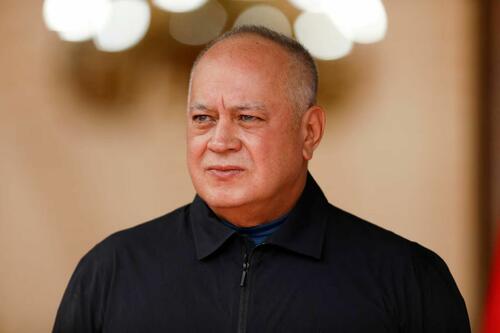
The White House was conducting back-channel communications with Venezuela’s hardline interior minister Diosdado Cabello months before the US operation to seize President Nicolas Maduro, and has been in communication with him since then, according to Reuters, citing multiple government officials who spoke on condition of anonymity.
Cabello, who was Maduro’s right hand and seen as Venezuela’s second most powerful figure (and close aide of the late former President Hugo Chavez), was key to a ‘smooth’ regime change – as the 62-year-old had (and has) the power to turn the country’s security services or militant ruling-party supporters he oversees to target the country’s opposition. That security apparatus he controls has remained largely intact since the Jan. 3 US raid.
Cabello is named in the same U.S. drug-trafficking indictment that the Trump administration used as justification to arrest Maduro, but was not taken as part of the operation.
The communication with Cabello, which has also touched on sanctions the U.S. has imposed on him and the indictment he faces, dates back to the early days of the current Trump administration and continued in the weeks just prior to the U.S. ouster of Maduro, two sources familiar with the discussions said. The administration has also been in touch with Cabello since Maduro’s ouster, four of the people said.
The communications, which have not been previously reported, are critical to the Trump administration’s efforts to control the situation inside Venezuela. If Cabello decides to unleash the forces that he controls, it could foment the kind of chaos that Trump wants to avoid and threaten interim President Delcy Rodriguez’s grip on power, according to a source briefed on U.S. concerns. -Reuters
Cabello has publicly pledged unity with interim president Rodriguez – who is seen as central to the Trump admin’s post-Maduro plans for Venezuela, while Cabello has the power to do things ‘the easy way, or the hard way’ as they say.
A former military officer, Cabello has great influence over Venezuela’s military and civilian counterintelligence agencies – which conduct widespread domestic espionage. He’s also been very close with pro-government militias, particularly the colectivos – a motorcycle gang of armed civilians who have allegedly been deployed to attack protesters.
The Trump administration has relied on Cabello to keep the situation under control while it accesses the OPEC nation’s oil reserves.
In the hours after Maduro’s ouster, some analysts and politicians in Washington questioned why the U.S. didn’t also grab Cabello – listed second in the Department of Justice indictment of Maduro.
“I know that just Diosdado is probably worse than Maduro and worse than Delcy,” Republican U.S. Representative Maria Elvira Salazar said in an interview with CBS’s “Face the Nation” on January 11.
In the days following, Cabello denounced American intervention in the country, saying in a speech that “Venezuela will not surrender.”But media reports of residents being searched at checkpoints – sometimes by uniformed members of the security forces and sometimes by people in plain clothes – have become less frequent in recent days. -Reuters
Meanwhile, Rodriguez has been working to surround herself with loyalists – installing them in key positions to protect herself against internal threats while boosting oil production at the request of Washington, according to Reuters interviews with Venezuelan insiders.
That said, Trump special representative on Venezuela (1st term) Elliot Abrams, expects Cabello to be removed at some point.
“If and when he goes, Venezuelans will know that the regime has really begun to change,” said Abrams, who’s now at the Council on Foreign Relations.
Cabello has been sanctioned by the US for several years on charges of alleged drug trafficking. In 2020, the US government issued a $10 million bounty for Cabello, who they indicted as a key figure in the “Cartel de Soles,” a group that the US has said is a Venezuelan drug-trafficking network – yet which President Trump admitted wasn’t an actual organization. As we noted earlier this month, this isn’t semantics: Both the Treasury and State Departments had officially designated the non-existent group as a terrorist organization. The latest development seems to at least partially confirm doubts raised by outside observers and lend credence to denials by the Venezuelan government. In November, the country’s foreign minister said he “absolutely rejects the new and ridiculous fabrication” by which Secretary of State Marco Rubio had “designated the non-existent Cartel de los Soles as a terrorist organization.”
Since the initial bounty on Cabello, the US has raised it to $25 million.
Tyler Durden
Sat, 01/17/2026 – 14:35
Google Search
