
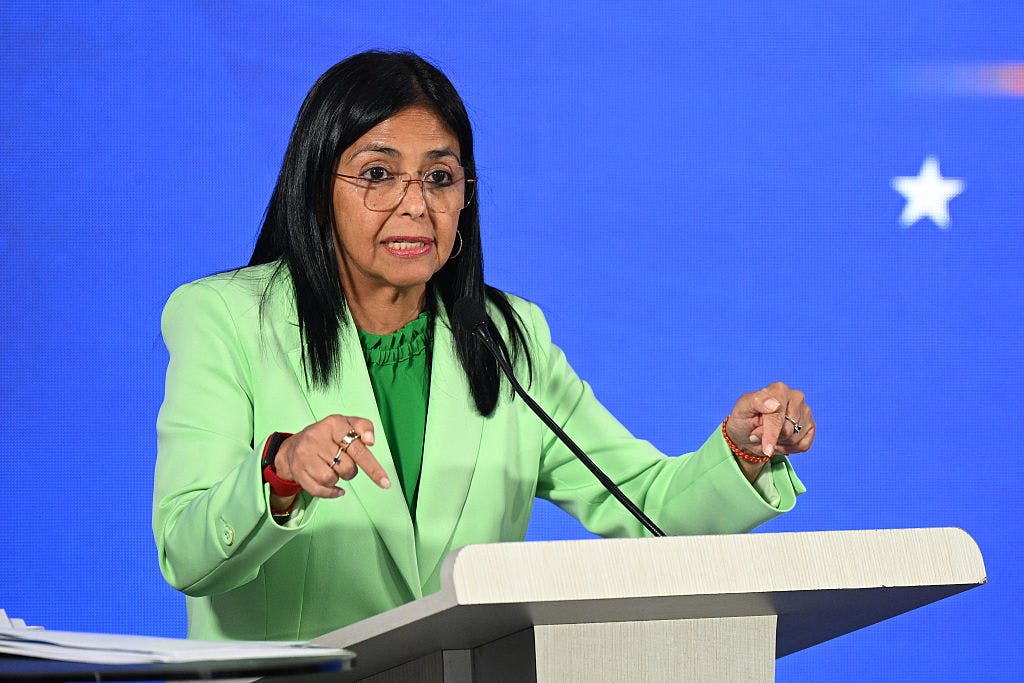
After American troops captured Venezuelan dictator in the early hours of Saturday morning, Washington quickly turned its attention to his number two: Vice President Delcy Rodriguez.
Rodriguez has remained loyal since Maduro’s capture.
“There is only one president in Venezuela, and his name is Nicolas Maduro,” she said in an address to Venezuela after his capture. Rodriguez, daughter of the Liga Socialista party founder, Jorge Antonio Rodriquez, rose through the ranks alongside her brother, Jorge, who currently serves as the President of Venezuela’s National Assembly. Upon naming her vice president in 2018, Maduro said she was a “young woman, brave, seasoned, daughter of a martyr, revolutionary and tested in a thousand battles.”
But not everyone is sold on Rodriguez.
“I don’t think we can count on Delcy Rodriguez to be friendly to the United States until she proves it,” Senator Tom Cotton told CNN anchor Dana Bash on Sunday.
The Arkansas Republican acknowledged that, while it’s possible Rodriguez could attempt to work with the United States, it’s unlikely.
“There are recent examples of anti-American leaders around the world turning over a new leaf,” Cotton said, citing Libya’s Muammar al-Qaddafi and his reconciliation with the west in 2003. “But they made concrete concessions that benefited the United States. Delcy Rodriguez and other sanctioned and indicted ministers in Venezuela were in league with Maduro until yesterday so I don’t think we can count on them to be pro-American at all.”
On Saturday, Trump noted Maduro’s selection of Rodriguez had raised concerns, but said she was, for now, cooperating with Secretary of State Marco Rubio.
“Well, I understand she was just sworn in, but she was, as you know, picked by Maduro. So Marco’s working on that directly,” Trump said. “He [Rubio] just had a conversation with her, and she’s essentially willing to do what we think is necessary to make Venezuela great again.”
Cotton later said that her promised cooperation with the United States aligns with Trump’s remarks about Washington effectively “running Venezuela.”
“When the President said the United States is going to be running Venezuela he means the new leaders of Venezuela need to meet our demands,” clarified Cotton.
Rodriguez also served as Venezuela’s oil minister, presiding over an industry Trump has repeatedly singled out as requiring United States oversight.
“As everyone knows, the oil business in Venezuela has been a bust, a total bust, for a long period of time,” he exclaimed at Saturday’s press conference. “They were pumping almost nothing by comparison to what they could have been pumping and what could’ve taken place. We’re going to have our very large United States oil companies, the biggest anywhere in the world, go in, spend billions of dollars, fix the badly broken infrastructure, the oil infrastructure, and start making money for the country.”
Beyond the energy sector, Trump argued that Venezuela needs a government capable of acting in the interests of its people: “We can’t take a chance that somebody else takes over Venezuela that doesn’t have the good of the Venezuelan people in mind.”
Cotton clarified that the Venezuelan government’s recognition of a new leader does not equate to recognition by the United States.
“We don’t recognize Delcy Rodriguez as the legitimate ruler of Venezuela. We didn’t recognize Nicholás Maduro as a legitimate ruler … It is a fact that she and other indicted and sanctioned officials are in Venezuela and have control of the military and security services. That does not make them a legitimate leader.”
Trump demonstrated that lack of recognition by issuing a warning to Venezuela’s remaining political and military figures, saying, “All political and military figures in Venezuela should understand what happened to Maduro can happen to them. It will happen to them if they aren’t just, fair, even to their people.”
For now, the president says he does not think the United States will need to initiate a second attack, but that if it becomes necessary the United States is prepared: “The first wave, if you’d like to call it that, the first attack was so successful we probably don’t have to do a second, but we’re prepared to do a second wave.”
Google Search
