
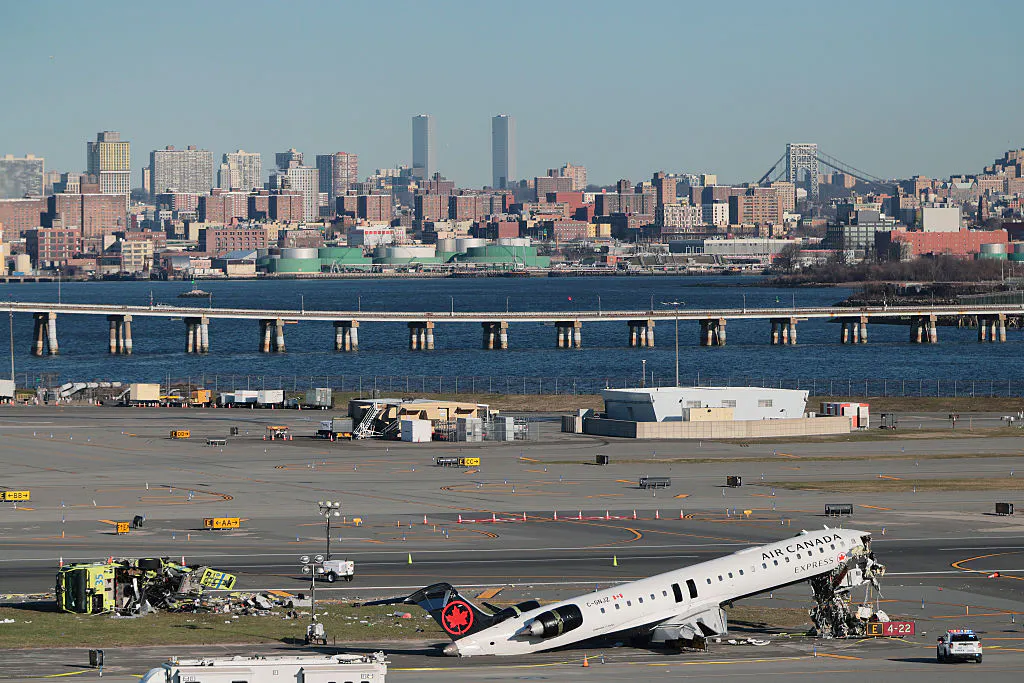
A surface radar detection system used by air traffic controllers to monitor movements on runways did not alert before an Air Canada jet collided with a fire truck at LaGuardia Airport in New York on Sunday night, a crash that killed both pilots and injured crew members and dozens of passengers.
As authorities continue to investigate the deadly crash, the National Transportation Safety Board said on Tuesday that LaGuardia’s “Airport Surface Detection System — Model X” (ASDE-X) did not alert air traffic controllers before a fire truck drove onto the runway in front of Air Canada Express Flight 8646.
The detection system uses radar and satellite technology to provide controllers with “detailed coverage of movement on runways and taxiways” and is “equipped with visual and aural alarms that will alert controllers of possible runway incursions or incidents,” according to the Federal Aviation Administration.
On Sunday night, however, LaGuardia’s surface detection system failed to notify controllers of the looming disaster on runway 4, NTSB Chairwoman Jennifer Homendy told reporters. Quoting the analysis from a replay of the detection system, Homendy said the system did not alert controllers because the fire trucks on the ground were in close proximity and were “merging and unmerging near the runway, resulting in the inability to create a track.”
Homendy said the truck that collided with the jet did not have a transponder. While surface detection systems can track vehicles without transponders, Homendy said that transponders help the effectiveness of the system.
“In order for ASDE-X to work well, you have to know where ground vehicles and aircraft are, and in this case, that ground vehicle did not have a transponder,” she said. “And it would’ve been helpful — when you have a radar target, it does not provide you with the information that you need like it would for an aircraft as a controller.”
The NTSB chairwoman added that when investigators watched a replay of what the detection system showed controllers, it did not show any “blobs”— which represented the emergency vehicles — move in front of the plane, indicating that the system failed to accurately track the fire trucks.
The NTSB also revealed on Tuesday that there were two controllers on duty at the time of the deadly crash, which Homendy said was consistent with normal operating procedures for many airports, including LaGuardia, for the midnight shift. The midnight shift at LaGuardia begins at 10:30 p.m. and ends at 6:30 a.m. The Air Canada jet crashed into the fire truck at approximately 11:40 p.m.
The NTSB chairwoman said that officials would look into whether it “makes sense” for LaGuardia to operate with just two air traffic controllers on the midnight shift, or if the airport should change its procedures.
Homendy cautioned reporters about “pointing fingers at controllers,” arguing that there are many factors officials still must investigate before pinning the blame on air traffic controllers. Audio from the air traffic control tower revealed one of the controllers saying that he “messed up” after the collision. Another controller replied, “No man, you did the best you could.”
According to the NTSB, 25 seconds before the crash, truck 1 requested air traffic controllers to allow it to cross runway 4 as a group of emergency vehicles were responding to an issue with another jet on the tarmac. Twenty seconds before the end of the radio correspondence, “the tower cleared truck 1 and company to cross runway 4 at Taxiway Delta.”
When the truck was cleared to cross, the Air Canada jet was 100 feet from the ground as it approached runway 4. Nine seconds before the radio transmission was cut off, however, the air traffic controllers told truck 1 to stop, just one second before the Air Canada jet’s landing gear was heard touching down on the runway.
Google Search
