
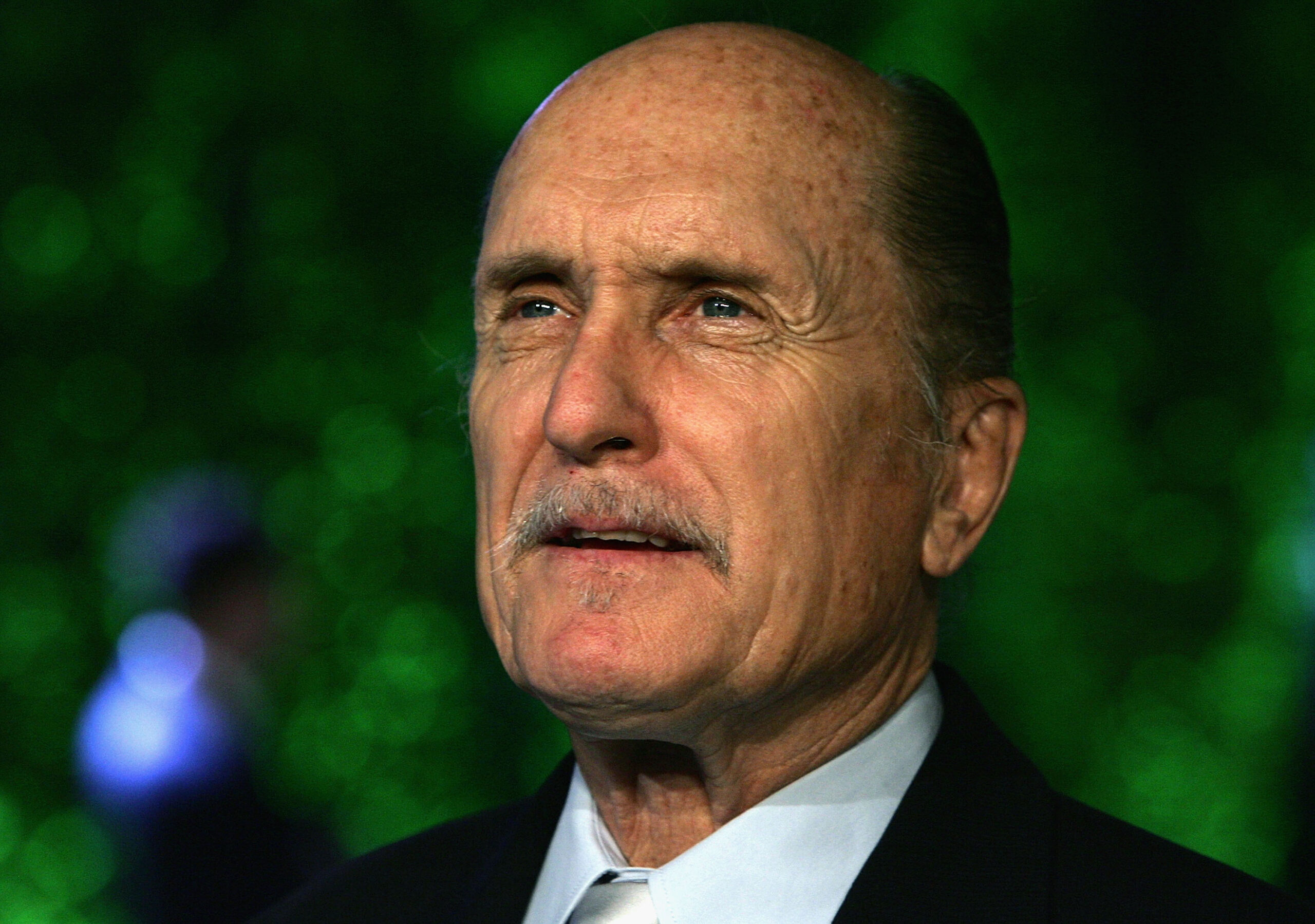
The Tender Mercy of Robert Duvall
From Mac Sledge to Col. Kilgore, Duvall’s characters embodied the soul of our nation.
Back in the old America, where country music still mattered and real men donned decent blue jeans and 10-gallon hats and sang until their hearts turned blue, Robert Duvall crooned beneath the heavens in front of a 40-foot wide Lonestar State Flag. In a dusty, dim Texas bar, couples held hands and swayed slowly as Mac Sledge, a washed-up country singer portrayed by Duvall in Bruce Beresford’s incredible 1983 film, Tender Mercies, sang the beautiful medley “If You’ll Hold The Ladder (I’ll Climb To The Top).”
There are so many indomitable performances by Duvall throughout his career that it’s difficult to choose a favorite, but for me, his redemptive arc as Sledge in Tender Mercies takes the very top prize. Always the real deal, Duvall had told Beresford he would only take on the role if Beresford promised Duvall he could sing the songs in the music-heavy film without autotune and in his own voice.
For that magnetic, majestic performance of true grit and faded misery, Duvall won the award for Best Actor at the 56th Academy Awards in 1984. The country music star Dolly Parton, who co-presented the award standing next to a youthful Sylvester Stallone, screamed with delight as she tore open the envelope.
There is no easy answer to the film, no sudden flash of light that completes the blighted canvas. That’s what made it so great. After all, life’s a lot like that too. “I don’t trust happiness,” Sledge tells his girlfriend Rosa Lee (played by Tess Harper), a young widow living on the edge of nowhere with her impressionable son. “I never did, I never will.”
But happiness is exactly what Duvall brought to America and viewers from around the world in a career that spanned country music barrooms to the war-torn beaches of Vietnam. He didn’t dance for fun or toss away one-liners for laughter. His characters were tough men, broken men, decent men, and devout men. They were the type of men that rarely seem to exist anymore in the new world we have conjured with pixels and irony. His loss is a tragedy not only to the giant empire of film but the one we built and lost somewhere between New York City and Los Angeles.
Duvall, one of the great American actors of the 20th century, passed away peacefully at his home in Middleburg, Virginia on Sunday, February 15. He was 95 years old and remembered for his great passion and dedication to the silver screen in a statement released the next day by his wife Luciana.
“Bob gave everything to his characters and to the truth of the human spirit they represented,” Luciana wrote. “In doing so, he leaves something lasting and unforgettable to us all.” Duvall played many memorable characters in a career that spanned seven decades. The actor and director starred in lead roles in The Great Santini, Tender Mercies, and The Apostle, earning nominations for best leading actor in each at the Academy Awards.
In 2003, Duvall portrayed Robert E. Lee in Ronald F. Maxwell’s Civil War drama Gods and Generals. A personal favorite of mine was his domineering force as crew chief and car builder Harry Hogge in the sports action film Days of Thunder featuring a young Tom Cruise. An old-school mechanic in Gone in 60 Seconds, a mysterious neighbor in To Kill a Mockingbird, and a fatherly CEO in Adam Sandler’s basketball love story Hustle, Duvall’s range was immense.
Duvall is perhaps best remembered for his brief role in Francis Ford Coppola’s tour de force Apocalypse Now. Though on screen for barely 15 minutes, Duvall delivered one of the most indelible performances in film history. Descending into the battlefield via a helicopter blaring “Ride of the Valkyries” in the middle of a burning jungle, the raw energy of Duvall’s character, the maniacal Col. Bill Kilgore, embodies the pure anarchy, chaos, and violence of the Vietnam War.
“You smell that?” Kilgore screams over the roar of a helicopter after landing on a bombed-out beachfront. “Napalm, son. Nothing else in the world smells like that. I love the smell of napalm in the morning. You know that gasoline smell? Smells like victory.”
Surveying the destruction wrought by his boys, Kilgore opens a deck of playing cards and begins tossing a card on each dead body he passes. A lieutenant in the background, via translator, yells at frightened Vietnamese civilians: “We are here to help you.” Duvall’s Kilgore is insane and completely untamed, emblematic of the on-the-ground reality for what became a red, white, and blue killing field. It’s why, nearly 50 years after its premiere, audiences can still instantly recall his stunning performance in the Palme d’Or-winning film.
Duvall is also remembered for his iconic portrayal of Tom Hagen, the quiet intellect of the Corleone mob family in Coppola’s 1972 film, The Godfather, and its 1974 sequel, The Godfather II. Though born a German-Irish orphan, Duvall’s character becomes consigliere and lawyer for mob boss Vito Corleone, acting as the trusted advisor and confidant for the crime family. Duvall’s character is the order amid Corleone chaos. He anchors the film in a way that no other character can. It’s a role that only an actor as skilled as Duvall could portray.
Duvall could be raw and electrifying, remorseful and forlorn, direct and blistering, calculated and charismatic. He was one of the greatest to ever do it. He often portrayed a side of America that is now fleeting, in honest and mercurial ways. He will be missed, immensely. See you on the other side, Mr. Duvall.
The post The Tender Mercy of Robert Duvall appeared first on The American Conservative.
Google Search
