
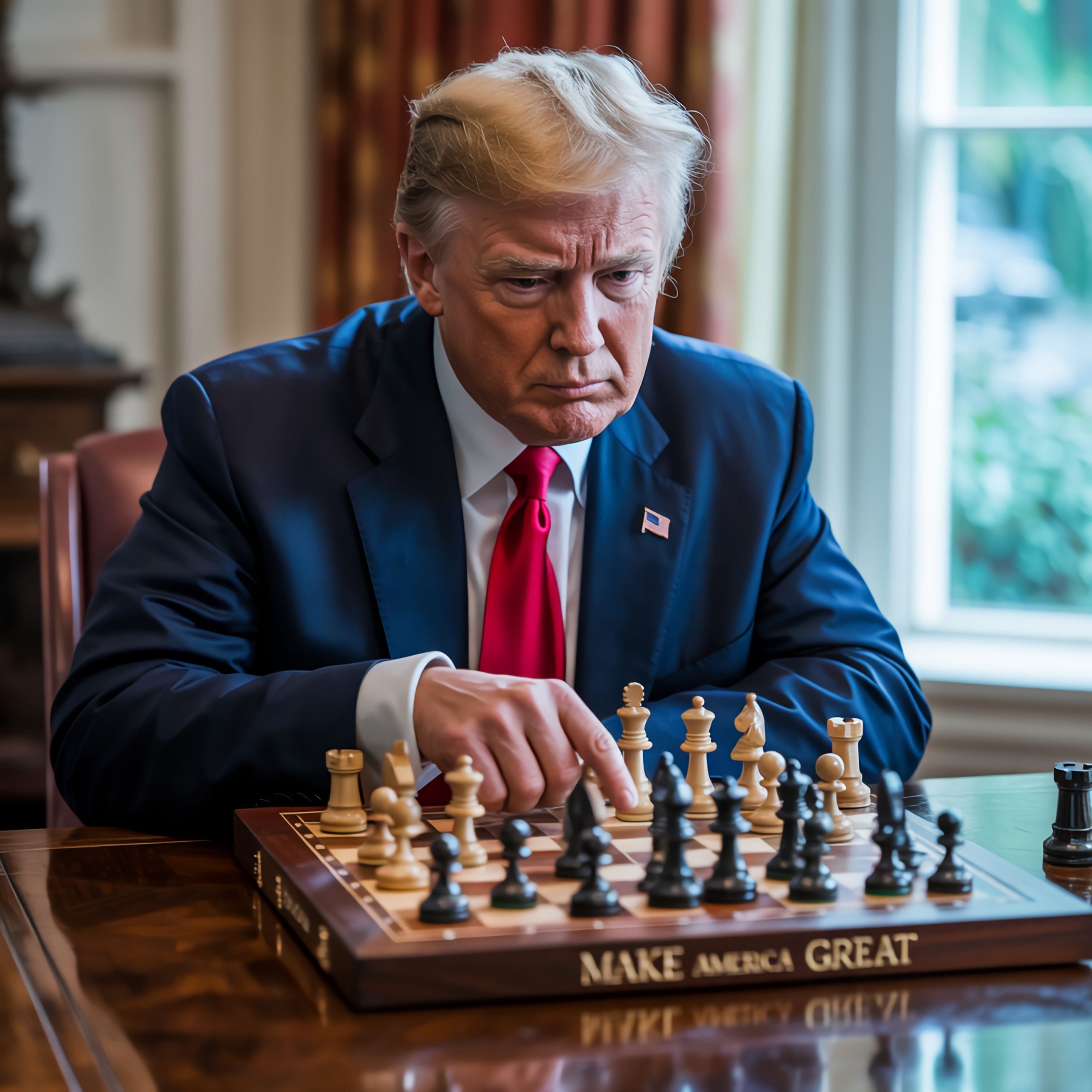
The following article, The Greatest Political Mistake Democrats Ever Made, was first published on The Black Sphere.
There are two things Democrats and their obedient stenographers in the corporate media could do tomorrow that would dramatically improve their credibility with the American public. The first would require them to stop lying, which admittedly represents a lifestyle change roughly equivalent to asking a shark to experiment with vegetarianism. The second would require them to acknowledge a truth so painfully obvious that even casual observers recognize it: Donald Trump is the GOAT of modern American politics.
That conclusion does not come from blind loyalty or partisan enthusiasm. Instead, it emerges from a simple observation that millions of Americans quietly share. The man who was supposed to be politically destroyed by scandal, investigations, impeachment, and a permanent media feeding frenzy instead managed to transform American politics. And now both parties orbit around him like smaller moons caught in a gravitational field.
People no longer believe what they see or hear in the media. After years of breathless “bombshell” stories that evaporate within weeks, the press has managed to accomplish the impossible: they destroyed their own credibility faster than politicians could.
Now let’s clarify something.
There is a difference between opinion and propaganda. Opinion writers analyze events, draw conclusions, and occasionally irritate fact-checkers who wander into the discussion like substitute teachers looking for contraband chewing gum. I’ve had my share of media watchdogs contact me over the years to declare that something I wrote was incorrect and required immediate retraction. My response remains consistent. I write commentary based on information available at the time, I present arguments, and I offer opinions.
Fortunately for me, those opinions tend to age well.
Corporate media, on the other hand, sells narrative disguised as journalism. Their product resembles political theater more than reporting, which explains why their coverage of Donald Trump often reads like a screenplay written by activists who forgot that reality eventually interrupts the plot.
The most revealing element of the Trump phenomenon is not that Democrats oppose him.
Political opposition is normal. The fascinating part is the intensity of the opposition and the sheer scale of institutional effort dedicated to stopping one man who, inconveniently for the establishment, entered politics without needing permission from any of its gatekeepers.
Trump did not require politics to become wealthy. He did not require politics to achieve fame. By the time he descended that famous escalator in 2015, he had already built a brand recognizable around the world. Unlike most modern politicians who enter office with modest bank accounts and leave with book deals, consulting contracts, and suspiciously lucrative “speaking engagements,” Trump arrived in Washington with his fortune already intact.
That fact alone introduced a level of unpredictability the political class could not comfortably process. A man who does not need the system is far more difficult to control than one who relies upon it.
I contend that the political establishment likely would have attacked Trump regardless of party affiliation.
Had he appeared on the national stage as a Democrat promising to expose the machinery of Washington, the same entrenched interests would have responded with equal hostility. Power protects itself first, ideology second.
Yet the early stages of Trump’s campaign revealed something even more entertaining. While Democrats now pretend they feared Trump from the beginning, the historical record tells a very different story.
During the Republican primary in 2015 and early 2016, many Democratic strategists practically salivated at the idea of facing Trump in the general election. They believed he would be the easiest opponent imaginable, a loud celebrity whose candidacy would collapse under the weight of scrutiny.
Media coverage reflected that assumption. According to research from Harvard’s Shorenstein Center on Media, Politics and Public Policy, Donald Trump received nearly $2 billion in free media coverage during the 2016 primary cycle, far more than any other candidate, largely because television networks considered him a ratings goldmine rather than a legitimate political threat.
In other words, the same networks that now portray Trump as a menace to democracy once treated him as a profitable sideshow.
But something curious began happening as the campaign progressed.
Debate after debate produced the opposite outcome of what the experts predicted. Instead of fading under scrutiny, Trump’s poll numbers climbed steadily. His blunt style, which horrified political consultants accustomed to carefully scripted speeches, resonated with voters who had grown tired of hearing politicians speak in language that sounded like it had been approved by twelve lawyers and a focus group.
Then came the rallies.
At first the press described the crowds as curiosity seekers. Commentators suggested that voters were merely “kicking the tires” on Trump, sampling the novelty before returning to more traditional candidates. Yet the crowds kept expanding. Small venues turned into arenas. Arenas turned into stadium events. Thousands became tens of thousands, and suddenly the political class found itself staring at a movement it did not understand.
Meanwhile many Democratic campaign stops resembled book club meetings that accidentally wandered into a diner.
The contrast was impossible to ignore. Trump’s rallies looked like political revival meetings filled with working-class voters who believed someone had finally decided to speak directly to them rather than about them. These were not the professional activists who dominate cable news panels. They were welders, truck drivers, construction workers, small business owners, and veterans who felt abandoned by both parties.
By the time Trump secured the Republican nomination, the initial amusement within Democratic circles had begun to mutate into something resembling panic.
The 2016 election that followed did more than place Trump in the Oval Office.
It detonated the assumptions that had governed American politics for decades. The professional political class discovered that voters could be mobilized outside the traditional campaign machinery. Social media, large rallies, and direct messaging allowed a candidate to bypass the usual gatekeepers who previously controlled the national conversation.
Even more frustrating for Trump’s critics was the performance of the economy during his presidency. Prior to the pandemic disruption in 2020, the United States experienced historically low unemployment rates across multiple demographic groups. Black unemployment, for example, reached the lowest levels ever recorded since the statistic began being tracked. Data from the Federal Reserve shows the unemployment rate for Black Americans falling to record lows during that period.
That development complicated the narrative many Democrats had promoted during the campaign, which predicted economic chaos under Trump’s leadership.
Meanwhile, the media’s obsession with the Russia collusion story dominated headlines for nearly two years before Special Counsel Robert Mueller concluded that his investigation did not establish that the Trump campaign conspired with Russia during the 2016 election.
The conclusion landed with a thud compared with the sensational coverage that preceded it, which illustrates a pattern Americans have now observed repeatedly. Accusations arrive with thunder, while corrections arrive quietly enough to be mistaken for background noise.
All of this history leads to a thought experiment that Democrats rarely indulge because the answer is too uncomfortable. Imagine, for a moment, that Donald Trump had run as a Democrat.
Strip away the party label and examine the results. Trump’s economic policies produced strong job growth. His administration renegotiated trade agreements in ways that appealed to manufacturing workers. His criminal justice reforms attracted bipartisan support. His foreign policy initiatives helped produce the Abraham Accords, a series of normalization agreements between Israel and several Arab nations that many analysts considered impossible only a few years earlier.
If those achievements had been delivered by a Democratic president, the media would already be producing documentaries describing him as a transformational figure in American history.
Instead, Trump became the villain in a political narrative constructed by the very people who once believed he would be their easiest opponent.
Which brings us to the greatest strategic mistake Democrats ever made.
By focusing their entire political identity on opposing Trump, they elevated him into the central figure of American politics. Every investigation, every impeachment, every attempt to remove him from the public stage reinforced the perception among his supporters that powerful institutions feared him. Political attacks that might have weakened a conventional candidate instead strengthened Trump’s bond with voters who already distrusted those institutions.
Democrats believed they were destroying Trump. In reality, they were helping to build the legend.
And that is the true irony of the entire saga. Had Trump run as a Democrat, the same people who now condemn him would likely celebrate him as a generational leader. They would praise his ability to attract working-class voters, applaud his economic achievements, and host academic conferences analyzing the brilliance of his political instincts.
Democrats created their own nemesis.
Republicans gained a figure who reshaped their party, energized voters, and forced the national conversation to revolve around issues the political establishment preferred to avoid. Democrats, meanwhile, remain trapped in a cycle where their most reliable strategy involves opposing whatever Trump happens to support that week.
History will eventually judge this period with greater clarity than today’s partisan shouting matches allow. When that happens, analysts may conclude that Donald Trump did not merely win elections or dominate news cycles. He changed the structure of modern American politics in ways few leaders ever manage.
The only thing left for Democrats and their media allies to decide is whether they will continue pretending otherwise or finally admit the obvious.
They bet everything on defeating Trump. Instead, they helped create the GOAT.
Continue reading The Greatest Political Mistake Democrats Ever Made …
Google Search
