
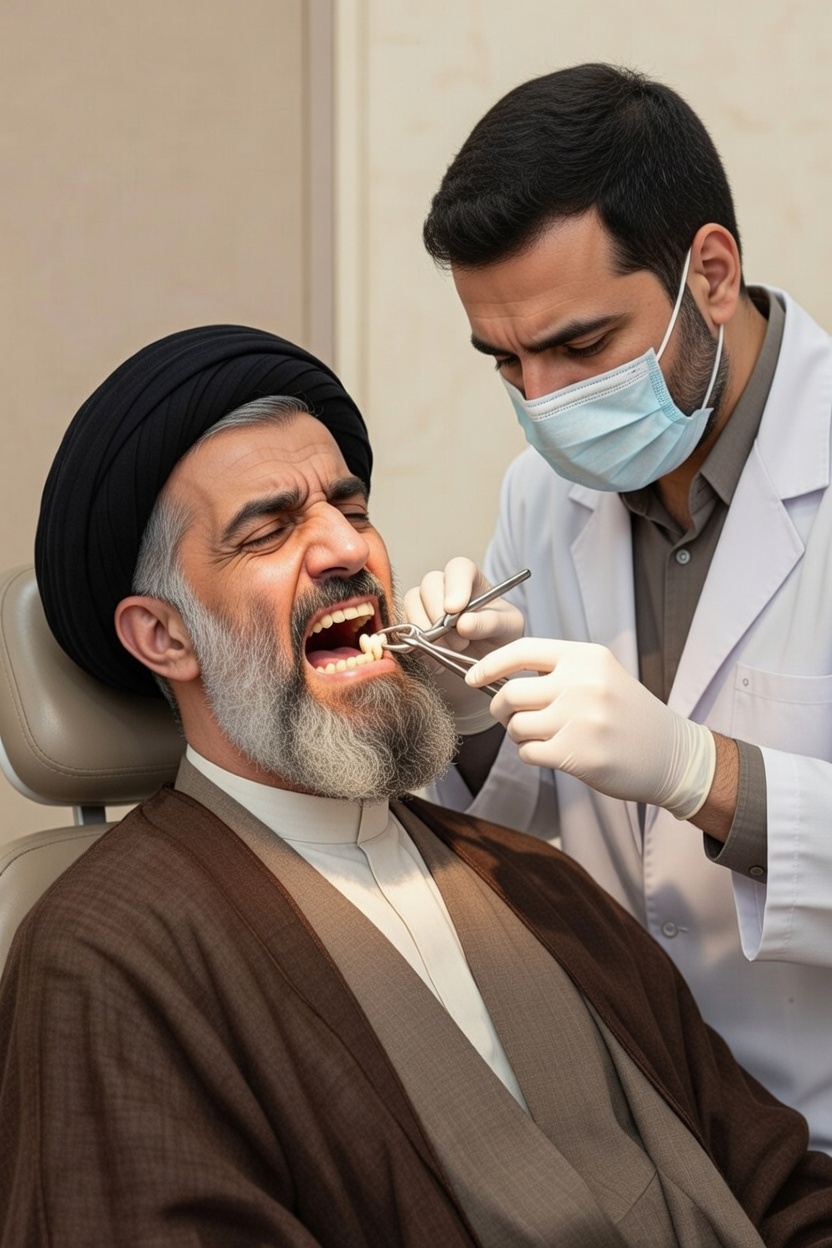
The following article, The Ayatollah’s Last Dentist Appointment, was first published on The Black Sphere.
There are military strikes, and then there are statements written in fire.
This week Israel carried out airstrikes on the Assembly of Experts building in Qom at the exact moment the clerical body was counting votes to select a successor to Ayatollah Ali Khamenei. The timing was not accidental. It was surgical.
The missile strike was the geopolitical equivalent of pulling the stage curtain down mid-monologue and informing the cast that the show has been canceled indefinitely.
According to reports in Axios, the strike was designed explicitly to prevent the selection of a new supreme leader. And if the objective was to halt succession before it could metastasize into stability, then the objective was met with precision that borders on mathematical cruelty.
Mission accomplished.
But this wasn’t an isolated spark. It was the second wave.
The opening salvo of what has been called Operation Epic Fury, a coordinated U.S.-Israeli military campaign, reportedly eliminated 49 of Iran’s top leaders. Not mid-level bureaucrats. Not regional deputies. Top leadership. The kind of men who normally sleep behind layers of security so thick that even paranoia has bodyguards.
Forty-nine.
If that number feels implausible, it should. Because it raises the natural question that every serious observer must ask: how do you locate nearly fifty of the highest-ranking members of a hostile regime in a country built on secrecy, counterintelligence, and religious militancy?
The answer, if even partially true, reads like something a Hollywood screenwriter would discard for being too outrageous. Reports circulating suggest that Mossad operatives embedded tracking devices in dental implants and medical procedures administered to senior Iranian officials, allegedly through agents posing as dentists and physicians. Whether every detail of that account withstands scrutiny is almost secondary to the broader reality: Israel’s intelligence penetration of Iran appears so deep that the regime’s inner circle cannot trust its own enamel.
If you are a member of the Iranian elite and your dental history includes a particularly attentive practitioner, you may want to rethink your retirement plans.
And this is not the first time Israeli ingenuity has rewritten the rules of engagement.
The world has not forgotten the alleged pager bomb operation that detonated devices linked to high-ranking Iranian military personnel, effectively turning communication tools into judgment devices. That episode alone demonstrated an unsettling truth: when Israel infiltrates, it does not merely observe. It plants consequences.
Let us pause here for perspective.
For decades, Iran has operated as the primary state sponsor of terror in the Middle East, funding proxies, arming militias, destabilizing neighbors, and chanting about the destruction of Israel while assuming that its clerical fortress in Qom was untouchable. The regime invested in asymmetrical warfare, cyber capabilities, and regional chaos, confident that geography and ideology formed an impenetrable shield.
And yet, one by one, senior figures have been removed from the chessboard with an efficiency that suggests the board itself may be compromised.
It is difficult not to compare this with the bureaucratic sprawl of American homeland security.
The United States Department of Homeland Security commands vast budgets, sprawling offices, and enough acronyms to choke a Scrabble board. Yet when it comes to projecting power deep into hostile territory and dismantling leadership networks in real time, the contrast with Mossad is stark. One feels like a risk assessment committee. The other feels like inevitability.
This is not a knock on American capability so much as an acknowledgment of specialization. Israel exists in a perpetual stew of existential threats. Its margin for error is thinner than a diplomatic apology. As a result, its intelligence services have evolved into something lean, patient, and mercilessly inventive. Mossad does not simply gather information. It curates leverage.
Now layer onto that the political context in Washington.
With Donald Trump back in office and projecting unmistakable resolve toward Tehran, the strategic calculus has shifted. During his previous term, Trump authorized the strike that eliminated Qasem Soleimani, signaling that America would not treat Iranian aggression as a theoretical nuisance. The message then was deterrence through decisiveness. The message now appears to be something closer to coordinated escalation with a defined end state.
Far be it from any commentator to declare wars over prematurely, but when a regime loses its supreme leader in an initial strike and then sees its constitutional body for succession obliterated mid-deliberation, we are no longer discussing symbolic retaliation. We are discussing systemic decapitation.
The question becomes whether a regime built on theological authority can survive repeated assaults on the very mechanism that legitimizes its leadership. The Assembly of Experts is not decorative. It is the constitutional organ tasked with selecting and supervising the Supreme Leader. Interrupting that process at the moment of vote counting is not merely tactical. It is psychological warfare aimed at the regime’s spine.
Imagine attempting to project divine inevitability while scrambling to confirm that your dental work is not broadcasting coordinates.
There is also a broader geopolitical implication that experts would be wise not to ignore.
By striking during a leadership transition, Israel has signaled that it will not allow Iran the breathing room typically afforded to regimes during succession crises. Historically, transitions can provide opportunities for recalibration, backchannel negotiations, or strategic pauses. Instead, this moment was treated as vulnerability.
And vulnerability, in war, is an invitation.
Critics will undoubtedly warn of escalation, regional spillover, or the risk of overreach. Those concerns are not trivial. Iran maintains proxy forces across Lebanon, Syria, Iraq, and Yemen. It retains missile capabilities and asymmetric tools. A wounded regime can lash out unpredictably.
Yet deterrence is not built by allowing adversaries to reorganize comfortably. It is built by demonstrating that the cost of aggression extends beyond sanctions and speeches. If the Iranian leadership understands that succession itself can be targeted, then the regime’s internal calculus shifts from expansion to survival.
There is an old strategic principle that wars are won not merely by destroying armies, but by collapsing the enemy’s ability to command and control. Remove the head, disrupt the nerves, and the body falters. What we are witnessing appears to be a deliberate campaign aimed precisely at that axis.
And so we arrive at the uncomfortable but unavoidable conclusion.
Between Israel’s intelligence penetration and America’s renewed executive resolve, this confrontation has entered a phase that looks less like tit-for-tat and more like structural dismantling. Whether one labels it war, extended conflict, or strategic eradication is largely semantic. The practical effect is the same: Iran’s ruling apparatus is under sustained, targeted assault, unless the ruling class all pull out their teeth.
Respect, in geopolitics, is not granted for rhetoric. It is earned through capability. When a nation can infiltrate your medical system, anticipate your succession process, and strike at the exact minute ballots are being counted, respect may not be the word your adversaries use aloud, but it is the one they feel privately.
History will debate the proportionality, the prudence, and the precedent. But it will not debate the audacity.
Because whatever else one thinks of these operations, they reveal a reality that Tehran can no longer deny: the walls are porous, the hierarchy is exposed, and the era of assumed immunity has ended.
Continue reading The Ayatollah’s Last Dentist Appointment …
[H/T The Black Sphere]
Google Search
