
On this day in 1896, the court issued Plessy v. Ferguson, in which it upheld a Louisiana law requiring “equal but separate” accommodations for white and black passengers on passenger trains. The decision was overturned in Brown v. Board of Education, which was handed down 58 years later, almost to the day.
Amy will take part in a LinkedIn Live event with Briefly’s Adam Stofsky on Wednesday at noon EDT about this term’s highest-profile cases. Register here.
And a correction from Friday’s newsletter: Justice David Souter’s former home is in Hopkinton, New Hampshire, not Hopkinton, Massachusetts. (Both towns exist and both are near Boston – but Souter was very much a New Hampshire guy!)
At the Court
Early Friday evening, the court denied a request from Virginia Democrats and the state’s attorney general to reinstate Virginia’s new congressional map. For more on the case, see the On Site section below.
On Thursday, the justices met in a private conference to discuss cases and vote on petitions for review. Orders from that conference are expected this morning at 9:30 a.m. EDT.
The court has indicated that it may release opinions on Thursday, May 21, at 10 a.m. EDT. We will be live blogging that morning beginning at 9:30.
Morning Reads
Virginia’s Spanberger fumes after Supreme Court declines to reinstate new map
Ryan Mancini, The Hill
Top Democrats in Virginia criticized the Supreme Court after the justices declined to pause a ruling preventing the state from using a new congressional map in the 2026 elections that would have aided Democrats. “The Supreme Court of the United States has now joined the Supreme Court of Virginia in choosing to nullify an election and the votes of more than three million Virginians,” wrote Virginia Gov. Abigail Spanberger on X. Similarly, Virginia Attorney General Jay Jones described Friday’s ruling as “yet another profoundly troubling example of the continued national attack on voting rights and the rule of law by Donald Trump, Republican state legislatures, and conservative courts.”
Justice Alito pushes back on calls to sit out a major Supreme Court climate case
Lawrence Hurley, NBC News
Next term, the court will hear a case concerning “an attempt by energy companies ExxonMobil and Suncor Energy to throw out a lawsuit in Colorado seeking damages for harms related to climate change.” In a May 14 letter to the Senate Judiciary Committee, “left-leaning groups” urged the committee “to investigate [Justice Samuel] Alito’s involvement in the case, citing in part his stock holdings in energy companies.” When asked about the letter by NBC News, a Supreme Court spokeswoman told NBC News that “Justice Alito does not have a financial interest in any party” involved, adding that “Alito was advised by the court’s legal counsel that ‘his recusal is not required.’” A representative of one of the groups that signed the letter told NBC News that “Alito should still step aside” because the court’s eventual ruling will impact other cases involving the energy companies he invests in.
Consumers sue Amazon for not refunding Trump tariff costs
Nate Raymond, Reuters (paywalled)
On Friday, a group of consumers seeking refunds for “costs passed on to them in the form of higher prices” before the Supreme Court struck down President Donald Trump’s signature tariffs sued Amazon.com Inc. “[I]n a proposed class action filed in federal court in Seattle,” according to Reuters, they “alleged that the e-commerce giant collected hundreds of millions of dollars in unlawful tariff costs by raising prices on imported goods before the Supreme Court had ruled.” Although other companies are facing similar lawsuits, the Amazon case is unique because the company is not seeking tariff refunds from the government. The consumers behind the new suit claim that the company “seeks to curry favor with Trump by allowing the federal government to retain the funds.”
Harris labeled ‘institutional arsonist’ for plan to fundamentally transform SCOTUS and Electoral College
Adam Pack and Kelly Phares, Fox News
Last week, former Vice President Kamala Harris “call[ed] on Democrats to consider expanding the Supreme Court” during a call with a “left-wing nonprofit” about what the Democratic Party should focus on moving forward, according to Fox News. “Let’s invite ideas, for example, that are about Supreme Court reform, including the notion of expanding the court,” Harris said. House Speaker Mike Johnson, a Republican from Louisiana, was among the Republicans who pushed back against Harris’ comments, accusing “Democrats of being ‘institutional arsonists.’” “For the former vice president of the United States and a candidate for president to suggest that you should pack the Supreme Court or destroy these institutions because they lost is I just think outrageous,” Johnson said.
Justice Dept. Aims to Denaturalize Ex-Marine for Sex Crime
Ernesto Londoño, The New York Times (paywalled)
A push from the Justice Department “to denaturalize a former Marine born in Ghana because of a sex crime he committed after he became a U.S. citizen” is putting Supreme Court precedent on denaturalization back in the spotlight, according to The New York Times. “A 1967 Supreme Court ruling effectively barred the government from stripping Americans of their citizenship unless they obtained it fraudulently,” but the DOJ has said “it would ‘maximally pursue denaturalization proceedings,’ targeting, among others, those who commit sex offenses, fraud and drug offenses.” The Times reported that the DOJ’s case against Nicholas Eshun centers “on a statute that applies to immigrants who” became citizens through military service but “fail to complete at least five years in the armed forces and depart without an honorable discharge.” Eshun “was dishonorably discharged from the military after four years and six months in the service” after being “charged with attempted sexual assault of a child” while in the military and reaching a plea deal.
On Site
Interim Docket
Court denies Virginia’s request to reinstate congressional map that would benefit Democrats
The Supreme Court on Friday evening turned down a request by Virginia’s attorney general and other Virginia Democrats to allow the state to use a new congressional map, which would have been expected to strongly favor Democrats, in the 2026 elections. The denial came in a brief, unsigned order sent to reporters at 6:30 p.m. EDT on Friday – just 15 minutes after the court’s Public Information Office distributed the reply filed by Jay Jones, the Virginia attorney general, and Democratic legislators.
Opinion Analysis
Court rules freight brokers can face negligent hiring suits under state law
A unanimous Supreme Court ruled on Thursday in Montgomery v. Caribe Transport II that federal law does not shield freight brokers from state lawsuits claiming they negligently hired dangerous motor carriers.
Opinion Analysis
Justices validate authority of federal courts to confirm arbitration awards – at least in cases already in federal court
Thursday’s opinion in Jules v. Andre Balazs Properties validated the authority of federal courts to enforce arbitration awards made in cases already pending in federal court.
From the SCOTUSblog Team
When (if ever) it’s appropriate to make jokes, take selfies, or curse before the court
The Supreme Court’s Guide for Counsel offers dos and don’ts for the attorneys who argue before the Supreme Court. It explains what the court is hoping to accomplish during an argument and gives a sense of how the court sees itself as an institution. Here’s what Kelsey learned from the guide about swearing, taking selfies, and the types of answers the justices like best.
From the SCOTUSblog Team
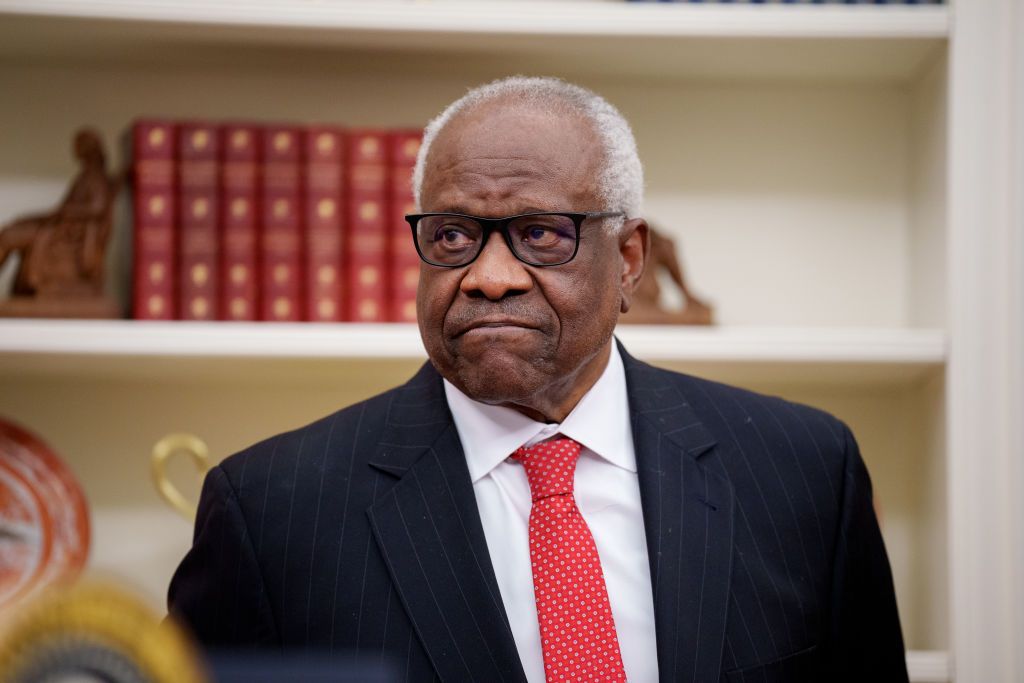
Justice Clarence Thomas reflects on shared values and his “deeper” friendships on a past court
Justice Clarence Thomas on Thursday afternoon spoke on the issue of shared national values. In an appearance at a conference outside Miami for judges and lawyers from the U.S. Court of Appeals for the 11th Circuit, which includes Alabama, Florida, and Georgia, Thomas described growing up in Georgia during segregation and said that “we shared a country, no matter how badly we were treated, with our fellow citizens.” Thomas also expressed nostalgia for earlier iterations of the Supreme Court, saying that “it’s a different court now” and he was “really grateful I had an opportunity to be on the court that I joined.”
A Closer Look
Death at the Lectern
In his recent (and controversial) TED Talk on preparing for Supreme Court argument and the value of AI in this process, SCOTUS advocate and Milbank partner Neal Katyal opened with: “There is a mahogany podium at the Supreme Court of the United States. One person died there, mid-argument, a stroke. Another collapsed there, dying soon thereafter.”
“I haven’t heard about [the mid-argument death],” wrote Stanford Law School professor Orin Kerr on X a few days later. “Does anyone know the details?” Kerr then answered his own question in the thread: “Katyal adds that another lawyer collapsed during an argument and died soon after, which I believe refers to William Pinkney in 1822. … The [death] reference appears to be to U.S. Attorney General Augustus Hill Garland, who had a stroke during argument in 1899, was carried to the clerk’s office, and died there, at least according to this 1908 biography [called A Life of Mr. Garland].”
Naturally, we wanted to investigate this further.
Let’s start with Pinkney. A renowned advocate known for “dressing in the latest fashions” (and for denigrating his opponents; so much so that Daniel Webster once locked him in a room in the U.S. Capitol) Pinkney also “often appeared in Court evidently intoxicated.” Despite this, he argued “over half” the cases in the 1814-15 term. In 1822, while arguing against his frenemy Webster in Ricard v. Williams – a case about land ownership – Pinkney indeed collapsed on the court floor and died two days later. In his obituary, he was remembered as “str[iving] to preserve [fame] with increasing anxiety, until, exhausted by overwork, he died at Washington and was buried there.” Another wrote that “Pinkney did die, in one sense, opportunely for his fame.”
As for former U.S. Attorney General Garland, his health had apparently been in decline in the months and years before his 1899 death, but he reportedly thought his condition wasn’t serious. On Jan. 26, 1899, Garland took to the lectern to resume argument in Towson v. Moore, a property dispute, which had begun the day before. While in the clerk’s office before argument, Garland remarked that he was not feeling well and would take time off the following Monday to rest. Fifteen minutes into the court session, Garland abruptly stopped his reading from a law book, gasped, and fell sideways to the floor. He had suffered a stroke and despite efforts to revive him (he was carried from the chamber to the chief clerk’s room), Garland died within 10 minutes. His last sentence would be “This, your honors, is our contention.” Ironically, Garland (supposedly) had said in conversation just two months before that “It has been over forty years since I argued my first case. Nothing would please me better, when my time comes to die, than to be stricken right here in this court room in the midst of an argument. That would be a fitting climax to my career.”
Advocate Thomas Emmet, too, collapsed from a stroke mid-argument in 1827 and died; one newspaper said there was “‘something glorious and consolatory’ in the manner of his death.” Advocate Prew Savoy died within 36 hours of his arguing in front of the justices in 1957, doing so while suffering from an advanced stage of lung cancer.
There are tales of less serious (although somewhat embarrassing) incidents. Ohio Sen. Thomas Ewing fainted and collapsed while speaking at oral argument in 1869. His son, General Thomas Ewing, did the same 26 years later in an 1895 argument, apparently followed the next day by the elder Ewing fainting yet again (as one paper put it, “While making an argument before the Supreme Court he fell in a faint to the floor, in about three feet of the spot where his son sunk on the carpet yesterday.”)
One advocate in 1945 fainted after Justice William Douglas asked a pointed question (“Who drafted this affidavit?”). When the lawyer recovered, he told Douglas “[t]hat he had.” Douglas also recounted one advocate collapsing in 1973 while arguing in a Fourth Amendment case (the case was reargued the next week by a new lawyer).
As Chief Justice John Roberts once noted in a lecture about oral advocacy: “Supreme Court oral argument has always been vigorous and rigorous. Some advocates have collapsed in the face of it.”
SCOTUS Quote
JUSTICE BREYER: “All right. Look, we have the same question. I just want an answer to my question. And, for the purposes of this question, I am assuming enormously in your favor. I am assuming that this set of conditions is the worst thing since sliced bread.”
(Laughter.)
JUSTICE BREYER: “All right. I think there – all right. I’m assuming that in your favor. All right.”
JUSTICE SCALIA: “Sliced bread’s supposed to be good.”
JUSTICE BREYER: “No, no. It’s been proved bad.”
— Koontz v. St. Johns River Water Management District (2013)
Google Search
