
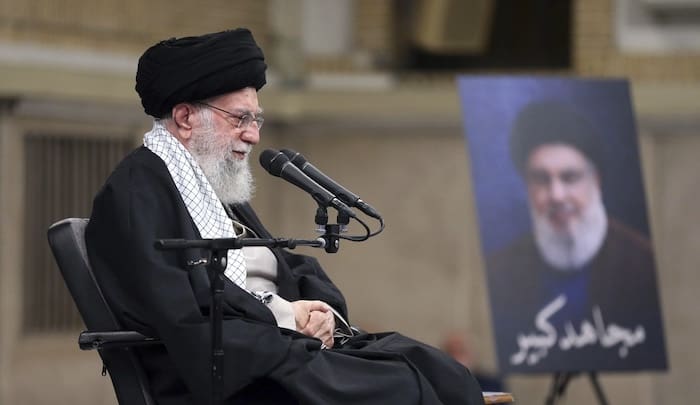
After 46 years of enduring the mullahs’ hellish regime, the people of Iran are now out on the streets all over the country, in Tehran, Mashhad, Kermanshah, and Qeshm, and a dozen other cities, in numbers we have not seen before, protesting against the economic degringolade. The rial has now hit a historic low of 1,250,000 to one US dollar (it was 70 rials to the dollar in 1979, when the Islamic Republic began); 40% of Iranians now live below the poverty line; 60% of university graduates cannot find jobs; unemployment is above 30%; the recent removal of subsidies has caused the price of fuel to skyrocket; the government has failed completely to deal with a historic drought, saying only that it may be necessary to move the entire population of Tehran out of the city to places with more water; the waste and mismanagement and misallocation of resources, including the $100 billion spent on Iran’s nuclear facilities that Israel obliterated, with help from the Americas, in the 12-day war in June, the $16 billion a year that the Iranian government chooses to spend annually on weapons for Hamas, Hezbollah, and the Houthis — money that the Iranians would like to be spent on themselves. No wonder people are out on the streets across the country, demanding not the resignation, but the death, of the Supreme Leader.
Andrew Fox, a former British army officer who served three tours in Afghanistan, and is now a Lecturer at Sandhurst, has some thoughts on what a toppling of the Iranian regime would look like here.
With protests in Iran hitting the headlines, here is a quick recap of a piece from the 12 Day War. Here are some of the factors to look for when it comes to regime collapse and change.
Military pressure alone, irrespective of its intensity, does not automatically lead to regime collapse. The breaking point of the Iranian regime will depend on a convergence of social, military, and psychological triggers that ultimately tip the balance. Drawing from historical precedents and Iran’s unique context, we can split this into social, military, and psychological thresholds that must be met.
- Mass civil unrest (social threshold). Widespread, sustained protests and chaos in the streets could signal that the regime’s authority is irreparably eroded. Iran has witnessed waves of mass protests before, but the difference now lies in the regime’s weakened coercive power. If news of the leadership’s flight emerges, ordinary Iranians may lose their fear and surge into the streets in vast numbers, sensing that the regime is on its last legs. A general strike, protesters overrunning government buildings, or large crowds gathering in Tehran’s Azadi Square to celebrate an anticipated “liberation” would exert enormous pressure on what remains of the security forces. Unlike past uprisings, protesters would now carry the morale boost of having seen the once-mighty IRGC humbled by Israeli strikes. Exiled opposition figures are openly encouraging civil resistance. Reza Pahlavi, the ex-crown prince, urged Iranians and even security personnel to seize this moment, declaring, “The regime is weak and divided… Iran is yours to reclaim”. If the populace answers that call en masse, sheer people power could overwhelm the regime’s remaining loyalists….
The mass protests in Iran continue. The merchants — bazaaris — in the Grand Bazaar in Tehran have kept their shops locked. Bazaaris in Meshhad and a half-dozen other cities have also gone on strike, shutting down their shops and with that, much of the economic activity in the country, despite the army’s threats to the bazaaris to reopen. Protests have spread to all the universities, where classes are no longer being held and the students have gone out on the streets to protest against the regime. The students, the merchants, and ordinary Iranians from every walk of life are calling “Death to Khamenei,” and some are calling as well for the return of Crown Prince Reza Pahlavi. Will the current protest peter out, the way that protests over the death of Mahsa Amini, the girl beaten to death by the religious police for not adjusting her hijab correctly, did in 2022? Or will the protests continue, swelling in size, with miliary units defecting to join the ranks of the protesters?
There is a difference. The killing by Israel of a dozen of Iran’s senior military figures in June has made the army and the Islamic Revolutionary Guards Corps appear weak, as did Iran’s failure to mount any kind of serious response to the IDF’s obliteration of both Iran’s nuclear facilities and of its stockpile of ballistic missiles and its ballistic missile plants. The 12-day war has shown the people of Iran that the military that keeps the regime in power can be beaten. And at the same time, never before in the 46-year history of the Islamic Republic has the economic situation been so disastrous. Those protesters believe they have nothing left to lose. They are right.
Google Search
