
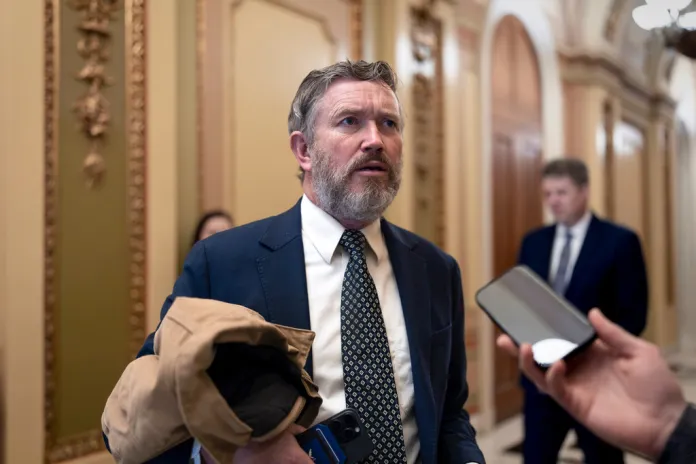
House Republicans narrowly blocked an effort to rein in President Donald Trump’s war powers, the first such vote in the lower chamber since the administration captured former Venezuelan dictator Nicholas Maduro.
The resolution, which failed in a tie vote, 215-215, was cosponsored by Reps. Jim McGovern (D-MA), Thomas Massie (R-KY), and Joaquin Castro (D-TX). Only two Republicans, Massie and Rep. Don Bacon (R-NE), supported the measure with all Democrats.
“Every member of this house has a duty to uphold the Constitution’s systems of checks and balances by exercising its Article 1 powers entrusted to us,” Massie said. “The executive’s military exercises that captured the leader of Venezuela represents one of the most blatant usurpations of congressional authority we have seen in modern times. If we ignore it, we are not merely acquiescing of executive overreach. We are rendering impotent our branch of government.”
Democratic chants for order filled the chamber as GOP leadership awaited the arrival of Rep. Wesley Hunt (R-TX), who was ordered to fly back from Texas, where he had been campaigning in the Texas Senate race, in order to defeat the resolution.
“Close the vote,” Rep. Pat Ryan (D-NY) yelled from the House floor at one point. “This is serious s***.”
Ryan continued, “This is pathetic,” and called on Republicans to “do the right thing” by closing the vote.
Hunt arrived in the House chamber to applause shortly after 5:30, before casting the decisive vote to kill the resolution.
Capitol Hill has been roiled in debate, largely along party lines, over whether to reassert its congressional authorities over Trump, after his administration carried out several strikes against suspected drug boats off the coast of Venezuela and authorized an operation to depose Maduro earlier this month.
Under the War Powers Resolution, passed in 1973 as a result of former President Richard Nixon’s overreach in the Vietnam War, the president is required to notify Congress within 48 hours of deploying troops into hostilities. The resolution allows a president to deploy troops for 60 days, with a possible 30-day extension, without the approval of Congress.
The resolution is similar to an earlier effort from the trio of lawmakers that failed in the House late last year by a 213-211 vote. Massie, Bacon, and former Republican Georgia Rep. Marjorie Taylor Greene were the only Republicans to vote in favor of the resolution at the time. Greene retired from Congress on Jan. 5.
Bacon signaled ahead of Thursday’s vote that he would still support the legislation and tied it to Trump’s vocal threats to seize Greenland.
“When you ask me why I voted the way I did on the War Powers Resolution later this week … here’s one reason,” Bacon wrote in a post on X on Jan. 20, pointing to an image shared by Trump that showed him, Vice President JD Vance, and Secretary of State Marco Rubio staking an American flag on Greenland to claim it as a U.S. territory in 2026.
The argument was undercut this week, however, by Trump ruling out the use of military force to take Greenland during a visit to the World Economic Forum in Davos, Switzerland. Later on Wednesday, the president announced that a framework deal had been reached regarding Greenland, though no details have been released.
Due to thin margins in the House, only a handful of Republicans needed to vote for the legislation for it to pass, with a simple majority being 216.
The Senate similarly scuttled legislation in the upper chamber that also sought to block the president’s military operations against the South American country, with Vance casting the tiebreaking vote to kill the resolution before it came to a vote.
GOP LAWMAKERS UNFAZED AND UNDECIDED BY TRUMP THREATENING TO INVADE GREENLAND
The Senate’s defeat of the resolution came after heavy intervention from the White House, which successfully lobbied two of five GOP senators, who had previously joined Democrats in a test vote challenging Trump’s authorities, to squash the legislation.
Sens. Todd Young (R-IN) and Josh Hawley (R-MO) flipped their votes after receiving assurances from Rubio that no troops were currently deployed in Venezuela and that the White House would notify Congress of future military operations that deploy troops in Venezuela.
Google Search
