
With an eye on the next round of redistricting, Democrats are investing heavily in local races and state parties, aiming to rebuild power in red and rural areas ahead of 2030 after fierce losses in 2024 with President Donald Trump’s electoral victory.
Rebuilding a party
According to poll research from the Associated Press-NORC Center for Public Affairs Research, favorability toward Democrats among their own party members has fallen sharply, from 85% in September 2024 to 67% in October 2025.
In response, Democrats are sharpening their strategy and broadening their focus ahead of the 2026 midterm elections and beyond.
A key priority is rebuilding a local base ahead of the 2030 census, which will trigger another round of redistricting. The party is also seeking to capitalize on Trump’s low approval ratings, with recent polling showing 48% of voters say they are “ashamed” he is president.
The national strategy
That shift is being formalized in a new Democratic National Committee organizing playbook, which argues the party is operating in a fundamentally changed political environment — one where traditional tactics are increasingly ineffective.
The more than 200-page document describes a fractured media landscape in which voters screen unknown calls, rely heavily on social media, and expect more meaningful engagement than a knock on the door or a scripted phone pitch.
Party officials also acknowledge a broader “attention crisis,” with key groups, including working-class voters, young men, rural communities, and Latino voters, drifting away because they are hard to reach and difficult to persuade.
Instead, the DNC is placing greater emphasis on who delivers the message, not just what the message is. Internal data shows personal stories and trusted messengers — neighbors, peers, and community members — are more persuasive than candidates or traditional outreach.
The aim is to make political appeals feel grounded in voters’ lived experience, particularly with economic anxiety, health care, and feelings of being left behind.
The rethink is driven in part by dismal 2024 data. Despite hundreds of millions of phone calls during former Vice President Kamala Harris’s 2024 presidential bid, more than any campaign in history, only a small fraction resulted in actual voter contact, underscoring the limits of legacy outreach.
The DNC’s rural work
Behind the scenes, the DNC is increasing investment in state and local parties, particularly in red and rural areas, in an effort to rebuild ground lost over the past decade.
The committee is now directing roughly $1 million per month to state parties, a historic level of support, a DNC spokesman told the Washington Examiner. Additional funding is flowing into GOP-leaning states through a “Red State Fund,” reflecting the view that no state is permanently out of reach.
Party officials point to early signs of progress, including a Democratic flip of a state House seat in Arkansas that had been held by Republicans for more than a decade, and a pickup in a Republican-leaning state House district in rural New Hampshire.
Still, it remains unclear whether those gains signal a broader shift or isolated successes in low-turnout races.
The party is also expanding voter registration and organizing in rural areas, with outreach targeting colleges such as the University of Nebraska at Kearney, the University of Wisconsin–Whitewater, and Morehead State University.
Those efforts build on existing programs such as “When We Count,” aimed at bringing new voters, particularly noncollege youth, into the Democratic coalition ahead of the 2026 midterm elections.
The DNC is also focusing on Florida, an increasingly red state, with what the committee calls a “historic” voter registration push this week.
“As Democrats continue to flip seat after seat in Trump’s own backyard, it’s clear that the wind is at our backs,” a DNC spokesman said to the Washington Examiner. “The DNC will continue investing in the Sunshine State to ensure Democrats are able to not just compete, but win big up and down the ballot in blue, purple, and red districts alike. No Republican-held seat is safe.”
To the states
Democratic state legislative leaders are also framing 2026 as central to the party’s term strategy that will extend beyond 2026.
The Democratic Legislative Campaign Committee, a national organization that focuses on state legislature elections, says it is targeting 42 chambers across 27 states this cycle, with as many as 650 seats in play. Success, the group argues, could yield eight new Democratic majorities, 10 new supermajorities, and break 10 Republican supermajorities.
The DLCC points to early momentum, noting that Democrats have flipped 30 seats in special elections and off-year contests in 2025 and 2026, though those races represent only a fraction of what is expected this November.
“On the heels of upset wins in red and rural districts all cycle long, state Democrats are on offense heading into November,” said DLCC spokeswoman Sam Paisley in a statement to the Washington Examiner. “The inroads we make in 2026 – including flipping Republican majorities and breaking GOP supermajorities – will set a crucial foundation.”
Paisley added that the stakes extend well beyond the current cycle, with 2026 gains shaping the 2030 redistricting fight, further strengthening the party in areas where it has struggled.
A candidate’s case: Pete Buttigieg
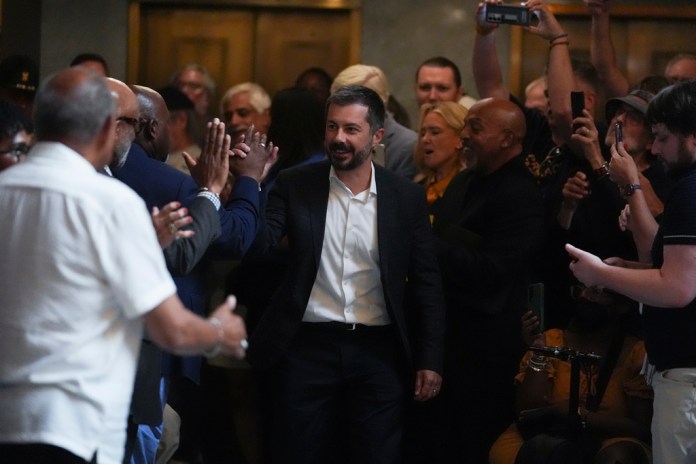
Perhaps the clearest example of a local focus is former Biden-era Transportation Secretary Pete Buttigieg, who has spent months traveling to rural and Republican-leaning areas.
From South Carolina to Michigan, Buttigieg has campaigned alongside state and local candidates while hosting town halls aimed at voters who rarely hear from Democrats with a national platform.
“This is a very conservative area, but there is a new kind of coalition to be built, and there is no such thing as a permanently red district,” Buttigieg wrote on X after campaigning in Georgia for candidate Shawn Harris in March. Harris will face off against Trump-backed Republican Clay Fuller in former congresswoman Marjorie Taylor Greene’s deep red seat on April 7.
Buttigieg says his approach is deliberately pragmatic. “The basic idea is to make myself useful to candidates and causes that I care about and that we all need to succeed,” he said while campaigning for Michigan’s state Senate Democratic nominee Chedrick Greene. Greene is up for a hotly contested seat in the Michigan state senate against Republican Jason Tunney.
SIX THINGS IN THE TRUMP BUDGET PROPOSAL YOU MAY NOT HAVE NOTICED
While other 2028 hopefuls — such as Rep. Ro Khanna (D-CA), Gov. Gavin Newsom (D-CA), and Gov. Andy Beshear (D-KY) — have focused on early primary states such as New Hampshire and South Carolina, their appearances have largely centered on national messaging and personal positioning.
Buttigieg, by contrast, is using his national profile as a surrogate to try to reinvigorate Democratic efforts in traditionally red areas.
Google Search
