
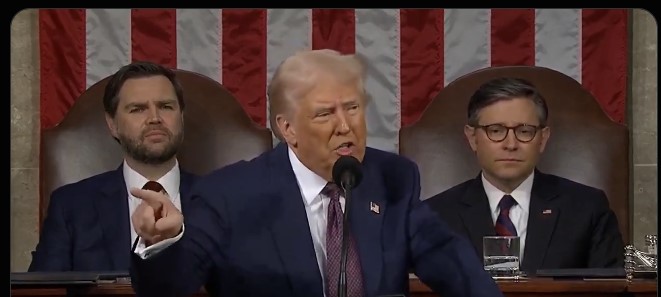
The following article, Democrats’ Fatal Mistake at the SOTU, was first published on The Black Sphere.
Some political mistakes fade quietly into history, tucked away between polling cycles and rewritten talking points. But not all.
Others arrive dressed in prime-time lighting, broadcast in high definition, replayed endlessly while consultants stare at screens wondering how nobody saw it coming.
The Democrats’ reaction to President Donald Trump’s 2026 State of the Union belongs firmly in the second category.
Because this was not merely a bad night for the opposition party. It was not a messaging error, a tone problem, or an unfortunate collection of viral clips. It was a strategic catastrophe, the kind that reshapes political permission structures for years, possibly decades.
Democrats did not just oppose Trump, they publicly validated his central argument about them.
The Setup Everyone Saw Except Them
By the time Trump entered the House chamber, the script was already written, though only one side appeared to recognize it.
Trump version 2.0 is not the improvisational insurgent of 2016. This is a president who has learned the rhythms of power, the psychology of opponents, and most importantly, the media ecosystem that converts moments into narrative gravity.
He understood something Democrats still struggle to grasp: modern politics runs less on speeches than reactions. So Trump constructed a speech designed not merely to communicate achievements but to provoke choices.
Every guest invited. Every story highlighted. Every pause timed just long enough for cameras to scan the chamber.
The speech functioned like political chess where one player had already mapped ten moves ahead.
When Protest Becomes Self-Exposure
Opposition is healthy in a republic. Reflexive opposition, however, eventually becomes parody.
Throughout the address, Trump spotlighted Americans whose stories embodied policy consequences. Families affected by illegal immigration. Victims of violent crime. Citizens presented as symbols of national resilience and recovery.
These were not abstract policy debates. They were human moments engineered to test whether Democrats could separate partisan hostility from basic civic acknowledgment.
They could not.
Democrats refused to applaud children nearly killed by illegal immigrants. They declined to stand when victims of brutal crimes were recognized. And when Trump asked those who believe American citizens should come before illegal entrants to stand, the chamber revealed a visual contrast more devastating than any campaign commercial.
Rows of Republicans standing, as large swaths of Democrats remained seated.
In politics, optics often outweigh explanation. Americans at home were not analyzing legislative nuance. They were asking why elected officials appeared unwilling to show empathy unless it aligned with ideological branding.
Trump didn’t accuse them of indifference. They illustrated it for him.
The Catharsis Becomes Strategy
This moment echoed Trump’s first State of the Union after his decisive 2024 victory, when Democrats similarly withheld applause for early accomplishments. At the time, the reaction seemed emotional, almost therapeutic for a party reeling from defeat.
But what happened in 2026 felt different. This was no longer catharsis, but a habit.
And Trump recognized that habit as a political asset.
At one point, after repeated displays of theatrical dissent, he remarked plainly, “These people are crazy.” No flourish. No theatrical indignation. Just a statement delivered with the calm certainty of someone describing observable reality.
The power of the line came not from rhetoric but confirmation. Millions of viewers had just watched behavior that made the remark feel less like insult and more like diagnosis.
Ironically, Democrats appeared comfortable with the label, as though outrage itself had become a form of identity branding.
The Fatal Miscalculation
Democrats believed they were denying Trump legitimacy. Instead, they granted him moral contrast.
For nearly a decade, Trump’s critics have framed him as divisive, cruel, or incapable of unity. The State of the Union handed him an opportunity to reverse that narrative in real time.
President Trump presented optimism. However, Democrats presented resistance to optimism.
He highlighted victims. They withheld visible sympathy.
He spoke about falling inflation, declining gas prices, and improving economic indicators. They responded as if positive news itself were partisan propaganda.
The mistake was not disagreement. The mistake was emotional asymmetry.
Americans generally tolerate ideological differences. What they distrust is perceived contempt for shared values. And Democrats displayed it on cue.
Prosperity as Political Threat
A thriving America creates a unique dilemma for a party dependent on systemic grievance. When conditions improve, arguments built on national decline lose persuasive force.
Trump leaned heavily into economic wins, citing indicators moving in favorable directions. Whether driven by policy, global trends, or timing, the political effect remains identical: voters associate improvement with leadership.
Historically, incumbents benefit when voters feel stability returning. Ronald Reagan’s 1984 “Morning in America” campaign succeeded precisely because optimism proved contagious.
Trump’s speech echoed that formula, though filtered through his unmistakable bluntness.
Democrats’ refusal to acknowledge progress unintentionally framed them as opponents not merely of Trump but of recovery itself. That perception is devastating in middle-class suburbs where elections are quietly decided.
The Signal Democrats Ignored
Perhaps the most consequential portion of the speech wasn’t what Trump emphasized but what he hinted at.
Throughout the address, he alluded to forthcoming accountability measures. References to investigations. Mentions of fraud. Signals that his administration intends to revisit controversies Democrats hoped were politically buried.
President Trump rarely telegraph nothing. His history shows that rhetorical foreshadowing often precedes major institutional action.
Trump appeared to be preparing the public psychologically for aggressive moves through the Department of Justice.
Democrats, busy performing resistance for cameras, seemed not to notice. Or worse, they assumed voters wouldn’t care.
Permission Granted
Political power expands when leaders believe the public will tolerate bold action.
The State of the Union may have supplied Trump with precisely that permission.
Watching elected officials refuse to stand for widely sympathetic figures created a moral framing advantageous to the president: he appears aligned with ordinary Americans while opponents appear ideologically rigid.
Fairly or unfairly, perception becomes reality in democratic politics.
Trump now holds a narrative advantage not solely because of what he accomplished but because Democrats dramatized his critique of them.
The Coming Reckoning
If Trump follows through on promises of exposing alleged fraud and pursuing legal accountability, Democrats will predictably claim political persecution. Media allies will amplify warnings of authoritarianism. Activists will mobilize outrage.
But the State of the Union altered the starting conditions of that debate.
Millions of Americans already watched Democrats behave in ways that made them appear disconnected from shared civic instincts. Future accusations against Trump will now filter through that memory.
Trust, once eroded visually, is difficult to restore rhetorically.
The Mistake That Will Haunt Them
Political disasters rarely announce themselves immediately. Watergate unfolded slowly. The Iraq War backlash matured over years. The 2016 election shocked analysts only after long-ignored signals accumulated.
The Democrats’ 2026 SOTU performance may join that lineage, not because of one speech but because it crystallized a broader impression: a party more committed to opposing Trump than supporting moments of national unity.
Trump didn’t defeat Democrats that night. He let them define and defeat themselves. And in politics, the most dangerous mistake is believing performance satisfies voters when voters are searching for sincerity.
The cameras turned off. The applause faded. The commentary cycle moved on. But the images remain.
A president highlighting Americans. An opposition refusing to rise. And a country quietly deciding what that meant.
Continue reading Democrats’ Fatal Mistake at the SOTU …
[H/T The Black Sphere]
Google Search
