
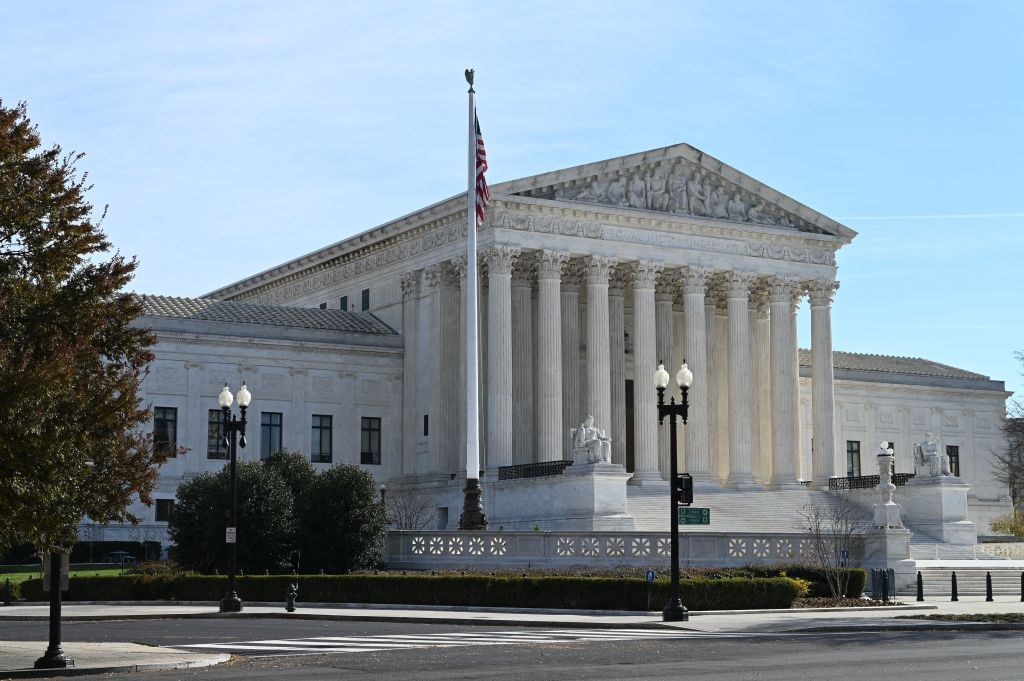
The Supreme Court on Thursday afternoon issued an order that continued to block a ruling by a federal appeals court in Louisiana which had barred the mailing of mifepristone, one of two drugs used in medication abortions – the most common form of abortion in the United States. Justice Samuel Alito, who handles emergency appeals from the U.S. Court of Appeals for the 5th Circuit, had last week temporarily put the lower court’s order on hold until 5 p.m. EDT on Monday to give the justices time to consider a request from two companies that manufacture mifepristone; he then extended that hold until Thursday at 5 p.m. Thursday afternoon’s order by the court, which was not sent to reporters until 5:26 p.m., extended that pause once again, and allows mifepristone to continue to be sent through the mail, while litigation continues in the lower courts.
Justice Clarence Thomas dissented, arguing that the drug companies “cannot, in any legally relevant sense, be irreparably harmed by a court order that makes it more difficult for them to commit crimes.”
Justice Samuel Alito also dissented. He called the court’s order “remarkable,” and he contended that “[w]hat is at stake is the perpetration of a scheme to undermine our decision in Dobbs v. Jackson Women’s Health Organization,” the court’s 2022 decision overturning the constitutional right to an abortion.
The dispute over mifepristone is not a new one for the Supreme Court. In 2023, in a lawsuit brought by several doctors who are opposed to abortion on religious or moral grounds, as well as medical groups whose members are opposed to abortion, U.S. District Judge Matthew Kacsmaryk rescinded both the FDA’s initial approval of the drug in 2000 and its 2016 and 2021 expansions of access to it, which included allowing the drug to be used through the 10th week of pregnancy, allowing health-care providers who are not physicians to prescribe the drug, and permitting it to be prescribed without an in-person visit.
The 5th Circuit concluded that the challenge to the FDA’s approval of mifepristone in 2000 had come too late, but it upheld the portion of Kacsmaryk’s ruling that rolled back the agency’s 2016 and 2021 changes that had expanded access to mifepristone.
The FDA and Danco Laboratories, which makes mifepristone, appealed to the Supreme Court, which ruled in 2024 that the doctors and medical groups did not have a legal right to sue, known as standing, to challenge the Food and Drug Administration’s expansion of access to mifepristone. In a unanimous ruling, Justice Brett Kavanaugh wrote thatalthough the challengers’ objections were “sincere,” they did not give them a right to bring a lawsuit, because the doctors and medical groups had not shown that they would be harmed by the FDA’s mifepristone policies.
Louisiana went to federal court last fall, seeking to reinstate the in-person dispensing requirement. After U.S. District Judge David Joseph paused the proceedings while the FDA finished its own review of mifepristone’s safety, Louisiana went to the 5th Circuit. That court agreed that Louisiana has a right to sue. It reasoned that, by allowing mifepristone to be prescribed by telehealth and sent by mail, the “FDA ‘opened the door for mifepristone to be remotely prescribed to Louisiana women,’” even though Louisiana generally bars abortion. Moreover, the court of appeals continued, the in-person dispensing requirement should be restored while the litigation continues, because (among other things) the state is likely to prevail in its challenge to the expansion of access to mifepristone.
The drug manufacturers, Danco and GenBioPro, came to the Supreme Court on May 2, asking the justices to intervene. They argued that, like the doctors and medical groups in the 2024 case, Louisiana does not have standing to challenge the in-person dispensing requirement. If anything, Danco suggested, “Louisiana’s theory—that it can base standing on having to pay those doctors if someone who received FDA-approved mifepristone through the mail seeks follow-up care to treat a complication—is a more attenuated version of the” theories that the court specifically rejected two years ago. And Louisiana’s claim that it is injured because of the disconnect between federal law and its own state law is not the kind of injury that courts can review, Danco said. Putting the 5th Circuit’s order on hold, GenBioPro argued, merely “will allow the years-long status quo to remain in force while the Food and Drug Administration (‘FDA’) completes its ongoing review” of mifepristone’s safety.
In its response to these requests, Louisiana insisted that it has a legal right to sue because its sovereignty has been injured, both by the violation of its laws and by its inability to enforce those laws, and because it has incurred costs as a result of the roll-back of the in-person dispensing requirement – for example, it has had to spend more than $17,000 to investigate three cases involving mifepristone sent through the mail from out of state, and it has had to pay “over $92,000 in Medicaid dollars … for emergency room care and hospitalization resulting from just two mifepristone-induced abortions in 2025.”
Moreover, Louisiana argued, it is likely to prevail on the merits of its claims. It emphasized that the FDA itself is not defending the decision to allow mifepristone to be sent through the mail. And both lower courts, it said, “also rightly concluded that Louisiana is likely to succeed in its” argument that the FDA violated the federal law governing administrative agencies when it reached that decision. For example, the state wrote, the lower courts agreed that the FDA had relied too heavily on the absence of data reflecting adverse effects from the use of mifepristone when it had eliminated the mandate to report such data.
Google Search
