
Last week, Tucker Carlson released a video framed as a shocking piece of history: “Winston Churchill presided over the imprisonment of his opposition party during the entire length of the war.” According to Carlson, their only crime “was being the opposition party and being disloyal and unpatriotic. They weren’t.”
He goes on to build this political prisoner up as a heroic figure: “The opposition was led by a First World War hero who fought not just as a pilot in the sky, but in the trenches — one of the great war heroes, a former Member of Parliament.”
So who exactly is Tucker talking about?
Gamma-Keystone via Getty Images
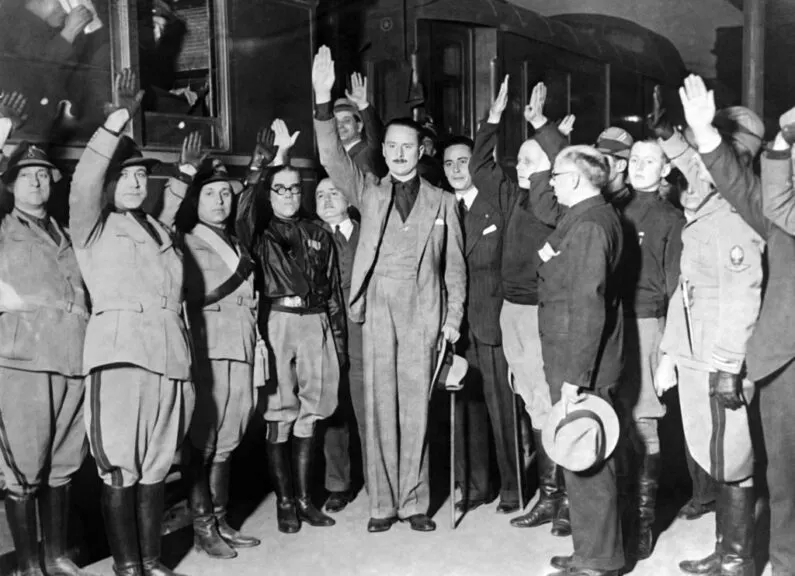
Although he is never named, images of Oswald Mosley flash throughout the video, fists clenched, rallying so-called patriotic Britons. But search his name and you’ll also see images of Mosley and his fellow British Union of Fascists (BUF) members performing Roman salutes in Mussolini-style uniforms, complete with imitation armbands bearing the BUF lightning bolt, drawing heavily from Nazi aesthetics. Mosley wasn’t the leader of a legitimate opposition party. By the time of his arrest, he wasn’t even an MP, and his party, the British Union of Fascists, operated outside Britain’s democratic system. These are hardly minor details, yet are conspicuously absent from Carlson’s video.
What else did Tucker leave out?
Mosley came from an aristocratic family. He served briefly in France during World War I as a cavalry officer, but after being injured in training with the Royal Flying Corps, he spent the rest of the war away from the front. His war record was later exaggerated for propaganda purposes — and apparently still is today.
He then entered Parliament, drifting from the Conservative to the Labour Party. After the Cabinet rejected his plan to tackle unemployment through public works and the nationalization of major industries as too radical, he resigned, turning toward the rising authoritarian movements in Europe.
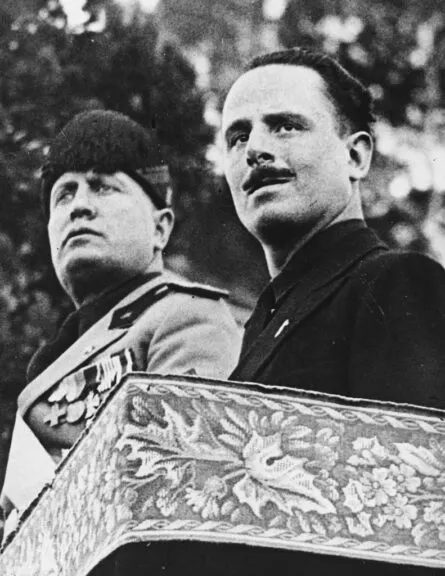
Mosley visited Mussolini’s Italy in 1932 and, impressed by what he saw, founded the British Union of Fascists.
Keystone/Hulton Archive/Getty Images
The BUF would also become closely aligned with Germany’s rising Nazi movement. Mosley was so close to the regime that he married his second wife, Diana Freeman-Mitford, herself a committed fascist, at Joseph Goebbels’ home. Only a handful of guests were present. The guest of honor? Adolf Hitler, naturally.
The early days of the BUF saw rallies drawing tens of thousands: members dressed in Mussolini-inspired blackshirt uniforms, standing in columns and raising Roman salutes as Mosley strode through to deliver impassioned speeches. Membership at one point reached 50,000. Popular British papers like the Daily Mail and the Daily Mirror heralded the movement with headlines “Hurrah for the Blackshirts” and “Give the Blackshirts a helping hand.”
Mosley saw British history as compatible with fascism, even incorporating the monarchy into his vision. He championed a form of fascism that would replace the parliamentary democracy he once served with a corporatist system centered on strong executive power. In his book The Greater Britain (1932), he declared:
The main object of a modern and Fascist movement is to establish the Corporate State. In our belief, it is the greatest constructive conception yet devised by the mind of man.
He argued this system would eliminate class conflict and organize industry under state direction to ensure stability, employment, and national unity — promising an “equitable distribution of the proceeds of industry.” That was the theory. What did it look like in practice?
The BUF drew on existing antisemitism in Britain from its early years; however, as Nazi Germany rose to prominence, it became increasingly central to the movement’s ideology. The BUF branded Jews as “alien” influences within Britain, blaming them for economic hardship, calling for restrictions on their role in public life, and promoting conspiracy theories of global control.
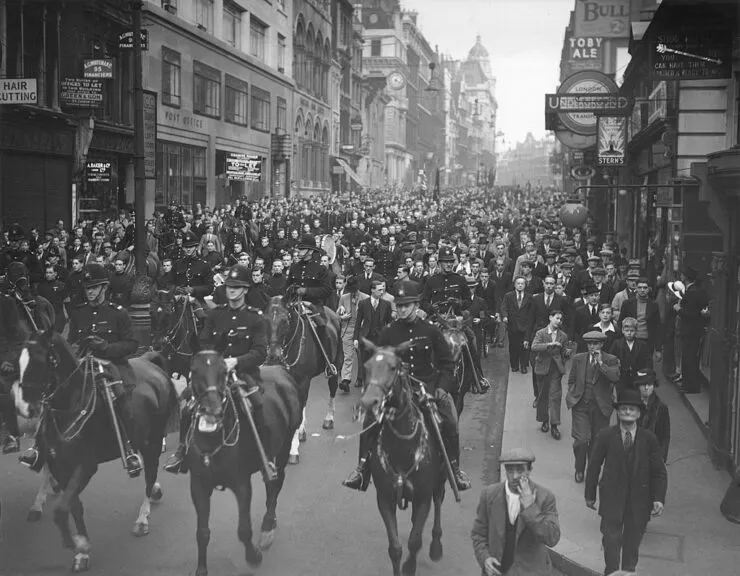
Like Hitler’s Brownshirts, Mosley’s Blackshirts terrorized Jews, particularly in London’s East End: marching through Jewish neighborhoods, spreading antisemitic propaganda, vandalizing shops, and provoking violence. The Olympia rally (June 7, 1934), attended by over 10,000 people, became infamous after BUF critics were brutally beaten for heckling.
Daily Herald Archive/SSPL/Getty Images
A turning point came at the Battle of Cable Street (October 4, 1936), when a planned BUF march through East London was blocked by tens of thousands of protesters chanting, “They shall not pass.” A violent clash followed, and, overwhelmed by the resistance, the BUF abandoned the march. The British public had little appetite for the BUF’s violence and persecution of minorities, and opinion quickly turned against them. The government responded with the Public Order Act (1936), banning political uniforms and restricting marches — marking the beginning of the end for Britain’s flirtation with Mosley’s brand of fascism.
Now enter Tucker’s chief villain, Churchill, who, after becoming Prime Minister and leading Britain into war with Nazi Germany, moved to shut down the BUF under Defence Regulation 18B — a wartime law that allowed the government to detain individuals without trial if they were deemed a threat to national security. Around 700 BUF members, including Mosley and his wife, were interned as security risks due to their fascist ties and perceived sympathy for Nazi Germany.
In his video, Carlson argues this was comparable to the internment of Japanese Americans during World War II, many of whom were detained largely on the basis of their ethnicity — not for campaigning for imperial rule in America or maintaining close ties to an enemy regime.
After the war, Mosley attempted to return to politics but was widely seen as a traitor. He sought to distance himself from Nazi crimes and became an early proponent of Holocaust denial. Mosley would be quite the popular podcast guest on the dissident right today.
Tucker concludes his Mosley video by saying, in reference to Mosley’s imprisonment during WW2, “that stuff happens in war, so I think we should be on guard.” If by “that stuff” he means politically aligning with, defending, or aiding the enemy of your own country, then he’s right – we should be on guard. Just perhaps not in the way he intended.
* * *
Nathan Livingstone is an Australian filmmaker and video editor who creates short films, commentary, and investigative pieces. Follow him on X: @TheMilkBarTV
Google Search
