
China Wants Iran War End, Pushes ‘Immediate’ Hormuz Reopening During Araghchi Visit Ahead Of Trump-Xi Summit
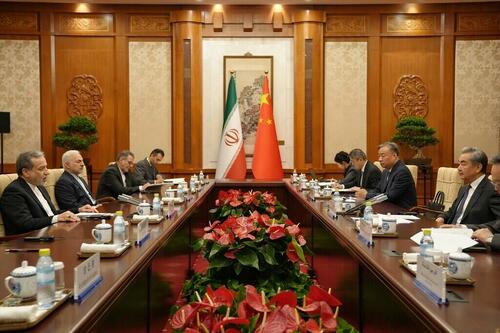
Iranian foreign minister Abbas Araghchi is currently in Beijing meeting with his Chinese counterpart, FM Wang Yi, and the timing of the visit sends a resounding message to Washington and the West. The highly anticipated Trump-Xi meeting is still scheduled for next week, expected for May 14-15, though there has been ample speculation the ongoing events of the unpredictable Iran war and Hormuz Strait crisis could derail the trip at the last minute.
Of course, Iran and the question of peace will be high on the agenda as Trump visits – and currently it seems the White House is desperate to set in place some kind of final offramp, given the Tuesday night ‘pause’ in Project Freedom operations in the Gulf.
Upon the occasion of Araghchi’s visit, Foreign Minister Wang has taken the opportunity to again call for the immediate opening of the strait. And the Iranian top diplomat seconded this at a moment the US Navy has imposed an effective blockade of Iranian ports, which of course severely impacts Iranian oil going to China. “Currently, it is possible to resolve the issue of reopening the Strait of Hormuz as soon as possible,” Xinhua quoted Araghchi as saying.
Wang during the meeting also called for a “comprehensive ceasefire,” saying his country is deeply distressed by the war. Xinhua further quoted him as saying:
“The international community shares a common concern for restoring normal and safe passage through the Strait, and China hopes the relevant parties will respond as quickly as possible to the strong calls from the international community.”
The two sides are clearly coordinating their messaging to some degree, given Wang also expressed that China “appreciates Iran’s pledge to not develop nuclear weapons.”
Tehran has for years insisted its program is only for peaceful nuclear energy development and for domestic needs, but has amid Trump’s Operation Epic Fury made clear it will never given up its right to enriched uranium. It has said this is as “sacred as the soil” and sees it as a matter of national sovereignty. This in the face of US demands that it transfer all nuclear material out of the country.
More out of Beijing on Wednesday:
“We believe that a comprehensive ceasefire brooks no delay, a resumption of hostilities is inadvisable, and persisting with negotiations is particularly important,” Wang told Araghchi at the start of their meeting, according to footage released by Hong Kong-based Phoenix TV.
…Earlier, US Secretary of State Marco Rubio urged China to press Iran to ease its blockade of the Strait of Hormuz, through which roughly one-fifth of the world’s oil and gas passes.
As for what China gains in this high-level diplomacy and engagement with Tehran at a moment it could face more US and Israeli bombs, Associated Press presents the following:
Some noted that the Iranian foreign minister visited at Beijing’s initiative. “It’s China exercising their leverage… to summon the Iranian foreign minister,” said Hoo Tiang Boon, a professor of Chinese foreign policy at Nanyang Technological University.
“By holding the talks with the Iranians, you can’t fault for them not putting in any effort,” Hoo said.
As for some further specifics to come out of the Araghchi-Wang meeting, Iran “expressed appreciation for China’s four-point proposal” – according to a readout in semi-official Iranian Students’ News Agency (ISNA).
Hilarious that the message Rubio is asking China to give Iran during Araghchi’s Beijing visit is that Iran is “globally isolated” when the very fact he’s invited to China (and that China is now fighting US sanctions on Iran’s oil) proves they aren’t.pic.twitter.com/UUGmfrL2d1
— Arnaud Bertrand (@RnaudBertrand) May 6, 2026
“Iran supports the formation of a new framework for the post-war period in the region” the readout adds. As for the ‘four points’ – these were issued by Beijing earlier in the conflict and are quite broad. These official points are featured below in their entirety, via Chinese state sources:
- Stay committed to the principle of peaceful coexistence. The Gulf states in the Middle East are close neighbours that cannot move away. It’s important to support the Gulf states in improving their ties, work to build a common, comprehensive, cooperative and sustainable security architecture of the Middle East and the Gulf region, and consolidate the foundation for peaceful coexistence.
- Stay committed to the principle of national sovereignty. Sovereignty serves as a foundation for all countries, especially developing countries, to survive and thrive, and it must not be violated.
- Stay committed to the principle of international rule of law. We should safeguard the authority of international rule of law, reject selective application, and prevent the world from returning to the law of the jungle. It is important to firmly uphold the international system with the United Nations at its core, the international order based on international law, and the basic norms governing international relations underpinned by the purposes and principles of the UN Charter.
- Stay committed to a balanced approach to development and security. Security is a prerequisite for development and development serves as a safeguard of security.
If negotiations between the US and Iran don’t proceed, and if they stay at ‘square one’, this could weaken any big leverage President Trump hopes to have entering his meeting with Xi Jinping. This is perhaps why American officials are scrambling to cobble something together, to at least cite progress toward resolving the Hormuz situation. Still Trump has insisted he has “all the cards” when it comes to Iran.
Tyler Durden
Wed, 05/06/2026 – 11:20
Google Search
