
Canada is opening up to China as Mexico looks to integrate more closely with the United States.
The new year of 2026 has the makings of a significant point in history, between marking the semiquincentenary of the United States of America and the upcoming political battle for the midterm elections in November. Less anticipated but still of significant importance is the impending renegotiation of the United States–Mexico–Canada Agreement (USMCA), the free trade agreement that replaced the North American Free Trade Agreement (NAFTA) at the end of President Donald Trump’s first term.
Though Trump has been a major critic of NAFTA over the years, the USMCA largely left NAFTA’s framework intact, preserving a broad section of commerce between the signatory countries free from import duties and controls. The updated agreement did increase IP protections, strengthened labor standards in an attempt to cut down on labor arbitrage (specifically aimed at reducing the outsourcing of American manufacturing to Mexico), and increased country of origin requirements that qualify goods like automobiles for tariff exemptions under the treaty. But the overall effect was more to tinker with the edges of the agreement than to seriously revise the North American commercial system.
One major change that does differentiate the USMCA from NAFTA, however, is its system of periodic renegotiation. Unlike NAFTA, which was signed on a permanent basis, the USMCA will sunset in 16 years, and the signatories must meet and renegotiate the terms of the agreement every six years. This allows for the agreement to be updated for contemporary concerns, and effectively allows the U.S. to leverage its position as the largest market in the hemisphere to periodically obtain concessions from its neighbors to the north and south.
When Trump signed the USMCA during his first term, it is unlikely that he expected to be at the table six years later to go over the terms of the agreement again. Now, however, the president again has the chance to materially alter the economic balance of the North American commercial system—this time, with a much stronger hand. Trump has already proven that he’s willing to hit Canada and Mexico with punitive tariffs and wield American economic might as a tool for extracting policy concessions, as Mexican and Canadian negotiators will be painfully aware of as they work on wrapping up the framework of a revised agreement by this summer.
America’s counterparts in the USMCA have taken starkly divergent approaches to that political and economic reality. Under President Claudia Sheinbaum, Mexico has worked diligently to reconcile itself to the priorities of the Trump administration and cooperate with it on its economic and security policies. Secretary of Security and Civilian Protection Omar García Harfuch and Economy Minister Marcelo Ebrard have spent many hours conversing with their American opposites, and behind closed doors Mexico has largely acquiesced to the desires of American leadership. The country has quietly embarked on a major escalation of border control and anti-narcotics operations aimed at reducing immigration and drug trafficking into the U.S.
Sheinbaum clearly views closer integration with the U.S. economy as the key to continued Mexican economic success, and has implemented a number of measures to reduce Mexican reliance on China. In December of last year, Mexico imposed tariffs of up to 50 percent on a wide swathe of Chinese imports, ranging from raw materials to textiles to automotive parts. Sheinbaum is betting that as the U.S. continues its efforts to decouple from China by nearshoring and friendshoring, Mexican industry will reap the rewards by being the natural place to relocate portions of American supply chains.
Canada, in contrast, has taken the opposite approach. Anti-American sentiment in Mexico is longstanding and deeply rooted, but Sheinbaum has waved off Trumpian threats to carry out military operations in her country or to slap Mexicans with tariffs. Canadians, on the other hand—with whom the U.S. has a long history of cooperation—were outraged by Trump’s suggestion that they should become the 51st state and infuriated that the president had the audacity to place tariffs on their exports to America.
Under the new Liberal Prime Minister Mark Carney, Canada hit back, placing retaliatory tariffs on American goods and distancing itself from the U.S. on the international stage. Canadian anti-Americanism, always a latent cultural force but until recently without much political expression, has become a major factor in Canadian foreign policy. Now, Canada is turning to China as a way to counterbalance America’s overwhelming economic leverage on their domestic economy. (The U.S. buys more than 75 percent of all Canadian exports.)
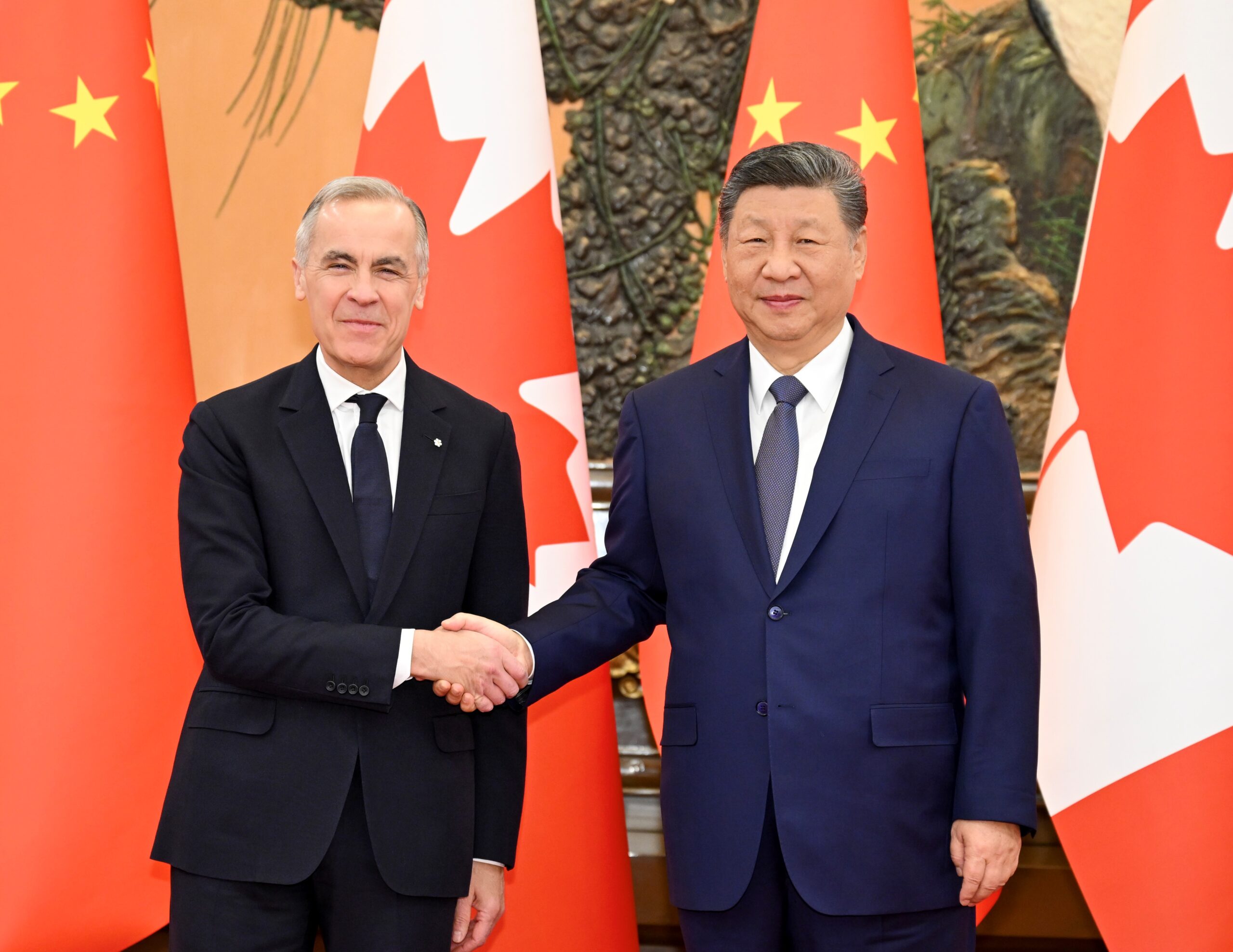
Carney took the stage Friday in Beijing with China’s Xi Jinping—during the first visit by a Canadian prime minister to the country in nearly a decade—to announce that China and Canada have signed a “new strategic partnership” that will significantly increase economic integration between the two countries. Chief among the included provisions is an agreement for Canada to import tens of thousands of Chinese electric cars at most-favored-nation tariff rates. (The vehicles were previously subject to import duties of 100 percent.) In return, China is cutting its tariffs on Canadian canola from 85 percent to 15 percent.
The deal opens up many more avenues of cooperation between the two countries, including energy—Canada may soon be shipping oil to China in return for solar panels and batteries. But the most important effect is to patch up what had been, following American trends, a rocky relationship, and to pave the way for a much more significant Chinese influence to the north. It also means that Canada will likely come into USMCA negotiations this year emboldened and more combative than it might otherwise have been. The U.S. is not the only country that can play power games with its economy.
For its part, the Trump administration has yet to make major statements on its position for the upcoming negotiations—its early focus on trade has been superseded by the lure of conflicts in the Middle East and Venezuela. Nor is the public likely to pay much attention; the mechanics of trade agreements are too dry to capture much interest. But 2026 quietly offers the Trump administration a chance to retool the North American commercial system to better serve American interests, if it is able to take advantage of the opportunity.
The post As Trade Talks Loom, Canada and Mexico Take Opposite Tracks appeared first on The American Conservative.
[H/T The American Conservative]
Google Search
