

The shrine of Our Lady of Walsingham attracts 250,000 pilgrims every year. Truly it can be said, in the heavenly light of the shrine’s resurrection, that the Queen has returned. One of the most exciting fruits of the spirit of Walsingham is the new and dynamic Community of Our Lady of Walsingham.
Bitter, bitter oh to behold
The grass to grow
Where the walls of Walsingham
So stately did show.
Such were the worth of Walsingham
While she did stand,
Such are the wrackes as now do show
Of that so holy land.
There was a time, for a very long time and a long time ago, when the shrine of Our Lady of Walsingham was one of the major places of pilgrimage in the whole of Christendom. By the sixteenth-century, the holy shrine at Walsingham, in the English shire of Norfolk, had welcomed pilgrims for more than 450 years. A succession of English monarchs had made pilgrimages there and pilgrims arrived in such numbers from all over Europe that the Milky Way became known as the Walsingham Way, the number of pilgrims being as countless as the stars in the night sky. All that changed in 1538 when the shrine was destroyed on the orders of Henry VIII. The lines quoted above, written in lamentation for the destroyed and desecrated shrine, are attributed to the English Martyr, St. Philip Howard.
For a further four centuries, the shrine lay in ruins, prompting another English saint, John Henry Newman, to write of Our Lady as the exiled pilgrim queen whose heavenly ghost continued to haunt the land from which she had been banished:
“Here I sit desolate,”
Sweetly said she,
“Though I’m a queen,
And my name is Marie:
Robbers have rifled
My garden and store,
Foes they have stolen
My heir from my bower.
In 1893, three years after Newman’s death, on the Feast of Saints Peter and Paul, the bishops of England and Wales consecrated England to the Blessed Virgin and to St. Peter. This was done at the request of Pope Leo XIII who had recalled that the Merrie England of the Middle Ages had been known as Our Lady’s Dowry. “When England returns to Walsingham,” Pope Leo wrote in 1897, “Our Lady will return to England.” It was in that same year that a pilgrimage was held to the Slipper Chapel in Walsingham, which had been restored to Catholic ownership after centuries of neglect. As the pope had proclaimed and prophesied, the resurrection of the shrine at Walsingham, heralded the return of the Queen to England.
As the decades passed, the trickle of pilgrims to Walsingham became a steady stream. In 1938, almost twenty thousand young people joined the National Pilgrimage of Catholic Youth to the shrine. Seven years later, in May 1945, nine days after the war in Europe had ended, members of the United States military arranged for the first Mass to be said in the priory grounds in Walsingham since the priory’s destruction four centuries earlier.
On March 29, 2020, at Our Lady’s shrine in Walsingham, England was rededicated as the Dowry of Mary in a solemn ceremony renewing the entrustment vows made by King Richard II in 1381. With England and much of the world in the midst of the COVID lockdown, more than half a million people watched the rededication ceremony online. Today, the shrine of Our Lady of Walsingham attracts 250,000 pilgrims every year. Truly it can be said, in the heavenly light of the shrine’s resurrection, that the Queen has returned.
One of the most exciting fruits of the spirit of Walsingham is the new and dynamic Community of Our Lady of Walsingham (COLW), which was founded on the Feast of the Epiphany in 2004. A community of consecrated religious sisters and associated lay members, the COLW is rooted in the Carmelite tradition inspired by the Fiat of Our Lady as expressed in the spirituality of Walsingham.
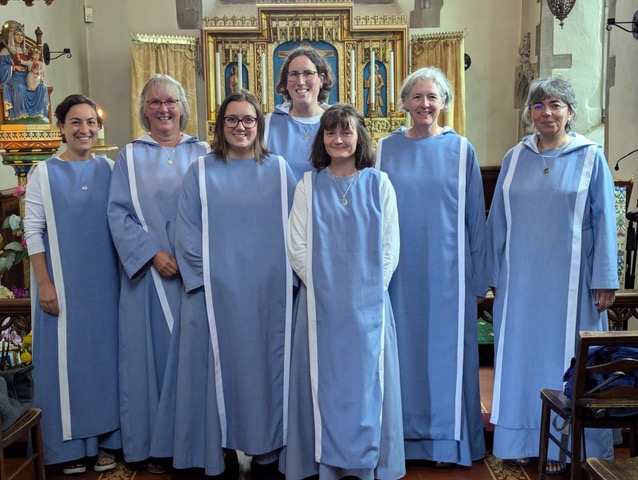 Following the Founding Mass in the Slipper Chapel at Walsingham, the COLW ran a House of Prayer until 2017, after which, until Easter 2023, they managed Dowry House, the retreat centre for the Catholic Shrine of Our Lady of Walsingham. Thanks to the generosity of many friends and benefactors, the sisters acquired their first convent in 2017, which they named the House of the Divine Will, in Dereham, a small town not far from Walsingham. Such is their dynamic vision that they are now raising funds to establish Mary’s House, a mission house of prayer and service, in the very heart of Walsingham itself. Those wishing to participate in this exciting endeavour, especially those who would like to help financially, should visit the sisters’ website to discover more about this next exciting step that the COLW are planning.
As one whose personal journey to the Catholic Church was influenced greatly by Our Lady of Walsingham, and as one who has made many pilgrimages to Our Lady’s shrine there, I confess to being personally invested in the hope that the “holy land” of Walsingham will prove to be the catalyst for the conversion of England. It is for this reason that I hope that the good sisters of the Community of Our Lady of Walsingham will receive the support that they need.
As for the Queen of Walsingham herself, we will end with the final two verses of St. John Henry Newman’s song to the Pilgrim Queen:
 I look’d on that Lady,
and out from her eyes
Came the deep glowing blue
of Italy’s skies;
And she raised up her head
and she smiled, as a Queen
On the day of her crowning,
so bland and serene.
“A moment,” she said,
“and the dead shall revive;
The giants are failing,
the Saints are alive;
I am coming to rescue
my home and my reign,
And Peter and Philip
are close in my train.”
__________
Visit the website of The Catholic National Shrine and Basilica of Our Lady.
The Imaginative Conservative applies the principle of appreciation to the discussion of culture and politics—we approach dialogue with magnanimity rather than with mere civility. Will you help us remain a refreshing oasis in the increasingly contentious arena of modern discourse? Please consider donating now.
Photos courtesy of the Community of Our Lady of Walsingham and Winston Elliott.
Google Search
