

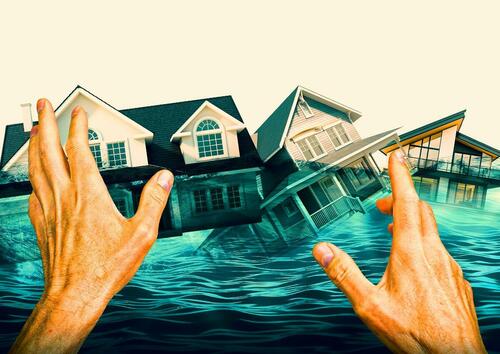
Gold, Debt And The Inevitable Global Housing Market Crash
Authored by Brandon Smith via Alt-Market.us
Maybe the most prominent economic discussion circulating today is the fear that the vast majority of people have been priced out of housing markets for the rest of their lives, regardless of the country they live. Gen Z and even Gen Alpha teens are already planning for a future in which buying a home is impossible. Those that are buying are aiming for cost efficiency and they are buying alone (prioritizing savings and home ownership over marriage).
This is a subject for another article but it represents a reversal in traditional consumer behavior; a sea change that needs to be examined because it reflects greater underlying social and economic struggles.
This struggle is not only happening in the US; all across the western world from Australia to Canada to most of Europe people are facing the worst home price inflation in decades and they’re scrambling to find ways to adapt.
That said, just as in physics, there are rules of motion that still apply to markets regardless of government or central bank intervention. What goes up must inevitably come down. There’s been an interesting development in the past year, specifically on the sellers side of the housing equation, and it signals big changes in the near term.
Because of the pandemic, the relocation panic, Covid stimulus and corporate buyers, prices were juiced across the board and the average cost of a home skyrocketed by 50% or more from 2019 to 2024.
A large portion of this buying involved people trying to escape draconian blue state mandates, but there were a lot of speculators trying to play the market and make a quick buck in the expectation that prices would continue rising. Instead, demand has crashed and there are limited buyers to meet the supply.
Google searches for “can’t sell my house” hit an all time high last month surpassing the peak of the crash of 2008. Housing sales have dropped by 32% from 2020 to 2026 while supply has spiked. Realtors have been warning of a massive slowdown, with many sellers refusing to read the room and cut prices as they struggle to find interested buyers.
The reason for the impasse and the frozen market is largely because of debt. In 2008, the crash was caused by easy mortgage loans to people who did not have the income to cover costs attached to ARM mortgages that ratcheted up interest rates over time. Millions of homes were sold to people that didn’t have the income to buy and they defaulted all at once, crashing the system and the derivatives tied to it.
Today, millions of homeowners are locked into ultra-low mortgage rates from previous years. Selling would mean giving up a 3% loan and replacing it with one closer to 6.5%. So they don’t sell.
Beyond that, too many owners bought at the peak of the pandemic rush and the peak of pricing. Now they are stuck trying to sell $250,000 homes for $600,000, and $500,000 homes for over a million dollars. To sell at a steep discount would be essentially the same as accruing even more debt.
The problem is, NO ONE wants to buy a house for $600,000 when they know it’s only going to be worth $250,000 in a few years. In the end, the speculators are left holding the bag and there’s only two options left – Put their excess homes on the rental market, or, cut their prices dramatically and take the loss. I believe this is going to start happening in an accelerated fashion within the next year, even if there is a government or central bank intervention.
Inflationary stimulus is not going to save the housing market this time.
This means considerable losses in home equity and the overall net worth of the population, not to mention a heavy decrease in mortgage loans and credit liquidity. Less credit access means a consumer slowdown. In the case of corporate buyers and banks, a stimulus package might protect them, but not average citizens.
Where there is no liquidity, there is a crash. For now money seems to be moving at a healthy pace, but this is largely in the stock market which is not representative of a stable economy. Stocks are not a leading indicator of crisis; they are always late to the party. By extension, stocks are not going to signal a future crash in housing, nor are they going to pick up on the throttling of buyers taking place right now.
Can this eventual plunge be managed? Yes, to a point, but not at a global level, only at a national level. And, even then it’s not going to change the ultimate outcome, which is concrete losses in liquidity and a spike in debt.
For people waiting to purchase a home this could be good news. Price cuts of 30% to 50% are possible and well overdue. That said, buyers will likely wait out the storm until they think prices have hit bottom. In the meantime there is a danger of post-crash systemic risk to stocks and credit markets. Investors will be looking for a safe haven alternative.
This brings us to a trend that’s been developing over the past couple years that we have not seem since the crash of 2008-2012. That crash coincided with a historic gold and silver surge and the same pattern is surfacing again. During narrow periods of heightened uncertainty, property might no longer represent a secure place for people to park their cash. When markets are in a panic and other hard assets are in decline, precious metals become the go-to investment.
Despite the wild fluctuations in the past couple months, gold is still up 270% since 2019 and is likely to continue climbing even as housing markets fall. The reason is simple: Consumer debt has continued to grow despite central bank interventions and increased interest rates. These measures were supposedly meant to reduce consumer borrowing, but that didn’t happen.
And, as debt grows, precious metal values invariably climb (inflation through stimulus does not need to be present, but it usually is).
US housing debt has shot up 38% since 2019. US consumer credit card debt has climbed 35% since 2019. The US national debt has climbed 71% since 2019. Property used to offer a safe haven for debt- exposed markets, but this is ending. There are very few secure places left in this environment. IF stock markets take hit (as they probably will), precious metals is one of last bastions of security.
There is definitely a correlation trend taking place which seems to echo the 2008-2012 crisis. Every time US housing prices dip or slow sharply, gold and silver prices typically rise.
As noted, it’s not just the US facing a housing market crash. Reports suggest conditions are even worse in Canada, Australia, the UK and most of Europe. In Canada, for example, leftists from the US have gone in search of alternative residency in order to “flee the Trump regime” only to come crawling back in desperation after dealing with unprecedented housing costs.
In the UK, housing for median income earners barely exists, even if they want to rent. In Australia, the median home price is around $700,000 (in the US, the median home price is $415,000). There’s really no escaping this trend unless you want to live in a third world country. And, ironically, those people are not too happy to see westerners moving into their backyards right now.
On top of the inflationary conditions for home buyers, there’s the mass invasion of illegal migrants into the west over the past decade and this has eaten up the rental markets and driven up prices further. Deportations could help alleviate some of the pressure, but this will also act as a catalyst to speed up housing depreciation. For home owners, a substantial loss of equity should be expected.
In the end the pain is necessary; something has to give. There needs to be a debt reconciliation and the economy needs to take its medicine (a deflationary event). Currently, buying has stabilized after years of decline, but we still have a long way to go before demand and supply are balanced.
It’s doubtful that central banks, built entirely on Keynesian interventionism, will allow this to occur without interference. They will eventually step in with more stimulus, which, again, means ever increasing gold and silver values. For now, the smart move for people looking to buy property (or protect their savings) is to rent until this process plays out, and perhaps invest in precious metals in the meantime as a hedge.
Homeowners should also think about investing a portion of savings into precious metals to offset losses caused by plunging property values. The status quo is ripe for an earthquake.
Tyler Durden
Fri, 05/08/2026 - 22:35
The post <a href=https://www.zerohedge.com/economics/gold-debt-and-inevitable-global-housing-market-crash target=_blank >Gold, Debt And The Inevitable Global Housing Market Crash</a> appeared first on Conservative Angle | Conservative Angle - Conservative News Clearing House
Continue reading...